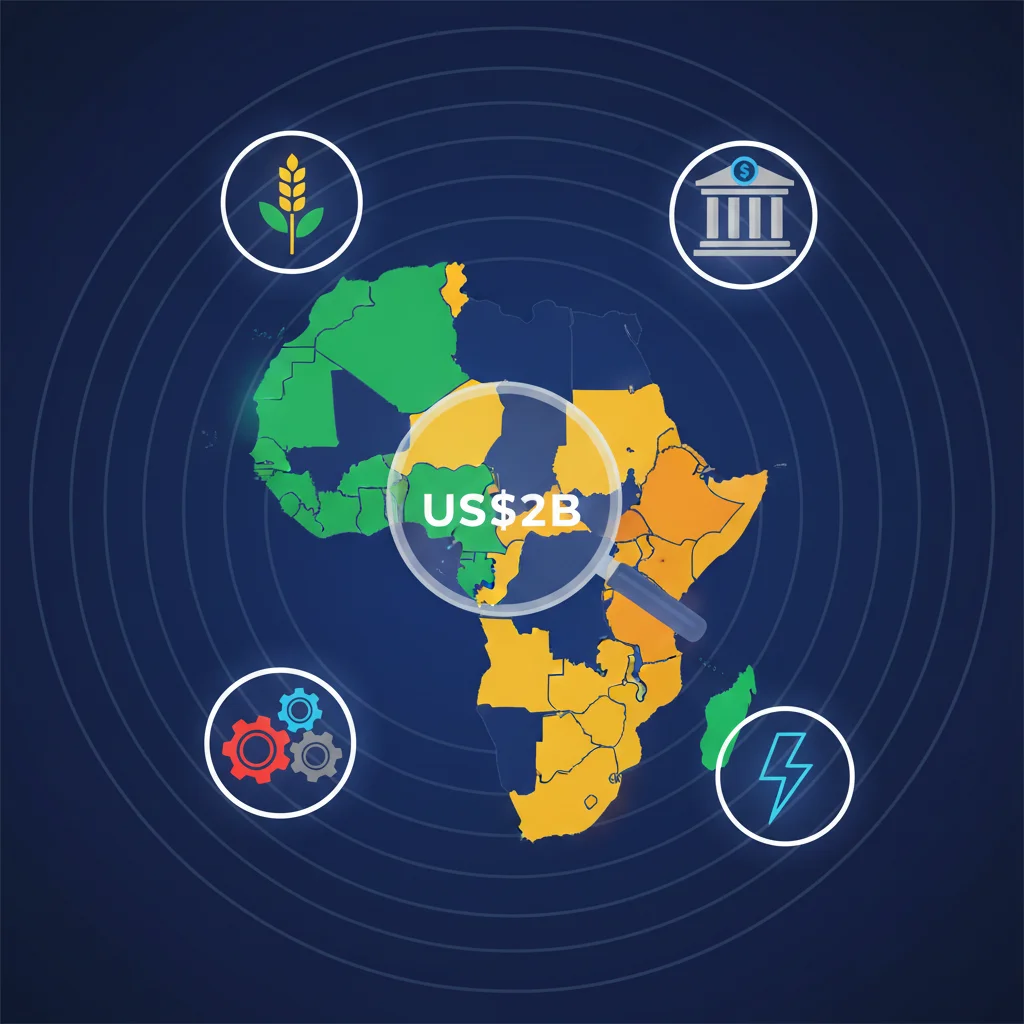
A new report from the Africa Resilience Investment Accelerator (ARIA) reveals 128 investment opportunities across five frontier markets—Benin, DRC, Ethiopia, Liberia, and Sierra Leone—with a combined capital need of US$2 billion. The analysis of over 400 companies highlights a critical readiness gap: 43% require technical assistance before Development Finance Institutions (DFIs) can invest. Sectors include agribusiness, financial institutions, manufacturing, and energy, with 53% of deals falling between US$5M and US$20M—a ''missing middle'' that demands innovative DFI tools like blended finance and local-currency products. This article unpacks the hidden economic logic behind the data and explores how DFIs are adapting to unlock sustainable growth.
Report Reveals: Five African Frontier Markets Hold $2 Billion in Investment Opportunities – But 43% of Companies Need "Readiness Support" First
New analysis from the Africa Resilience Investment Accelerator (ARIA): 128 investment opportunities in Benin, DRC, Ethiopia, Liberia, and Sierra Leone await unlocking, with agribusiness and financial services leading the way
[IMAGE: A world map focused on West and Central Africa, with five countries – Benin, DRC, Ethiopia, Liberia, and Sierra Leone – highlighted in different colors against a dark professional gradient background]
Frontier markets — economies overlooked by mainstream capital yet rich with structural growth potential — are sending a clear signal to international Development Finance Institutions (DFIs): they are ready for investment, but need smarter tools.
A new report released in July 2024 by the Africa Resilience Investment Accelerator (ARIA) reveals that across five frontier markets — Benin, the Democratic Republic of Congo (DRC), Ethiopia, Liberia, and Sierra Leone — there are 128 investable opportunities requiring a total of $2 billion in capital. This figure comes from a systematic analysis of over 400 companies and highlights a long-underestimated reality in frontier markets: capital is not scarce; "investment readiness" is.
The report finds that 43% of these 128 companies require technical assistance before they can meet the investment thresholds of Development Finance Institutions. This means that even if DFIs are willing to deploy capital, many enterprises are not yet ready to receive it.
Opportunity Breakdown: Agribusiness and Finance Lead, Manufacturing and Energy Follow
[IMAGE: Pie chart showing percentages across four sectors: Agribusiness 27%, Financial Institutions 21%, Manufacturing 19%, Energy 17%, each with a corresponding icon]
ARIA's analysis categorizes the 128 opportunities by sector. The data shows that investment opportunities in frontier markets are not concentrated in a single area, but instead display a diversified structural profile:
- Agribusiness (27%): The largest share, reflecting the agricultural foundation of these economies. Opportunities span the value chain — from cocoa processing to grain storage facilities.
- Financial Institutions (21%): Including microfinance institutions, digital banks, and insurtech companies. These enterprises are critical conduits for capital transmission, and their development directly affects SME access to finance.
- Manufacturing (19%): Focused on import substitution and export processing — textiles, building materials, and food processing.
- Energy (17%): Predominantly renewable energy, especially solar mini-grids and biomass projects, directly addressing low electrification rates in these countries.
- Other (16%): Digital infrastructure, healthcare, and education.
One strategically noteworthy finding: 50% of pipeline companies have import substitution or export potential. This means investment in these firms can generate not only financial returns but also help reduce trade deficits and boost foreign exchange reserves — critically important for African economies currently facing currency pressures.
In addition, 42% of companies are locally owned, indicating a solid grassroots entrepreneurial base in these markets. DFIs that build long-term partnerships with such firms can significantly enhance the resilience and systemic impact of their investments.
[IMAGE: Simple bar chart showing investment size distribution, with the US$5M–US$20M range as the tallest bar, highlighted]
The "Missing Middle": Why $5M–$20M Deals Are the Hardest to Close
The report highlights a structural problem that has long plagued frontier markets: the "missing middle."
Data shows that 53% of pipeline companies require investment between $5 million and $20 million. This scale is too large for microfinance and too small for direct DFI investment — the latter typically prefers single transactions above $100 million to absorb due diligence and operational costs.
As a result, this middle tier has long been neglected: local banks lack risk appetite, and international capital finds the scale uneconomical. The consequence is that these companies become stuck on a "growth cliff" — they have orders and markets, but lack the capital to expand.
More critically, ARIA found that 43% of companies need technical assistance to reach investment standards. These needs cluster in three areas:
- Financial management capacity: Many companies lack financial statements and audit processes that meet international standards.
- Governance structures: Unclear roles and responsibilities during the transition from family-owned to professionally managed enterprises.
- ESG compliance: Environmental, social, and governance standards are becoming hard thresholds for DFI investment.
This means the DFI challenge is not simply "how much money to invest," but rather "how to help enterprises become ready to receive it."
Tool Innovation: Blended Finance, Early-Stage Equity, and Local-Currency Products
Faced with the unique risk structures of frontier markets, DFIs are developing a new set of financial tools tailored to the "missing middle." ARIA's founding members — British International Investment (BII) and Dutch development bank FMO — are at the forefront of this shift.
Blended finance is currently one of the most discussed tools. The logic is simple: use public or philanthropic capital to take first losses, reducing the risk exposure of private capital and thereby unlocking larger volumes of commercial funding. For example, in a $20 million project, a DFI could provide a $5 million first-loss guarantee, attracting private capital for the remaining $15 million.
Early-stage equity has also proven to be an effective entry point. Unlike mature companies seeking stable dividends, growth-stage firms in frontier markets need patient capital. By setting up venture capital funds or co-investment platforms, DFIs can step in at the most vulnerable phase of a company's development, taking equity and participating in governance.
Local-currency products are a key innovation for managing currency risk. Because national currencies in frontier markets are generally weak, dollar-denominated loans cause debt servicing costs to swing sharply with exchange rates. Some DFIs are beginning to offer loans in local currency or link repayments to local inflation rates, thereby reducing enterprise debt risk.
The common feature of these tools is: lowering the entry barrier without lowering discipline. DFIs are learning how to reduce the feasible transaction size from $100 million to $5 million without compromising due diligence quality.
Opportunities and Challenges: The Frontier Market Investment Logic Is Being Rewritten
The appeal of frontier markets is easy to understand: young demographics, accelerating urbanization, rapidly rising digital penetration. But investor patience is finite — especially when investment cycles require five to ten years.
ARIA's report offers an important perspective: the problem in frontier markets is not "lack of opportunity" but "opportunities not yet structured." The finding that 43% of companies need technical assistance is both a challenge and a signal — it indicates that DFIs must play a role not just as "financiers" but as "capacity builders."
In Benin, a farming entrepreneur undergoing training may need to learn how to produce international-standard audit reports. In the DRC, an energy company may need an ESG framework to assess its project's social impact. In Ethiopia, a manufacturer may need a governance structure to attract institutional investment.
These "hidden prerequisites" are conditions for investment to actually land. When 43% of companies need such support, it means the current ecosystem requires more "investment catalysts" — technical assistance funds, incubators, localized due diligence teams — to bridge the gap between enterprises and capital.
Conclusion: From "Capital Gap" to "Readiness Gap" — A Cognitive Shift
ARIA's report clearly shows that the investment narrative for frontier markets needs rewriting. The core issue is no longer "is there money available?" but rather "are enterprises ready?"
This means the role of DFIs is shifting from pure capital providers to ecosystem builders. Investment must go hand in hand with technical assistance, policy dialogue, and market development. Innovative instruments such as blended finance, local-currency tools, and early-stage equity are practical responses to this thinking.
For investors focused on African frontier markets, the data sends a clear message: 128 opportunities, $2 billion in demand, a 43% readiness gap — this is a market that requires patience, but one that is worth the effort.
The next "unicorn" may not be glamorous. It may be a Benin-based organic cocoa processing plant, or a DRC-based solar micro-grid operator. And the capital and tools that enable such companies to grow will be those willing to put in the work on the "missing middle."
---
The full ARIA report can be found on its official website. The research was conducted from October 2023 to June 2024, covering the five countries of Benin, Democratic Republic of Congo, Ethiopia, Liberia, and Sierra Leone.