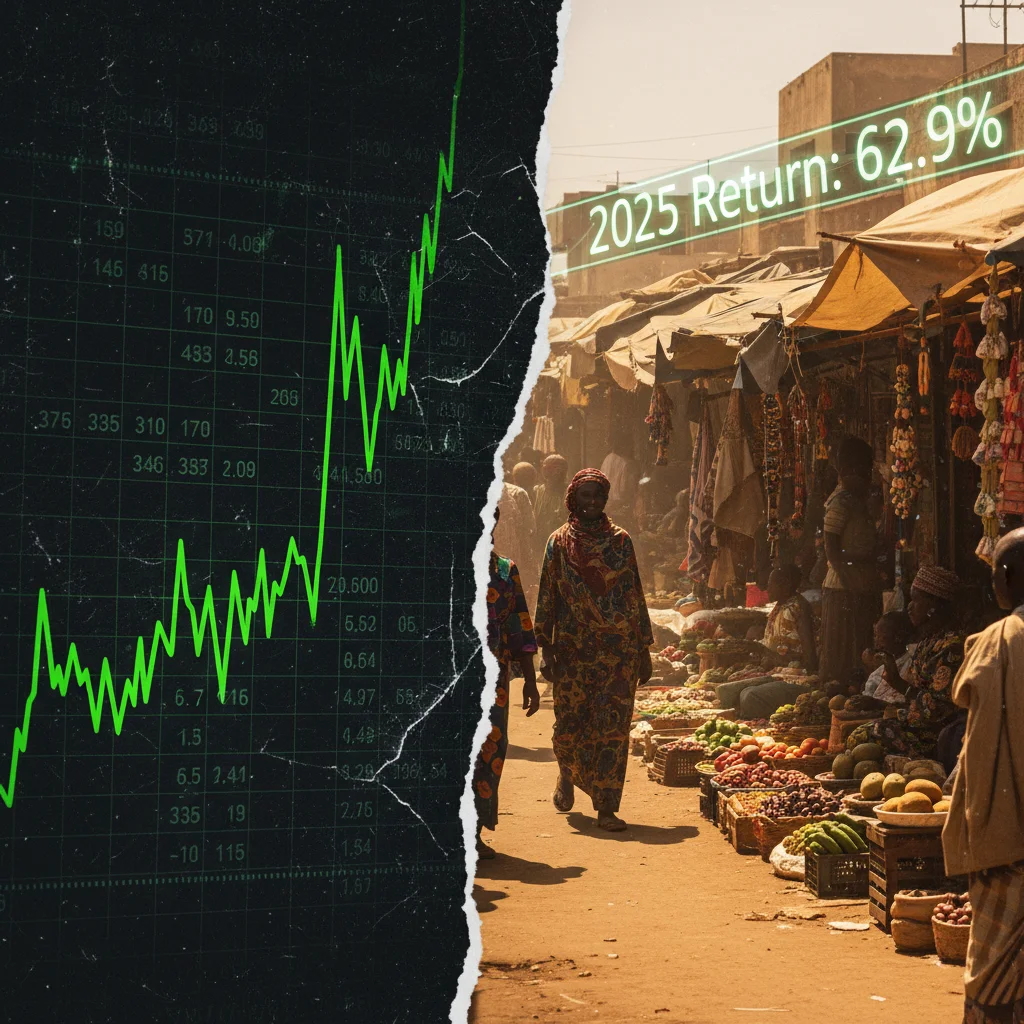
African equities exploded in 2025, with the Allan Gray Africa ex-SA Equity
Africa's 2025 Market Rally: A Value Trap or the Start of a Structural Shift?
By a Senior Technical/Financial Audit Journalist
Introduction: The 2025 Mirage
African equity markets delivered the strongest performance among global asset classes in 2025, a fact that demands rigorous scrutiny rather than celebration. The MSCI Emerging Frontier Markets Africa ex-SA Index returned 42.2% during the calendar year, nearly 2.4 times the S&P 500's 17.9% return and double the MSCI World Index's 21.1% (Source 1: [Primary Data]). The Allan Gray Africa ex-SA Equity Fund, a bellwether for institutional frontier market exposure, posted a 62.9% return, outperforming every referenced benchmark by a wide margin.
Yet these headline numbers conceal a more complex reality. Measured over three years, the same African index delivered an annualized return of 14.5%, significantly below the S&P 500's 23.0% and the MSCI World's 21.2% (Source 1: [Primary Data]). As Rory Kutisker-Jacobson, the fund manager at Allan Gray, noted: "Measured over three years and longer, the stellar returns of African markets in 2025 look significantly less… stellar. One could argue that much of the outperformance seen in African markets this year resulted from recovering the underperformance of prior years." (Source 2: [Fund Commentary])
The central analytical question is whether the 2025 rally represents a genuine structural shift—driven by economic reforms, currency normalization, and earnings improvement—or merely a cyclical rebound from a distressed asset base that had been pricing in catastrophic scenarios. The answer carries significant implications for asset allocation decisions in frontier markets.
The Valuation Paradox: Why High Returns Haven't Killed the Bargain
The most counter-intuitive finding from the 2025 data is that valuations across select African equities remain deeply attractive despite the dramatic price appreciation. At year-end 2025, the S&P 500 traded at a price-to-earnings (P/E) multiple of 27x, the MSCI World at 24x, and the MSCI Emerging Markets Index at 17x (Source 1: [Primary Data]). In contrast, key African stocks continue to trade at fractions of these multiples, suggesting that the market's risk pricing mechanism has not fully adjusted to the improved fundamentals.
Eastern Tobacco provides a case in point. After a difficult 2023 and 2024, the company generated a total US dollar return of 43.1% in 2025. Yet it trades on a forward P/E of less than 7x with a dividend yield exceeding 7.5% (Source 1: [Primary Data]). This valuation profile implies that the market remains skeptical about the sustainability of earnings recovery, demanding a substantial risk premium even after strong operational performance.
The banking sector offers the most compelling evidence of a valuation disconnect. Four institutions—Guaranty Trust Holding Company (GTCO), Zenith, Stanbic IBTC, and Commercial International Bank (CIB)—collectively accounted for 23.7% of the Allan Gray Africa ex-SA Equity Fund's net asset value at year-end (Source 1: [Primary Data]). The unweighted average dollar return of these four banks in 2025, including dividends and corporate actions, was 77% (Source 1: [Primary Data]). Despite this performance, these banks continue to trade at depressed multiples relative to their fundamental metrics.
The critical metric here is return on equity (ROE). The average ROE across these four banks exceeds 30%, a figure that would command substantial valuation premiums in developed or emerging markets (Source 1: [Primary Data]). The gap between book value and market price reflects a persistent structural discount applied to African financial assets. As Kutisker-Jacobson stated: "After such strong performance, you would expect them to trade at elevated multiples, but given strong fundamental performance and an extremely depressed starting base, they are anything but. We believe we continue to find good value in these businesses." (Source 2: [Fund Commentary])
The market is implicitly pricing in perennial risks: currency devaluation, political instability, regulatory intervention, and capital controls. The question is whether the 2025 data suggests this risk premium is overblown or whether it appropriately accounts for the historical volatility of these markets.
The Delta Corporation Case Study: Currency Normalization as a Catalyst
Delta Corporation's 61% return in 2025 provides the most instructive example of how currency normalization can drive structural repricing (Source 1: [Primary Data]). The Zimbabwean beverage company now operates in an environment where beer volumes have reached 15-year highs, and more than 80% of Zimbabwean sales are conducted in US dollars or South African rands (Source 1: [Primary Data]).
The fundamental shift here is the de facto dollarization of the Zimbabwean economy, which solves the hyperinflation accounting problem that had previously rendered financial analysis of Zimbabwean equities nearly impossible. Delta's ability to generate significant free cash flow and pay healthy dividends in US dollars transforms the company's risk profile from a speculative bet on currency stabilization to a genuine cash-generating consumer staple business.
At year-end 2025, Delta traded on a P/E of approximately 8x with a dividend yield of 5.6% (Source 1: [Primary Data]). These metrics are attractive by any absolute standard but become extraordinary when compared to global beverage companies trading at 20-25x earnings with lower dividend yields. The market is effectively applying a Zimbabwe-specific discount that may persist even as the operational environment normalizes.
The Delta case illustrates a broader pattern across African markets: companies that have successfully navigated currency chaos and established hard-currency revenue streams are being repriced as the market recognizes the structural improvement in their earnings quality. This is not merely a cyclical recovery but a fundamental shift in the operating environment that should reduce the risk premium applied to these assets.
Sectoral Deep Dive: Banks, Consumer Staples, and Resources
Banking Oligopolies: The ROE-Valuation Disconnect
The African banking sector presents a structural anomaly that demands careful analysis. The four banks highlighted above—GTCO, Zenith, Stanbic IBTC, and CIB—operate in markets characterized by high barriers to entry, limited competition from foreign institutions, and wide net interest margins. These conditions produce ROEs exceeding 30%, a level that would be unsustainable in competitive markets but persists in African financial systems due to structural factors.
The valuation discount applied to these banks reflects legitimate concerns about asset quality, regulatory capital requirements, and currency risk. However, the magnitude of the discount—banks with 30%+ ROE trading at single-digit P/E multiples—suggests that the market may be overcorrecting for these risks. If the 2025 earnings growth proves sustainable, these multiples should expand to levels more consistent with their fundamental profitability.
Consumer Staples: The Delta Template
Beyond Delta, consumer staples companies across the continent are benefiting from improved currency stability and urbanization trends. The ability to pass through input cost increases to consumers, combined with growing formal retail channels, is improving margins and cash flow generation. Companies that have invested in hard-currency revenue streams—through exports, tourism exposure, or dollarized local sales—are particularly well-positioned.
Resources: Valuation and Volatility
Companies such as Zimplats (platinum), Endeavour Mining (gold), and Seplat (oil and gas) represent the resources exposure within African equity portfolios (Source 2: [Fund Commentary]). These stocks benefit from commodity price tailwinds but carry additional operational and political risks specific to their jurisdictions. The resource sector's contribution to the 2025 rally was significant but should be evaluated separately from the structural arguments driving banking and consumer staples.
The Historical Pattern: Volatility and the "Lumpy Returns" Problem
The three-year return data reveals the fundamental challenge of African equity investing. While the 2025 index return of 42.2% is remarkable, it follows years of underperformance that left many investors with negative real returns over longer time horizons. The 14.5% three-year annualized return for the African index compares unfavorably with developed markets, despite the recent spectacular year.
As Kutisker-Jacobson cautioned: "Returns across African markets have historically been volatile and lumpy. As such, investors should temper expectations that consistently stellar returns will be achieved without some degree of volatility and drawdowns over any multi-year period." (Source 2: [Fund Commentary])
This "lumpy returns" pattern is a structural feature of frontier markets, driven by concentrated economies, commodity price exposure, and political risk events. The 2025 rally may simply be one of the positive lumps in a distribution that includes negative lumps of similar magnitude. The critical question is whether the underlying fundamentals—currency normalization, improved corporate governance, and earnings growth—can smooth out this pattern over time.
Conclusion: Framework for Assessment
The 2025 African equity rally presents investors with a genuine analytical challenge. On one hand, the valuations remain compelling by any absolute metric, with selected stocks trading at P/E multiples that suggest significant embedded pessimism. The banking sector's 30%+ ROE at single-digit multiples, Eastern Tobacco's sub-7x P/E with a 7.5% dividend yield, and Delta's 8x P/E with dollar-denominated dividends all point to opportunities that exist in few other global markets.
On the other hand, the historical record is unambiguous: African markets have delivered lumpy returns, and the three-year performance still lags developed markets despite the extraordinary 2025. The risk premium embedded in current valuations may be justified by the genuine structural risks—currency instability, political uncertainty, and regulatory unpredictability—that have historically punished investors who ignored them.
The most defensible conclusion is that the 2025 rally represents a partial repricing of assets that were excessively discounted, but not yet a full recognition of improved fundamentals. The valuation gap between African and global equities remains substantial, suggesting that further upside is possible if earnings growth continues and the operating environment stabilizes. However, investors should expect continued volatility and should not extrapolate the 2025 return into a new trend of sustained outperformance.
The structural shift thesis—that currency normalization, improved corporate governance, and economic reforms are fundamentally reducing the risk premium on African equities—has gained empirical support from the 2025 data. But its confirmation requires at least two to three more years of consistent earnings growth and stable currencies. Until then, the most prudent framework treats the 2025 rally as a recovery from undervaluation that has created attractive entry points, rather than the beginning of a sustained structural bull market.
Past performance is not a guarantee of future returns. Volatility and drawdowns are expected in African equity markets over any multi-year period.