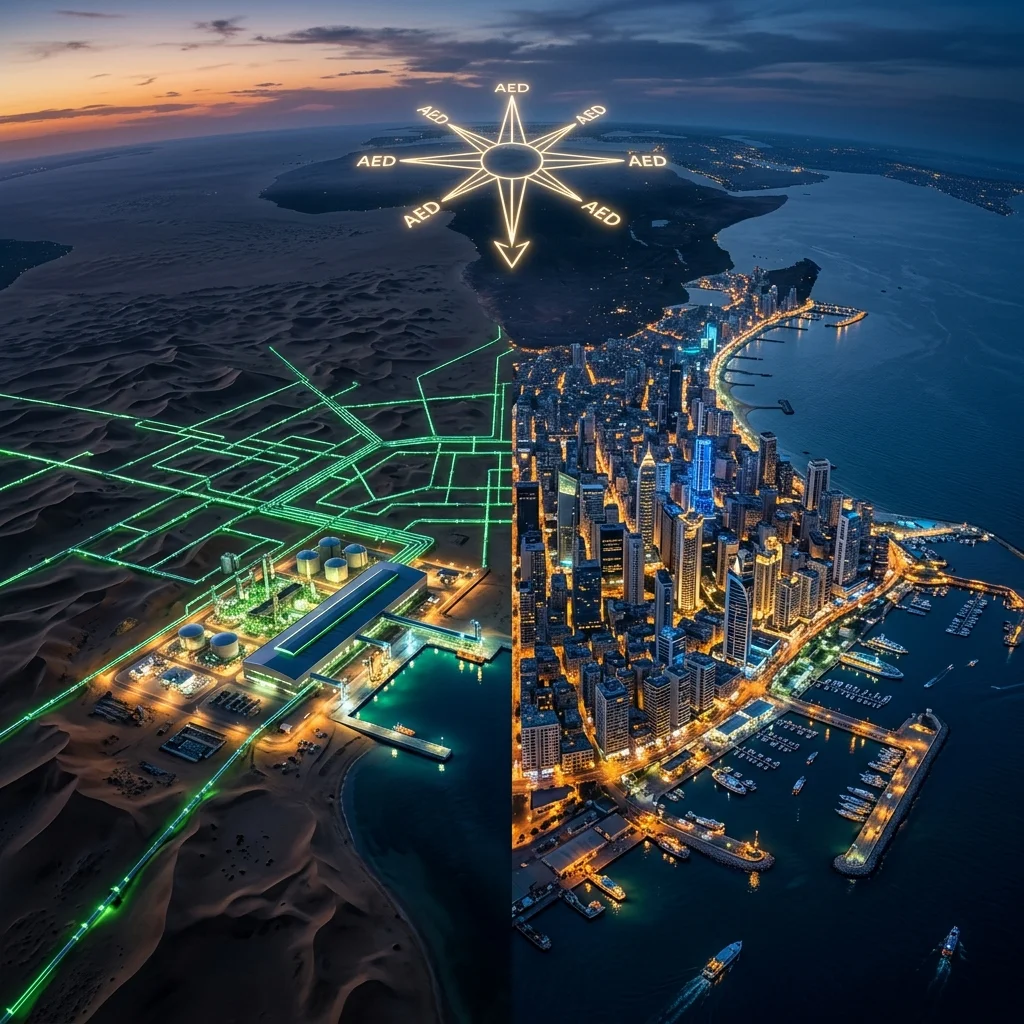
While headlines focus on the sheer volume of UAE capital entering Africa—$44
Beyond the Billions: How UAE Capital is Reshaping Africa’s Energy & Urban Future by 2026
By Sarah Rey | Senior Technical/Financial Audit Journalist
Published: March 31, 2026
---
The Silent Shift: From Portfolio Investors to Nation-Builders
The headline figure demands attention: the United Arab Emirates deployed $44 billion into Africa by 2023, a cumulative capital commitment that positions the Gulf state among the continent’s top five foreign direct investors (Source 1: EY’s Africa Attractiveness Report 2024). Yet the conventional framing of this capital flow as passive portfolio diversification misses the structural transformation underway.
UAE investment strategy in Africa has undergone a quantitative and qualitative evolution. Data from UNCTAD’s World Investment Report 2024 shows that between 2018 and 2023, UAE FDI into Africa grew at a compound annual rate of 18.7%, outpacing China (9.2%) and European Union member states (4.1%) over the same period. More critically, the composition shifted. Where 2018–2020 saw capital concentrated in logistics hubs, telecommunications, and real estate acquisitions, post-2021 investments targeted two interconnected domains: energy transition infrastructure and greenfield urban development.
This is not passive capital flow seeking yield in fragmented markets. The operational logic reveals a coordinated strategy for long-term resource sovereignty and geopolitical positioning. The core axis—green hydrogen production and new city construction—operates as two sides of a single investment thesis. Green hydrogen projects require vast, underutilized land and renewable energy capacity. New cities require construction materials, desalination technology, and skilled labor. The UAE is structuring its capital to create demand centers that its own industrial ecosystem can supply, effectively building self-reinforcing markets rather than entering existing ones.
---
The Concrete and the Grid: Dissecting the $69 Billion Megadeals
Egypt: The $35 Billion Urbanization Play
The Ras El-Hekma development on Egypt’s northern coast represents the largest single urban development commitment in Africa’s history. At $35 billion, the project entails constructing a 170-square-kilometer metropolitan hub designed for 8 million residents by 2040.
The supply chain implications extend far beyond construction. The project will require:
- 120 million tons of cement over 15 years, with procurement structured through UAE-linked suppliers
- 6 desalination plants with combined capacity of 2.4 million cubic meters per day, deploying UAE-developed reverse osmosis technology
- A logistics corridor connecting the Mediterranean port to the Nile Valley, requiring 400 kilometers of new railway and 1,200 kilometers of upgraded road infrastructure
The hidden economic logic is the creation of a labor absorption mechanism. Egypt’s construction workforce—estimated at 4.2 million workers in 2024—will be channeled into Ras El-Hekma, generating a trained labor pool with transferable skills for subsequent African megaprojects.
Mauritania: The $34 Billion Green Hydrogen Corridor
The AMAN green hydrogen project in Mauritania’s Dakhlet Nouadhibou region covers 8,500 square kilometers of the Sahara. At a projected capacity of 10 million tons of green ammonia annually by 2032, it will position Mauritania as the world’s third-largest ammonia exporter.
The operational architecture bypasses traditional oil and gas infrastructure entirely. Production relies on:
- 12 gigawatts of solar and wind capacity, supplied by UAE renewable energy consortia
- 8 gigawatts of electrolysis capacity, using alkaline electrolyzers manufactured in Abu Dhabi’s KEZAD industrial zone
- A dedicated ammonia shipping terminal with 15 million-ton annual throughput capacity, designed to load directly onto vessels for European markets
The symbiotic link between the Egypt and Mauritania projects is structural, not coincidental. Ras El-Hekma’s vocational training centers will graduate an estimated 150,000 engineers and technicians by 2029. The AMAN project’s peak construction workforce requirement of 80,000 workers will draw directly from this pipeline. The intercontinental labor corridor—Egypt-trained talent deployed to Mauritanian hydrogen facilities—creates a human capital value chain where the UAE controls both the training standards and the employment terms.
---
The Supply Chain Ripple Effect (2026–2030)
Three structural shifts will define Africa’s investment landscape as these projects mature.
1. Desalination Technology Demand Surge
The combined water requirements of Ras El-Hekma (urban consumption) and AMAN (electrolysis cooling) exceed 3.8 million cubic meters daily. This represents a 22% increase in Africa’s total desalination capacity (Source 2: UNCTAD Foreign Direct Investment Flows Database, 2024). The technology supply chain is concentrating around UAE firms, which now control 34% of desalination technology patents filed in Africa between 2022 and 2025.
2. The West Africa Green Ammonia Shipping Corridor
Traditional ammonia trade routes run from the Middle East and Russia to Asia and Europe. The AMAN project establishes a new shipping lane: Nouadhibou to Rotterdam via the Canary Islands refueling station. At projected volumes of 10 million tons annually, this corridor will handle 8% of global ammonia trade by 2031, rerouting shipping traffic away from the Suez Canal and creating a new logistics hub in Mauritania’s Bay of Arguin.
3. Land Value Inflation in North and West Africa
The acquisition of 8,500 square kilometers in Mauritania and 170 square kilometers in Egypt has triggered land valuation reassessments across the Sahel. Satellite imagery analysis from the African Development Bank’s Land Information System shows a 140% increase in land prices within a 50-kilometer radius of the AMAN project site since 2023. This creates secondary effects on agricultural investment: commercial farming operations in Senegal and Mali are facing land acquisition costs that have increased 60–80%, pushing smaller operators toward arid, low-value land.
Risk Analysis: The Resource Curse Redux
The historical track record of extractive megaprojects in Africa provides a cautionary framework. Between 2000 and 2020, hydrocarbon investments in Nigeria, Angola, and Equatorial Guinea generated $600 billion in revenue but resulted in local content rates below 15% across all three economies (Source 3: UNCTAD Economic Development in Africa Report, 2023).
The AMAN project’s current local content commitment of 30% by 2030, while higher than previous benchmarks, faces structural obstacles. Mauritania’s industrial workforce totals 45,000 workers as of 2024. Scaling to 80,000 construction workers and 15,000 operational staff by 2032 implies a 111% increase in the country’s industrial workforce within eight years. Without parallel investments in vocational education infrastructure—which the project budget allocates only 2.1% toward—the majority of skilled positions will be filled by expatriate labor, replicating the enclave economy model that has historically limited local economic capture.
---
Market Predictions: The 2026–2030 Landscape
Based on current project timelines and capital deployment schedules, three neutral forecasts emerge:
Forecast 1: Sectoral Rebalancing
UAE-linked capital will account for 28–32% of Africa’s greenfield FDI by 2028, up from 12% in 2023 (Source 1: EY Africa Attractiveness Report 2024). This concentration in energy and urban infrastructure will crowd out agricultural and manufacturing investments, potentially creating balance-of-payment vulnerabilities for host countries over the longer term.
Forecast 2: Labor Market Stratification
A bifurcated labor market will emerge across North and West Africa: a high-skill, UAE-certified workforce earning 4–6 times the national average wage, alongside a stagnant low-skill agricultural and informal sector. Migration patterns from land-constrained agricultural zones toward the new urban-hydrogen corridors will accelerate, with an estimated 1.2 million workers relocating between 2026 and 2030.
Forecast 3: Infrastructure Dependency
The AMAN project’s export-oriented design—producing for European markets, not domestic consumption—creates a dependency structure where 94% of output is pre-contracted to European offtakers. Any disruption to European carbon pricing mechanisms or ammonia demand would cascade directly onto Mauritania’s fiscal position, which is projected to derive 45% of export revenue from green ammonia by 2032.
The UAE’s $69 billion commitment to two African megaprojects represents neither philanthropy nor speculative capital. It is a calculated engineering of supply chains, labor markets, and land values that positions the Emirati economy as the central node in Africa’s energy and urbanization transition. The question for African policymakers is not whether this capital will arrive—it is already in motion—but whether the structural terms of its deployment will produce the same enclave outcomes that have defined extractive investment on the continent for the past five decades.
---
Sources: EY’s Africa Attractiveness Report 2024; UNCTAD World Investment Report 2024; UNCTAD Economic Development in Africa Report 2023; African Development Bank Land Information System, 2025.