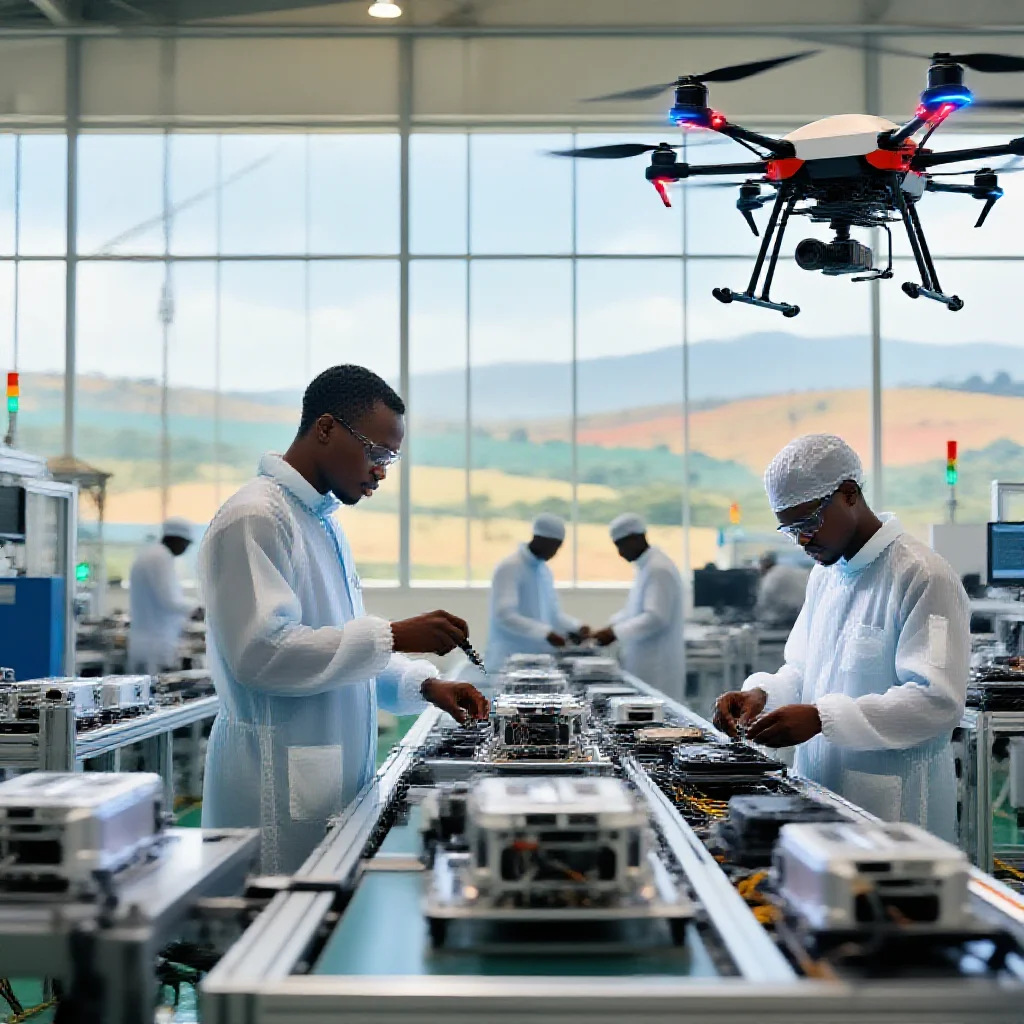
Terra Industries'' announcement to build what it claims will be Africa''s
Beyond the Headline: Why Terra Industries' Ghana Drone Factory Signals Africa's Strategic Tech Shift
The Surface Fact: Announcing Africa's 'Largest' Drone Factory
Terra Industries has announced plans to construct a drone manufacturing facility in Ghana. The corporate statement positions the planned facility as "Africa's largest drone factory" (Source 1: [Primary Data]). This declaration functions as an immediate market signal, asserting scale and ambition within a sector still in its formative stages on the continent. The claim of "largest" requires contextualization against existing benchmarks, such as smaller-scale assembly units in Rwanda, South Africa, or Kenya, which currently define the industry's manufacturing capacity. The selection of Ghana as the location aligns with established perceptions of the nation's relative political stability and its developing technology ecosystem, which includes digital infrastructure and a growing pool of technical graduates.
Image Suggestion: A conceptual graphic comparing the purported scale of the new factory to existing drone facilities globally.
The Hidden Economic Logic: Why Ghana, Why Now?
The strategic rationale extends beyond conventional factors like labor costs. Ghana's value is analyzed as a gateway to the West African market, a region with demonstrated demand drivers for drone applications. These include precision agriculture for cash crops like cocoa, logistics support for mining operations, and last-mile medical delivery across challenging terrain. Ghana presents a viable "testbed" hypothesis: its diverse geography and evolving, yet open, regulatory stance toward unmanned aerial vehicles (UAVs) allow for the development and validation of drone solutions scalable across similar African markets.
A critical, unspoken driver is supply chain decoupling. Localized production is a calculated response to chronic import challenges: high tariffs on finished goods, currency volatility affecting procurement costs, and long lead times that hinder operational deployment in sectors like agriculture and infrastructure inspection. Establishing fabrication capacity mitigates these dependencies, potentially lowering total cost of ownership and improving service reliability for end-users in growth sectors.
Image Suggestion: A map of West Africa highlighting Ghana, with overlay icons for key drone application sectors: agriculture, mining, healthcare delivery, and infrastructure.
The Unspoken Tech Trend: From Consumption to Creation
This move suggests a nascent pivot in the continent's technological narrative. The model shifts from Africa as a passive consumer of finished technology goods to a potential site for intellectual property generation and advanced hardware fabrication. The establishment of a large-scale factory has a tangible talent pipeline angle. It creates high-value technical employment, potentially stimulating further investment in local STEM education and helping to retain engineering talent that might otherwise seek opportunities abroad.
This trend enables adaptation over mere adoption. Localized manufacturing creates the conditions for developing drones specifically engineered for African operational environments. This could involve designs optimized for resistance to dust and heat, enhanced payload capacities for cargo, or communication systems configured for areas with sparse cellular infrastructure. The value shifts from distributing generic global products to creating specialized tools for localized challenges.
Image Suggestion: A split image: one side showing consumer drone delivery, the other showing a custom-built industrial drone inspecting a remote pipeline or farm.
Deep Audit: Critical Questions and Verification Points
A rigorous audit of the announcement necessitates cross-verification against independent data points. The primary verification task involves examining records from Ghana's Free Zones Authority or the Ghana Investment Promotion Centre to confirm the formal registration of the project, the committed investment value, and the stipulated timelines. This provides a basis for assessing the project's substance beyond the press release.
A market reality check is required. Analysis must investigate the current, addressable demand for industrial-grade drones in West Africa versus the projected demand often cited in market forecasts. This determines whether the facility is built for an existing market or is a bet on catalyzing future adoption. The competitive landscape analysis—the "who else" factor—is crucial. Scrutiny must identify if other global commercial drone manufacturers (e.g., DJI, Parrot) have comparable localized manufacturing plans, or if Terra Industries is assuming first-mover advantage alongside pioneer risk.
Finally, the level of manufacturing integration warrants scrutiny. The sustainability and economic impact of the facility depend on the depth of the value chain localized within Ghana. Key questions include whether the operation will involve deep manufacturing processes, such as PCB assembly and frame fabrication, or if it will primarily be a final assembly and configuration site for imported component kits (SKD/CKD). The sourcing strategy for core components like flight controllers, sensors, and batteries will ultimately define the project's contribution to technology transfer and economic complexity.
Neutral Market and Industry Predictions
The announcement by Terra Industries is likely to accelerate strategic planning among competitors and adjacent service providers. If the project proceeds as announced, it will establish a new benchmark for scale in Africa's drone industry, potentially lowering unit costs for drones in the region and validating Ghana as a destination for advanced manufacturing investment. The long-term success metric will be the facility's output mix: the proportion of drones designed and built for specific African use cases versus rebranded global models. This project will serve as a live case study on the viability of localizing advanced, technology-driven manufacturing in Africa, with outcomes that will inform investment and policy decisions across the continent for the next decade. The operational and commercial performance of this facility will provide definitive data on Africa's readiness to transition from a technology market to a technology production hub.