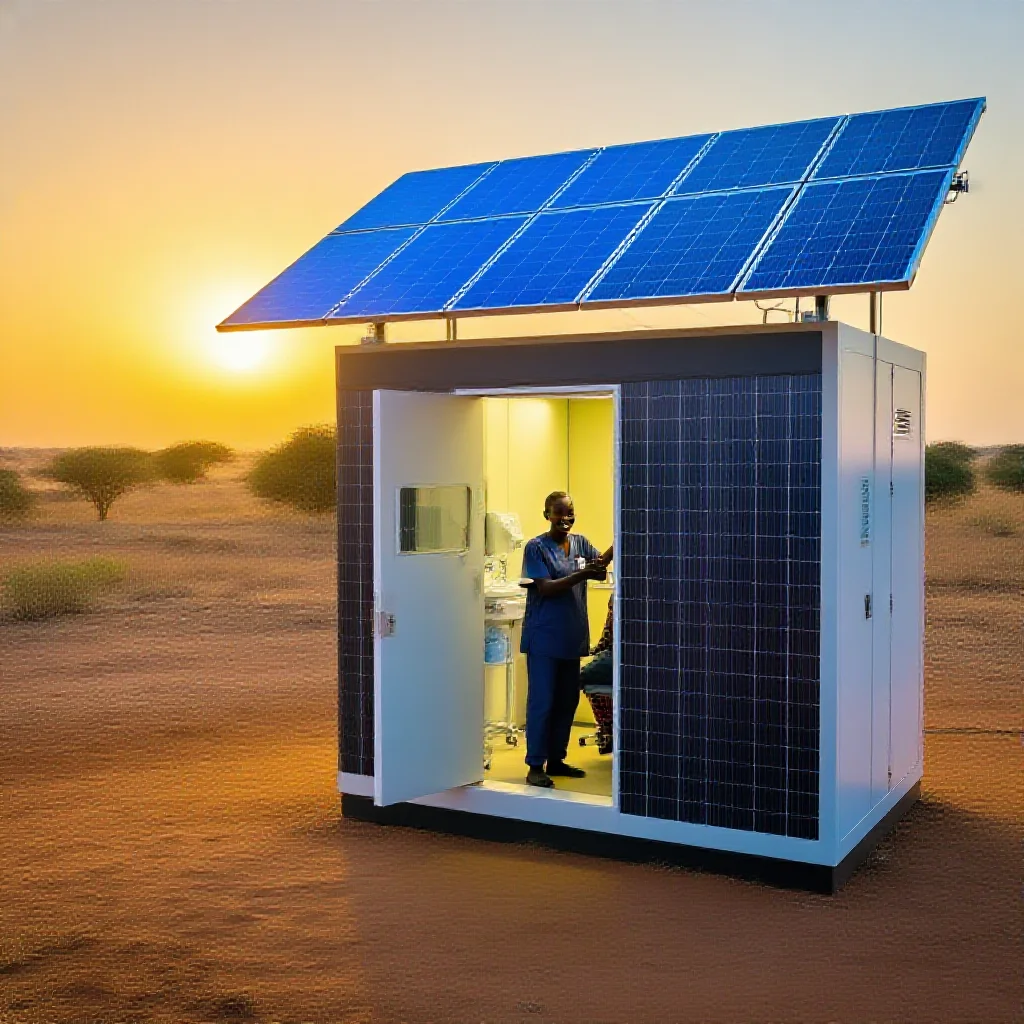
The deployment of solar-powered medical kiosks by Telemedan in remote Chad
Beyond Power Grids: How Solar-Powered Medical Kiosks in Chad Reveal a New Model for Frontier Market Healthcare
Introduction: The Kiosk as a Strategic Node, Not Just a Clinic
The deployment of solar-powered medical kiosks by the organization Telemedan in remote regions of Chad represents a distinct case study in frontier market healthcare innovation. These units are engineered to provide basic medical services in areas with minimal existing infrastructure. The operational model extends beyond simple service delivery; each kiosk functions as a self-contained node integrating power generation, telecommunications connectivity, and clinical capability. This analysis posits that the initiative reveals a nascent economic logic for delivering sustainable services to populations traditionally considered commercially unviable. The model shifts focus from replicating centralized, grid-dependent facilities to deploying decentralized, autonomous units.
Decoding the Core Axis: The Economics of Bypassing Broken Infrastructure
The strategic foundation of this model is not predicated on charitable subsidy but on a fundamental economic recalculation. The driver is the declining cost curve of specific technologies—namely, photovoltaic solar panels and telemedicine software platforms—against the perpetually high and unpredictable cost of constructing and maintaining traditional, grid-tied healthcare facilities in remote regions.
The primary economic proposition of the solar-powered kiosk is its energy independence. In frontier markets, unreliable fuel supply chains and non-existent or failed electrical grids constitute the single largest operational risk for healthcare delivery. Diesel generators entail volatile fuel costs and maintenance burdens. By eliminating this variable, the solar kiosk establishes a predictable, near-zero marginal cost for its core operational power. This predictable cost structure is a prerequisite for financial sustainability. It enables the potential for viable fee-for-service, subscription, or micro-insurance models in geographies where such structures were previously impossible due to uncontrollable overheads. The unit's capital cost, while significant, is a one-time investment against which decades of stable operation can be projected.
Slow Analysis: A Blueprint for the 'Last Mile' Healthcare Ecosystem
The kiosk's design allows it to function as a platform for a broader ecosystem, not merely a point for primary care consultations. Its guaranteed power and connectivity create a reliable anchor in otherwise unstable environments. This enables secondary service layers: it can host digital patient records, facilitate micro-insurance product sign-ups, act as a node for public health data aggregation and outbreak monitoring, and serve as a secure dispensing point for medications.
A deeper analytical entry point concerns the medical supply chain. The inherent solar power capacity of these kiosks presents a potential evolution for last-mile logistics. A stable, powered node could enable a "cold chain lite" system for essential thermolabile medicines and vaccines, utilizing integrated solar-powered refrigeration. This would address a critical bottleneck in remote healthcare, transforming the kiosk from a consultation point to a vital storage and distribution hub.
This model suggests a redefined role for external aid and development funding. The function shifts from perpetual operational subsidy for services to the catalytic financing and de-risking of initial infrastructure deployment. Once the autonomous physical node is established, operation can be transitioned to local healthcare workers or entrepreneurs under sustainable economic models, reducing long-term aid dependency.
Evidence & Verification: Scrutinizing the Model's Claims and Challenges
The claims of sustainability and scalability inherent to the Telemedan model require rigorous validation against operational data. Key performance indicators must be scrutinized: actual uptime of solar systems versus projected, the true cost-per-patient consultation inclusive of all capital and maintenance, and the rate of utilization by target populations. A critical challenge is the dependency on telecommunications infrastructure for telemedicine functionality; in areas with no cellular signal, the kiosk's capabilities are reduced to its on-site resources and any stored diagnostic protocols.
Furthermore, the model's commercial viability hinges on the population's ability and willingness to pay for services, even at low cost. This intersects with complex socio-economic factors beyond the technological solution. The maintenance of sophisticated medical and solar equipment in harsh, remote environments presents another significant hurdle, requiring innovative local technician training and spare parts logistics chains. The model's success is contingent not just on technology working in isolation, but on its integration into a support ecosystem that is often absent.
Conclusion: Neutral Projections on Market Evolution and Replication
The Telemedan initiative in Chad provides a tangible prototype for a healthcare delivery archetype suited to frontier markets. Its replicability in other regions with similar infrastructure deficits—such as parts of the Sahel, Central Asia, or isolated island nations—is technically feasible. The determining factors for widespread adoption will be economic, not technological.
Market evolution will likely follow two paths. First, a reduction in the unit cost of integrated kiosk systems as design and manufacturing scale, improving the return-on-investment profile for governments and impact investors. Second, the emergence of specialized operators who manage networks of these kiosks as a service, leveraging economies of scale in procurement, telemedicine backend services, and technical support.
The long-term industry prediction is a gradual bifurcation in frontier market healthcare. Traditional brick-and-mortar clinics will continue to serve peri-urban areas, while decentralized, technology-enabled nodes will become the standard for reaching dispersed, remote populations. This model does not replace the need for robust public health systems but offers a pragmatic, parallel channel for extending basic services. Its ultimate impact will be measured by its transition from a pilot project to a financially sustainable, scalable standard of care, setting a new benchmark for infrastructure-light service delivery in the world's most challenging environments.