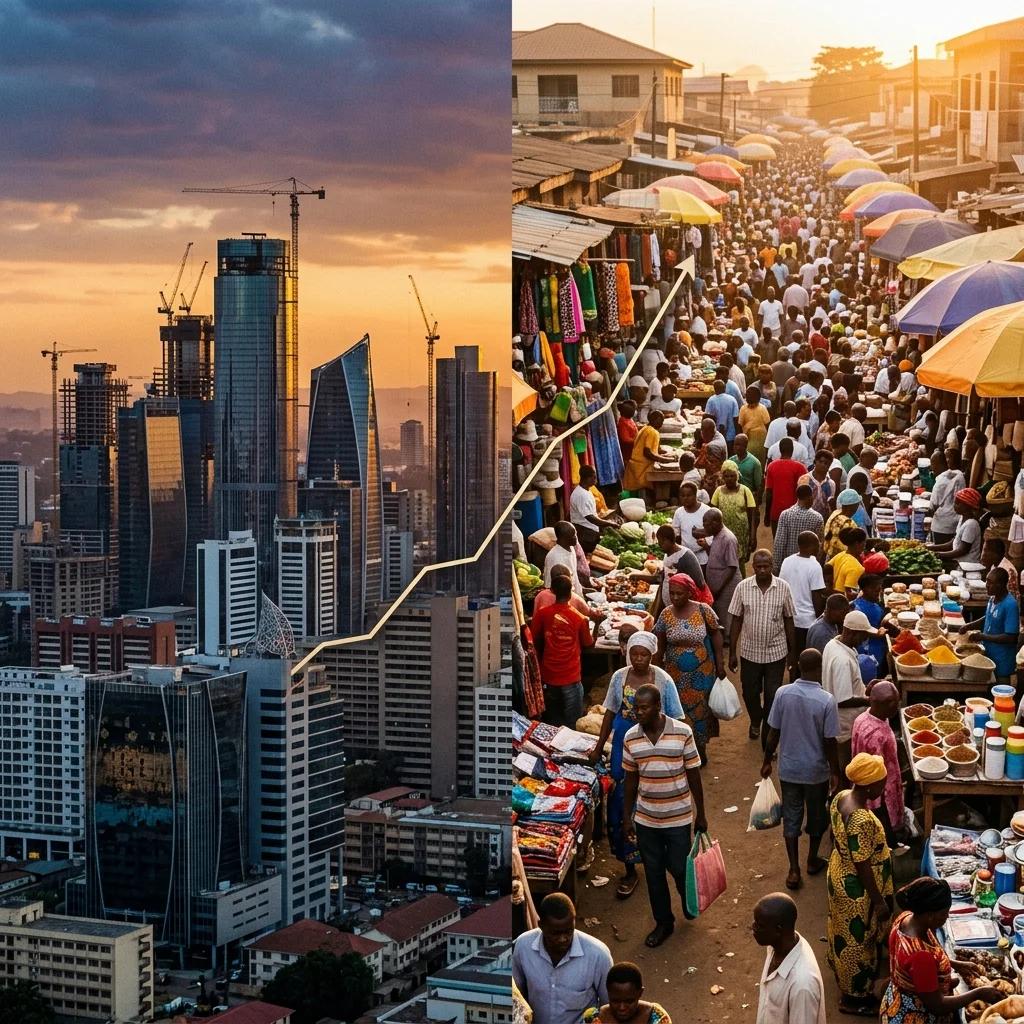
While most analyses focus on aggregate capital flows, this article explores
The Hidden Ripple Effect: How Foreign Investment Reshapes Africa’s Middle Class Beyond GDP Growth
Introduction: Beyond the Headline Numbers
The dominant narrative surrounding Africa's rising foreign direct investment (FDI) inflows treats capital accumulation as an unambiguous engine of prosperity. Between 2010 and 2022, FDI into Africa increased from $45 billion to roughly $80 billion annually, with projections suggesting continued growth (UNCTAD World Investment Report). However, a more granular analysis reveals that aggregate figures obscure significant structural discontinuities in how these capital flows redistribute economic opportunity.
Amadou Sy, Senior Fellow at the Brookings Institution, offers a corrective lens in his analysis of increased foreign investment in Africa (Source: Brookings.edu). Sy’s framework advances a critical thesis: investment does not automatically lift all boats; rather, it redefines the composition of those afloat. The core analytical question shifts from "How much is coming in?" to "Who is being included, and who is being structurally excluded?"
This article dissects three dimensions of this transformation: labor market stratification, consumption pattern dependency, and the forward-looking policy signals embedded in Brookings’ own editorial framing. The evidence suggests that Africa’s middle class expansion may be less a story of sustainable prosperity and more a narrative of conditional inclusion tied to volatile capital cycles.
The Composition Effect: Which Jobs and Incomes Are Being Created?
Foreign investment into Africa demonstrates a pronounced sectoral bias. Approximately 60% of FDI flows target extractive industries (oil, gas, mining) and high-technology services (fintech, telecommunications, logistics) (Source: African Development Bank Economic Outlook). This creates a bifurcated labor market with distinct income trajectories.
The bifurcation mechanism operates as follows: High-skill professionals in urban hubs such as Nairobi’s Kilimani district or Lagos’s Victoria Island command wages that place them solidly within the upper-middle consumption bracket — households earning between $10 and $20 per day (African Development Bank middle class definition). Simultaneously, the majority of labor absorption occurs in informal services, retail, and agriculture, where income growth remains stagnant or negative in real terms.
Sy’s analysis prompts a structural question: Is this new middle class sustainable, or is it a thin layer dependent on volatile foreign capital? Evidence from the 2014-2016 commodity price collapse demonstrates the fragility. When copper prices fell 40%, Zambia’s middle class contracted by approximately 1.5 million individuals within two years (Source: World Bank Zambia Poverty Assessment). The investment-driven middle class proved to be a leveraged phenomenon — expanding rapidly during booms, contracting catastrophically during busts.
Labor market stratification creates a paradox: Urban professional hubs see rising apartment rents, imported vehicle purchases, and international school enrollments — all indicators of middle class expansion. Meanwhile, peri-urban and rural middle-income groups, who depend on agricultural value chains or manufacturing linkages, face shrinking margins as investment capital bypasses labor-intensive sectors.
Consumption Shifts: From Saving to Spending — The Hidden Risk
The consumption basket of investment-created middle class households exhibits distinct characteristics that introduce macroeconomic vulnerability. Research on household financial behavior in emerging economies demonstrates that new entrants to middle-class status display higher marginal propensities to consume relative to established middle class cohorts (Source: Brookings Global Economy and Development working papers).
Three consumption patterns are particularly notable:
- Import-intensive goods adoption: Consumer durables — smartphones, vehicles, home appliances — disproportionately originate from foreign direct investment supply chains. This creates a structural current account dependency where middle class consumption directly fuels import bills rather than local manufacturing.
- Service sector premium: Education, healthcare, and housing services linked to foreign-financed developments command premium pricing. In Accra, rent for a two-bedroom apartment in a foreign-invested development averages $1,200 monthly — 8 times the median household income of the informal sector (Source: Ghana Statistical Service).
- Savings rate compression: Household savings rates among Africa’s new middle class average 8-12% of disposable income, compared to 15-20% in comparable Southeast Asian economies (Source: McKinsey Global Institute). The difference reflects higher debt service ratios — auto loans, mortgages, and consumer credit linked to investment-driven financial inclusion.
The macro vulnerability is compound. Sy’s colleague Landry Signé has documented that debt service ratios across Sub-Saharan Africa have exceeded 20% of government revenue since 2022 (Source: Brookings Africa Growth Initiative). When investment inflows slow — as they do during global interest rate tightening cycles — the consumption-dependent middle class faces simultaneous income decline and credit contraction. The 2023-2024 period demonstrated this: as FDI into Kenya fell 18% year-on-year, formal sector employment growth slowed to 1.2%, while household defaults on digital loans surged 35%.
The Forward-Looking Signal: Why a 2026 Article Reference Matters
A notable editorial artifact appears in the Brookings page: a reference to "Foresight Africa at the 2026 Spring Meetings: How the world’s economic leaders are preparing for the next crisis" (Source: Brookings.edu, associated content). This is not a random cross-link. It signals that Brookings is explicitly framing current investment trends through anticipatory crisis management logic.
Three analytical implications emerge:
- Timeline predictive modeling: The reference date — April 30, 2026 — positions the current middle class expansion as a pre-crisis phenomenon. This mirrors the trajectory observed in East Asian economies (1997-1998) and Latin American economies (2014-2016), where middle class growth preceded external shock-driven contractions.
- Resilience measurement: By framing investment in Africa within crisis preparedness discourse, the institution signals that current middle class metrics are being evaluated for stress-testing rather than celebratory reporting. Brookings’ methodology likely incorporates scenario analysis where FDI retrenchment triggers cascading consumption and employment effects.
- Policy sequencing: The 2026 reference implies that current investment patterns require policy recalibration before the next global economic downturn. Specifically, the analysis suggests that Africa’s middle class expansion lacks the social protection infrastructure (unemployment insurance, portable benefits, health coverage) that would cushion against capital flow reversal.
The logical endpoint of this analysis: without structural transformation of how investment capital links to domestic labor markets and savings institutions, Africa’s current middle class expansion may be categorized historically as a credit-driven, investment-dependent phenomenon rather than a self-sustaining economic transformation.
Conclusion: Neutral Market Predictions
Based on the structural evidence and Brookings’ editorial framework, the following projections are analytically supportable:
Near-term (2024-2026): The African middle class will continue numerical expansion in urban professional centers, but at a decelerating rate. Consumption patterns will shift from durable goods toward services, reflecting rising debt servicing costs. Urban-rural income divergence will reach historic peaks.
Medium-term (2026-2028): Should global interest rates remain elevated, FDI inflows will stabilize or decline, triggering a correction in consumption-dependent middle class segments. Countries with diversified investment profiles (Kenya, Rwanda, Ghana) will demonstrate greater resilience than extractive-dependent economies (Nigeria, Angola, Zambia).
Structural risk indicator: The ratio of FDI to gross fixed capital formation — currently above 25% for Sub-Saharan Africa — will be the primary metric to monitor. A drop below 15% would signal the contraction phase of the middle class cycle (Source: IMF Regional Economic Outlook).
The hidden ripple effect of foreign investment in Africa is not in GDP growth figures, but in the reconfiguration of who belongs to the middle class — and the structural conditions that determine whether that belonging is permanent or conditional.