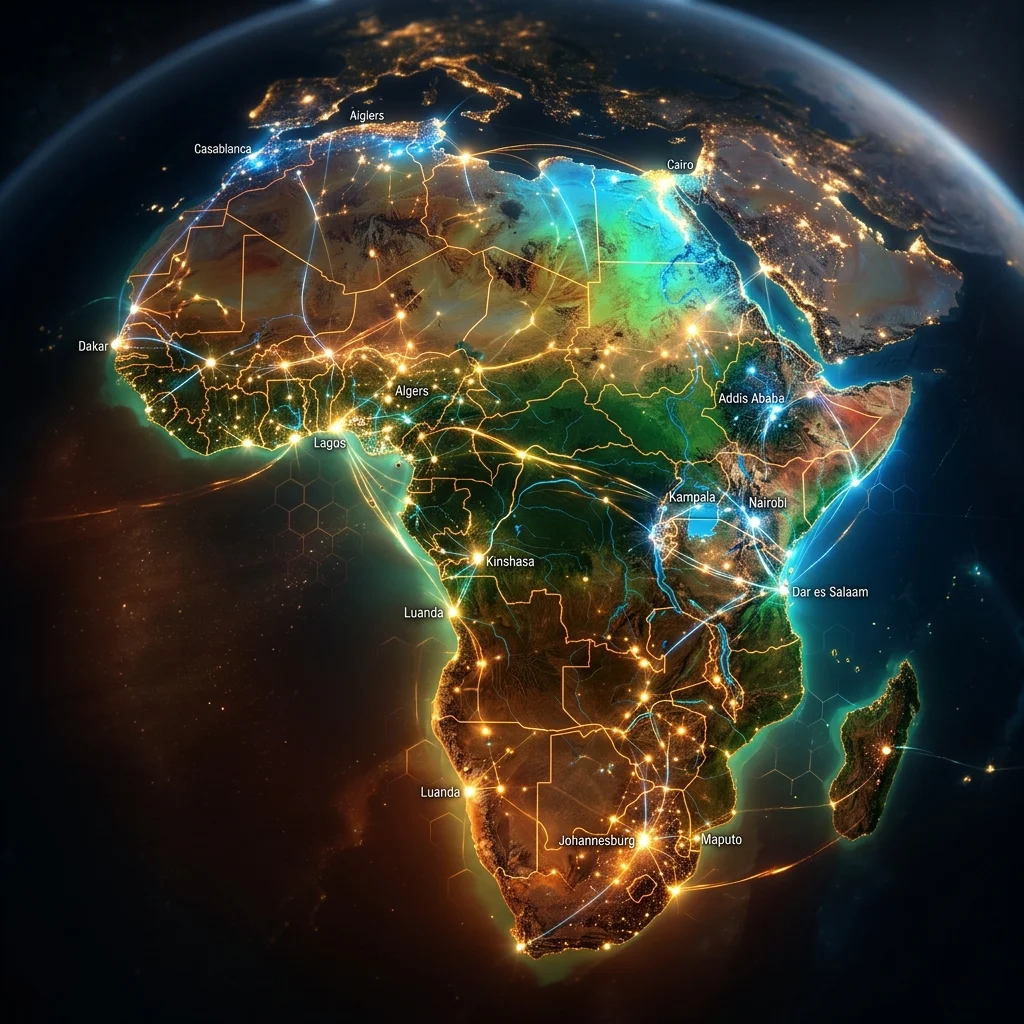
Foreign Direct Investment (FDI) in Africa is undergoing a structural shift
The New Frontier: How Foreign Direct Investment is Reshaping Africa’s Economic Landscape Beyond Commodities
Introduction: The Quiet Revolution in African FDI
In 2021, foreign direct investment (FDI) flows to Africa rebounded to $83 billion, according to UNCTAD’s World Investment Report. The headline figure masked a deeper transformation. For decades, the continent’s FDI story was written in oil fields, copper mines, and gas terminals—extractive projects that generated export revenues but left limited structural imprint on local economies. That script is being rewritten.
Today, a new wave of capital is flowing into digital services, renewable energy, and light manufacturing. Behind this pivot lies a confluence of forces: a demographic bulge of 1.4 billion people, mobile phone penetration that has leapfrogged legacy banking, and policy reforms that are making African markets more accessible. For global investors, Africa offers the last frontier of high-growth, non-correlated returns. For African economies, the composition of FDI determines whether these flows will drive genuine structural transformation or simply reproduce old patterns of dependency.
[IMAGE: Infographic showing FDI inflows by sector over the last decade (2013 vs 2023), with highlights on tech, energy, and manufacturing]
---
1. The Great Pivot: From Commodities to Digital & Services
According to fDi Markets data from 2023, services now account for over 50% of greenfield FDI projects in Africa. The shift is not marginal—it is structural. The key enabler is mobile money. M-Pesa in East Africa and Orange Money in Francophone West Africa created the digital rails for a fintech ecosystem that attracted $3.6 billion in venture capital in 2022 alone, per Partech Africa’s annual report.
The hidden logic here is crucial: investing in digital platforms is not merely about capturing consumer markets. Fintech investments are rewiring Africa’s underlying payment and credit infrastructure. This creates a foundation for future FDI in logistics, agriculture, health, and education. When Mastercard Foundation committed $1.4 billion to digital financial services across the continent, it was betting on infrastructure—not just apps.
Flutterwave, the Nigerian payments unicorn, now processes transactions in over 30 African countries, including smaller markets like Sierra Leone and Malawi. Its expansion demonstrates how fintech investment Africa is enabling cross-border commerce in a region where traditional banking penetration remains below 40%. The same pattern is visible in insurtech, agritech, and e-health: FDI in digital services is building the middle layer of Africa’s future economy.
[IMAGE: Photograph of a mobile money agent in a bustling market in Nairobi, with a smartphone showing a transaction – human-scale illustration of digital inclusion]
---
2. Infrastructure as a Gateway: Renewable Energy and Transport Corridors
Infrastructure finance in Africa is undergoing its own transformation. For decades, the dominant model was large-scale hydroelectric dams and road projects funded by Chinese state-owned enterprises under the Belt and Road Initiative. Today, a more diversified picture is emerging.
Renewable energy investment Africa reached $14 billion in 2022, according to BloombergNEF. Solar and wind projects are being led by multinationals like TotalEnergies and Norway’s Scatec, but also by a growing number of domestic developers. Critically, these projects are no longer standalone power plants—they are bundled with smart grid technology and battery storage, and they are creating new local supply chains. In South Africa, solar panel assembly plants have sprung up in Gauteng and the Western Cape. In Kenya, a homegrown solar inverter manufacturer now exports to neighbouring countries.
The transport corridor race is equally revealing. The Lobito Corridor, linking Angola’s port to the Democratic Republic of Congo and Zambia’s copperbelt, is backed by the US and EU as a direct competitor to Chinese-financed rail projects. This is not just geopolitics—it is a test of whether Western capital can offer better terms and local content requirements. The corridor is being designed to facilitate not just mineral exports but also agricultural produce and manufactured goods, signalling a shift toward integrated trade infrastructure.
[IMAGE: Map of Africa showing the Lobito Corridor and major Belt and Road rail projects, with overlay of solar and wind farm locations]
---
3. The Demographic Dividend: How Africa’s Youth Is Reshaping FDI Strategy
Africa’s median age is 19 years. By 2050, one in four people on the planet will be African. This demographic reality is fundamentally altering the calculus of foreign investors. Consumer-goods companies like Coca-Cola and Unilever have long been present, but the new wave of FDI is targeting the continent’s emerging middle class in more sophisticated ways.
The digital economy Africa narrative is inseparable from demography. Young Africans are not only consumers but also producers of digital content, software, and services. Venture capital flows to African tech startups reached $4.5 billion in 2022, with a growing share going to early-stage companies outside the traditional hubs of Nigeria, Kenya, and South Africa. This is creating a virtuous cycle: as digital native companies scale, they attract follow-on FDI from global tech giants. Google’s $1 billion investment in Africa—including an undersea cable, equity stakes in startups, and a new AI research centre in Accra—exemplifies how Africa FDI trends are now dictated by talent, not just resources.
Yet the demographic dividend is a double-edged sword. The continent needs to create 12 million new jobs annually just to absorb new entrants into the labour market. FDI in labour-intensive manufacturing—such as garment factories in Ethiopia and leather processing in Kenya—has been a mixed success. The lesson from early industrial parks is that supply chain localisation is critical. When an Ethiopian shoe factory sources raw materials locally rather than importing them, it generates far more downstream employment and skill transfer.
[IMAGE: Split image: left side shows young African tech workers in a co-working space in Lagos; right side shows workers in a solar panel assembly plant in South Africa]
---
4. Chinese vs Western Capital: A Tale of Two Strategies
The rivalry between Chinese and Western investment in Africa is often framed as a zero-sum game. In reality, the strategies are diverging in ways that affect the continent’s development outcomes.
Chinese FDI has historically concentrated on construction, extractive industries, and large-scale infrastructure under government-to-government agreements. The Belt and Road Initiative provided $150 billion in loans and investments to Africa between 2000 and 2022, but these have slowed due to debt sustainability concerns. Today, Chinese private capital is increasingly flowing into manufacturing—Chinese-owned industrial parks in Ethiopia and Egypt produce everything from smartphones to pharmaceuticals. Yet, these investments often operate in enclaves, with limited integration into local supply chains.
Western capital, by contrast, is pivoting toward services, technology, and sustainable infrastructure. The US government’s Prosper Africa initiative and the EU’s Global Gateway strategy explicitly prioritise digital transformation, green energy, and gender-inclusive investment. But Western private equity firms remain cautious, held back by currency risk and regulatory uncertainty.
The most promising developments occur when the two models compete and converge. The Lobito Corridor and the Belt and Road rail projects in East Africa are both vying to attract mining companies and agricultural exporters. This competition drives better terms for host governments—lower financing costs, more local content requirements, and stronger environmental standards. The real winners may be African countries that can play both sides effectively.
[IMAGE: Bar chart comparing Chinese vs Western FDI by sector in Africa for 2022, with sectors labelled: infrastructure, manufacturing, extractives, services, tech]
---
5. Real Transformation or New Dependency?
The evidence for genuine structural transformation is real but uneven. On the positive side, infrastructure finance Africa is increasingly bundled with technology transfer and local manufacturing. The solar panel assembly plants in South Africa and Kenya are employing local engineers and creating export capacity. Fintech platforms are enabling small and medium enterprises that previously had no access to credit.
Yet warning signs persist. The bulk of digital FDI still flows through tax-optimisation structures that minimise revenue for African governments. The AfDB estimates that illicit financial flows—much of it through transfer pricing by multinationals—cost Africa $80 billion annually, roughly equivalent to total FDI inflows. Moreover, the shift toward services does not automatically create the mass employment needed for a young, rapidly growing population. A fintech startup employs 200 software engineers; a garment factory employs 10,000 sewing machine operators.
The question of dependency also takes new forms. When a continent’s payment system is built on a foreign-owned fintech platform, or its power grid relies on imported solar panels financed by concessional loans from a single donor, the old dynamics of extraction re-emerge in digital guise. The antidote is supply chain localisation and domestic capacity building—policies that tie FDI to local sourcing, workforce training, and technology licensing.
McKinsey’s 2023 report on Africa’s economic potential argues that the continent’s opportunity lies in creating “integrated value chains” that combine digital platforms, renewable energy, and local manufacturing. That requires deliberate policy, not just market forces.
[IMAGE: Diagram showing a circular flow: FDI → digital infrastructure → local fintech → SME lending → local manufacturing → exports → reinvestment]
---
Conclusion: The Next Decade of African FDI
The reshaping of Africa’s economic landscape through FDI is neither a miracle nor a mirage. It is a messy, uneven, and highly contingent process. The pivot from extractive projects to digital services and renewable energy is real, but its impact depends on how deeply it integrates with local economies.
For investors, the lesson is that Africa no longer fits a single narrative. The continent offers fintech investment Africa opportunities that rival Silicon Valley in growth rates, renewable energy investment Africa projects that are bankable and scalable, and infrastructure finance Africa deals that are increasingly competitive with traditional markets.
For African policymakers, the challenge is to design regulatory frameworks that maximise local benefits—taxing digital services fairly, mandating local content in infrastructure, and building skills ecosystems that allow young Africans to move from being consumers of foreign technology to producers of it.
The quiet revolution in African FDI is underway. Whether it becomes a genuine transformation or a new wave of dependency will be decided not in boardrooms in New York, Beijing, or London, but in the policy choices made in Accra, Nairobi, and Lusaka over the next five years.
[IMAGE: A stylised map of Africa illuminated with glowing data nodes and connecting lines representing digital financial flows, overlaid on a gradient from dark earth tones to vibrant green and blue, with a subtle grid pattern symbolising infrastructure. No text, no watermark.]