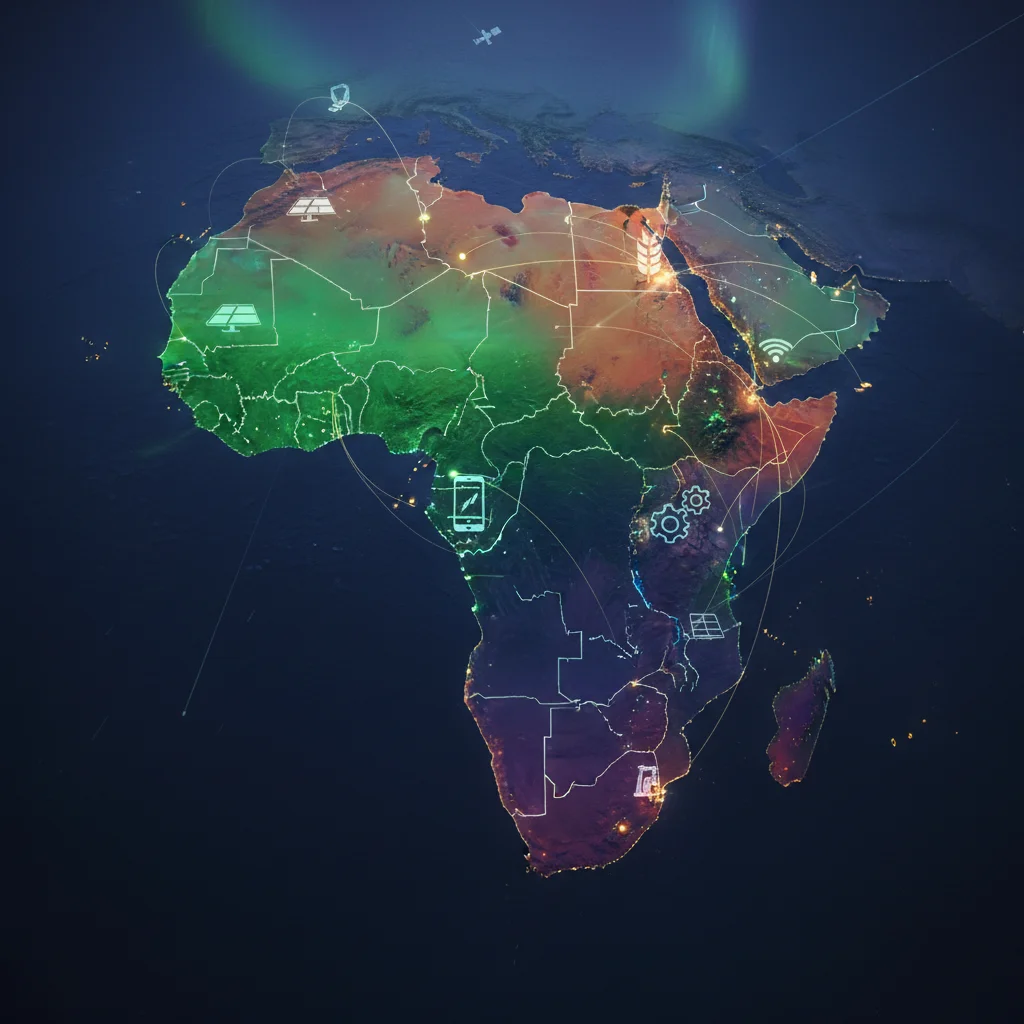
Africa's investment outlook for 2026 reveals moderate but resilient GDP growth,
Africa's 2026 Investment Landscape: Navigating Growth, Risk, and New Opportunities
Introduction: The 2026 Pulse of African Economies
Africa enters 2026 with a tempered yet resilient macroeconomic outlook. Continental GDP growth is projected at 3.8% on average, driven by domestic consumption, accelerating digital adoption, and sustained infrastructure investment. The picture, however, is far from uniform. East Africa leads the pack at an estimated 5.9%, propelled by robust service sectors, agricultural modernization, and cross-border trade corridors. West Africa follows at 4.3%, buoyed by Nigeria’s oil recovery and Ghana’s fiscal consolidation. North Africa trails at 3.6%, weighed down by geopolitical tensions and water scarcity, while Southern Africa lags at 2.2%, constrained by structural bottlenecks in South Africa and grid reliability issues.
[IMAGE: A labeled map of Africa with regional GDP growth percentages overlaid — East Africa in bright green at 5.9%, West Africa in blue at 4.3%, North Africa in orange at 3.6%, and Southern Africa in purple at 2.2%.]
These figures represent more than headline numbers. They reflect underlying shifts: a youthful population entering the workforce at 15–20 million per year, urbanization rates exceeding 4% in several nations, and a growing share of GDP generated by services and digital platforms. Investors examining Africa finance investment trends must look beyond aggregate statistics to the sub-regional engines driving growth. Ethiopia and Kenya are turning into manufacturing and tech hubs; Senegal and Côte d’Ivoire are leveraging commodity processing and logistics; Rwanda and Tanzania are reforming business climates at breakneck speed.
The continent stands at a tipping point. Structural reforms — from tax digitization in Nigeria to port modernization in Angola — are beginning to show measurable returns. The operationalization of the African Continental Free Trade Area (AfCFTA) is no longer a theoretical promise; it is reshaping trade flows, supply chains, and investment calculations. For global capital, the question is no longer whether to engage with Africa, but how to navigate its opportunities and perils with precision.
The AfCFTA Effect: Tariffs, Harmonization, and Trade Realignment
Since the start of guided trade in 2021, the AfCFTA has progressively lowered tariffs on 90% of goods traded among member states. By 2026, tariff reductions are expected to be fully phased in for most non-sensitive products, with rules of origin harmonized across sectors. The impact on investment is twofold: lower cross-border logistics costs and expanded market access to a consumer base of over 1.4 billion people.
[IMAGE: A diagram of African trade routes with directional arrows showing increased intra-regional flows, highlighting tariff reduction zones in West Africa and East Africa.]
Early implementation is already reshaping value chains. A garment manufacturer in Kenya can now source cotton from Chad at reduced duty, process it in an industrial park near Mombasa, and sell finished products to Nigeria without incurring prohibitive import taxes. This new geography of production reduces reliance on extra-continental imports and encourages vertical integration. The AfCFTA also targets non-tariff barriers — bureaucratic customs procedures, inconsistent product standards, and discriminatory licensing — through digital platforms like the Pan-African Payment and Settlement System (PAPSS) and harmonized certification protocols.
For investors, the implications are clear. AfCFTA investment opportunities are no longer limited to single-country plays. Multi-country manufacturing hubs, regional logistics networks, and cross-border services (especially in finance and telecom) become viable. The trade area effectively de-risks supply chains by offering multiple sourcing points and a unified regulatory framework. However, implementation remains uneven. Some countries have moved faster to digitize customs and align standards; others lag due to political inertia or infrastructure deficits. Investors must calibrate their entry strategies based on bilateral trade facilitation scores and customs readiness.
High-Impact Sectors: Where Capital Flows and Value Addition Converge
Three sectors stand out as the primary recipients of capital flows in 2026: renewable energy, digital technology and fintech, and agribusiness with agro-processing. Each offers a convergence of high demand, policy support, and AfCFTA-enabled scale.
Renewable Energy. East Africa leads with ambitious solar and wind projects in Kenya, Ethiopia, and Tanzania, while Southern Africa moves to upgrade its transmission grids to accommodate cross-border power trade. The African Development Bank estimates that green finance flows to the continent reached $40 billion in 2025, with 2026 on track for a 15% increase. Regional power pools — the Eastern Africa Power Pool and Southern African Power Pool — are enabling utilities to trade surplus electricity across borders, stabilizing supply and attracting independent power producers. Investors targeting high-impact sectors in Africa should note that renewable energy projects that incorporate battery storage and mini-grid components are particularly favored by development finance institutions and impact funds.
Digital Technology & Fintech. Mobile money systems, led by M-Pesa in East Africa and MoMo in West Africa, have leapfrogged traditional banking in many markets. By 2026, the number of mobile money accounts across the continent exceeds 800 million. The Pan-African Payment and Settlement System (PAPSS) is reducing cross-border transaction costs by up to 50%, making intra-African commerce cheaper and faster. Fintech startups are expanding into lending, insurance, and wealth management, often using alternative credit scoring based on mobile data. The regulatory landscape is maturing, with central banks in Nigeria, Ghana, and Kenya issuing digital banking licenses and sandbox frameworks. Investors looking at Africa finance investment trends will find fintech the most dynamic sub-sector, albeit with rising competition and valuation caution.
Agribusiness & Agro-Processing. The AfCFTA directly incentivizes value addition over raw commodity export. Ghana is moving from exporting raw cocoa beans to processing cocoa butter and chocolate; Ethiopia is building coffee roasting and packaging capacity; Nigeria is expanding cassava starch processing. Agro-processing captures higher margins, creates jobs, and benefits from lower intra-African tariffs on processed goods. Moreover, climate-smart agriculture — drought-resistant seeds, precision irrigation, and cold-chain logistics — is attracting ESG-focused capital. The opportunity lies not only in production but in vertical integration: farm-to-fork logistics, packaging, and distribution across multiple AfCFTA markets.
Business Climate Reforms and Risk Management
Improvements in the business environment are encouraging but uneven. Rwanda remains a top reformer, ranking among the easiest places to do business in Africa due to digitized company registration, property transfer, and tax filing. Senegal and Côte d’Ivoire have streamlined investment codes and created one-stop shops for permits. Nigeria’s recent reforms — including the removal of fuel subsidies and unification of exchange rates — signal a move toward market-driven pricing, though implementation remains bumpy.
[IMAGE: An infographic of a risk matrix with axes of "Political Stability" and "Regulatory Transparency", with bubbles representing major African economies sized by GDP and colored by risk level.]
Yet investors must navigate persistent obstacles: bureaucratic complexity, infrastructure gaps, and currency volatility. Land acquisition can take months in parts of West Africa; customs delays still plague inland ports in the Democratic Republic of Congo. Currency devaluation in Nigeria, Egypt, and Ethiopia has eroded foreign investor returns. Effective Africa risk management requires a multi-layered approach: hedging currency exposure through forward contracts or local currency instruments, building relationships with local partners who understand regulatory nuances, and purchasing political risk insurance from institutions like MIGA or the AfDB.
Security risks also vary. The Sahel region, parts of the Lake Chad Basin, and the eastern DRC remain volatile. However, most investment destinations — Kenya, Ghana, Rwanda, Senegal, Botswana — are stable and have robust security frameworks. Investors should conduct thorough political economy assessments and scenario-planning rather than rely on blanket assumptions about "African risk."
Market Entry Strategies for 2026
Given the diversity of regulatory environments and market maturity across Africa, a one-size-fits-all entry strategy rarely works. Successful investors are adopting hybrid models:
- Partnerships with local champions. Joint ventures with established African firms provide on-the-ground knowledge, regulatory navigation, and distribution networks. This is especially critical in regulated sectors like banking, telecom, and natural resources.
- Phased expansion via AfCFTA hubs. Rather than entering 54 countries at once, investors can start in a regional hub — for example, Kenya for East Africa, Ghana for West Africa, and South Africa for Southern Africa — then leverage AfCFTA trade preferences to scale into neighboring markets.
- Digital-first business models. The high smartphone penetration and mobile money adoption in East and West Africa allow investors to offer fintech, e-commerce, and digital services without heavy physical infrastructure. API integrations with PAPSS and mobile money operators reduce transaction costs.
- Blended finance with DFIs. Many high-impact sectors (renewable energy, agriculture, affordable housing) require concessional capital to de-risk early-stage projects. Development finance institutions (DFIs) like the IFC, AfDB, and bilateral agencies offer risk-sharing guarantees and technical assistance, especially for ESG-aligned projects.
Convergence of Digital Transformation, ESG Imperatives, and Regional Integration
The most distinctive trend in Africa’s 2026 investment landscape is the convergence of three powerful forces: digital transformation, environmental and social governance (ESG) imperatives, and regional integration under the AfCFTA. Digital platforms enable carbon tracking in supply chains; ESG compliance opens doors to international green bond markets; regional integration lowers the cost of scaling sustainable solutions across borders.
For example, a Kenyan solar mini-grid developer can use mobile money to collect payments, blockchain to verify carbon credits, and AfCFTA rules to import panels duty-free from South Africa. The result is a lower levelized cost of energy and a carbon offset that can be sold on international markets. Similarly, an agribusiness firm can use satellite data to monitor deforestation in its cocoa supply chain, comply with EU deforestation regulations, and export processed chocolate tariff-free to Nigeria.
Investors who embed ESG and digital innovation into their market entry Africa strategies will find not only higher returns but also stronger alignment with local development priorities and international capital requirements. The Africa finance investment trends of 2026 are increasingly shaped by the "triple helix" of digital, sustainable, and integrated.
Conclusion: A Window of Measured Optimism
Africa’s 2026 investment landscape is not a story of unbridled boom, but of measured, resilient growth supported by structural reforms. The regional disparities — with East Africa racing ahead and Southern Africa struggling — mean that investors must be granular in their analysis. The AfCFTA is beginning to deliver tangible trade cost reductions and market access, particularly for high-impact sectors like renewable energy, fintech, and agro-processing. Business climate reforms in leading countries offer improved predictability, while risk management tools — from currency hedging to political risk insurance — are readily available.
The convergence of digital transformation, ESG imperatives, and regional integration creates a unique window for capital that is patient, strategic, and locally grounded. For those willing to navigate the complexity, Africa in 2026 offers one of the most attractive frontiers for long-term growth and impact.