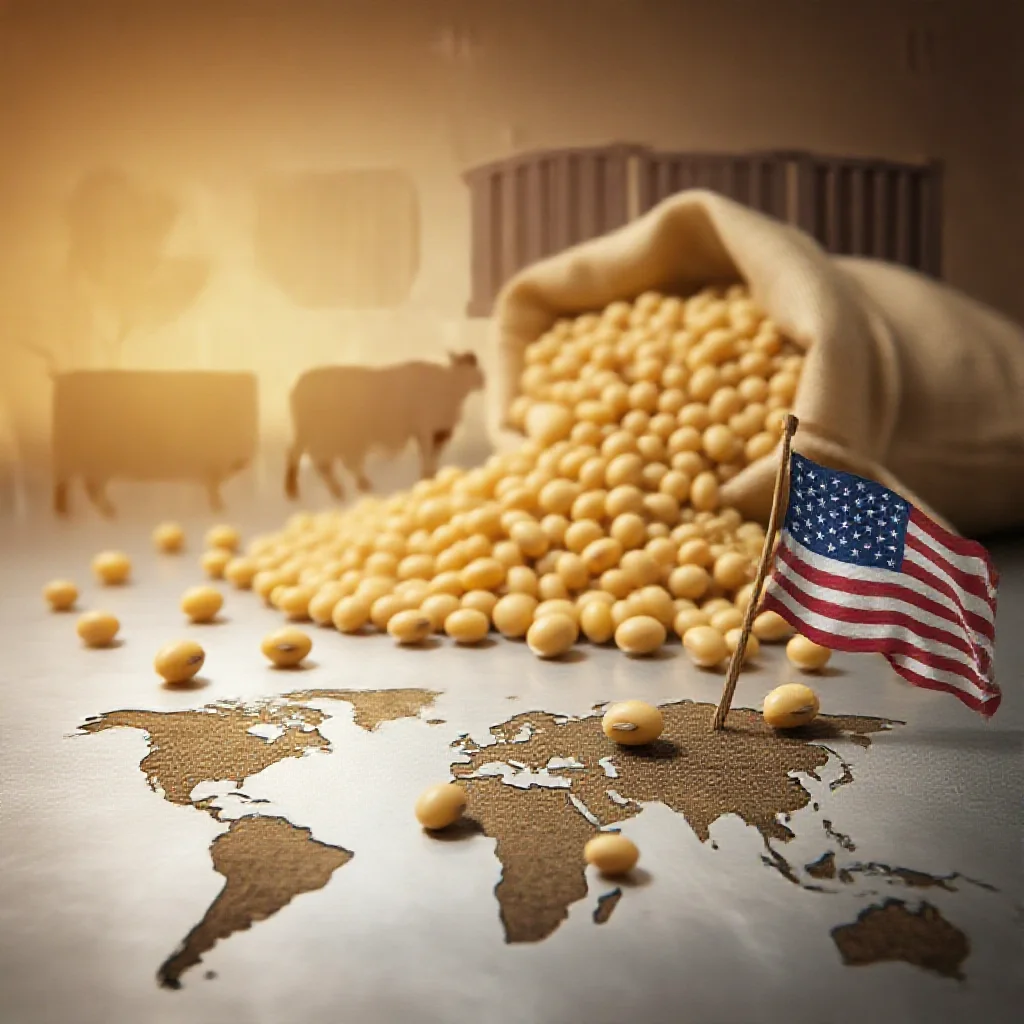
The USDA's recent $14 million allocation to USSEC and ASA/WISHH for U.S.
Beyond the $14 Million: How USDA's Soy Funding Reveals a Strategic Shift in Global Agricultural Trade
The Announcement Decoded: More Than Just $14 Million
On April 17, 2026, the United States Department of Agriculture (USDA) announced the allocation of $14 million in trade development funding to promote global exports of U.S. soy (Source 1: [Primary Data]). The capital is designated for a joint initiative between the U.S. Soybean Export Council (USSEC) and the American Soybean Association’s World Initiative for Soy in Human Health (ASA/WISHH). This funding event, while a routine component of the USDA’s annual trade promotion budget through its Foreign Agricultural Service (FAS), signifies a deliberate operational consolidation. The partnership merges USSEC’s high-level market access and branding work with ASA/WISHH’s on-the-ground technical assistance programs. Initial verification of the allocation confirms its placement within the FAS’s Market Access Program (MAP) and Foreign Market Development (FMD) program frameworks, which have historically directed billions toward agricultural export growth.
Image Suggestion: An infographic comparing this $14M allocation to past USDA agricultural trade promotion funding.
The Hidden Economic Logic: From Market Access to Demand Creation
The strategic pivot embedded within this funding is its target orientation. Analysis indicates a move away from a primary focus on defending mature markets, such as the European Union or China, toward cultivating nascent demand in developing economies across Southeast Asia, Africa, and Latin America. The economic logic is one of demand creation rather than simple market access. ASA/WISHH’s core methodology involves building the foundational capacity of foreign livestock and aquaculture sectors through technical training, feed formulation assistance, and value-chain development. This approach creates structural, long-term demand for U.S. soy as a critical feed input. The public funding serves to de-risk entry into these high-growth-potential but commercially unstable markets, enabling U.S. industry stakeholders to establish a presence before large-scale commercial demand fully materializes.
Image Suggestion: A world map highlighting traditional vs. emerging target markets for U.S. soy exports.
Supply Chain Implications: Securing the Future Pipeline
This funding mechanism is designed to wire U.S. soy into the foundational protein supply chains of developing nations at an early stage. The long-term implication is the creation of preferential trade relationships and ingrained specifications that can withstand future price volatility or intensified competition from South American producers like Brazil and Argentina. By influencing feed mill formulations and livestock production standards today, the initiative seeks to lock in a preference for U.S. soy characteristics—often marketed around consistency, quality, and sustainability—for decades. For the U.S. agricultural supply chain, from farmers to elevators to exporters, this represents a strategic investment in demand portfolio diversification. It provides a hedge against over-reliance on any single, potentially volatile, export destination and plans for demand growth aligned with global population and protein consumption trends.
Image Suggestion: A flowchart showing the connection between USDA funding, foreign livestock industry development, and sustained U.S. soy exports.
The Geopolitics of Protein: Trade Policy as Food Security Strategy
The allocation operates within the broader context of trade policy as a tool of food security strategy and soft-power influence. By supporting the development of foreign protein sectors, the U.S. positions itself as a reliable partner in economic development and a stable supplier of critical agricultural inputs. This enhances U.S. influence through technical partnership and supply chain interdependence. Concurrently, USSEC’s parallel work promotes U.S. sustainability and quality standards as a key value proposition, directly countering competitor narratives. This dual-track approach—building capacity while promoting standards—frames agricultural exports within geopolitical competition. Reports from entities like the Congressional Research Service have previously documented the role of agricultural reliability in U.S. foreign policy, a framework within which this soy funding is situated.
Image Suggestion: A diplomatic-style handshake between U.S. and foreign agricultural officials, with soy plants in the background.
A Model Under Scrutiny: Efficacy and Accountability
The public-private partnership model exemplified by this funding—where federal resources amplify the efforts of commodity checkoff-funded organizations like USSEC—remains subject to ongoing scrutiny regarding efficacy and accountability. Metrics for success extend beyond immediate export tonnage to longer-term indicators such as the establishment of U.S. soy-specific import standards in new markets, the growth rate of partner countries’ livestock sectors, and the sustained market share held by U.S. origin soy amid competition. The strategic bet is that near-term public investment will yield disproportionate long-term private returns and fortified market position. The model’s continuation depends on demonstrable returns on investment and its alignment with overarching U.S. trade and diplomatic objectives.
Neutral Market and Industry Predictions
Based on the strategic direction indicated by this funding allocation, several trends are likely to intensify. Competitive pressures from South America will necessitate an increased focus on value-differentiation strategies beyond price, particularly around sustainability credentials and supply chain traceability. Future USDA trade promotion allocations may see a greater proportion directed toward similar technical capacity-building programs in other commodity sectors. The focus on developing economies will require the U.S. agricultural export apparatus to develop deeper expertise in navigating non-traditional market risks, including political instability and infrastructure deficits. The success of this $14 million initiative will be measured not by its immediate fiscal value, but by its role in catalyzing a structural shift in global demand patterns for U.S. agricultural products.