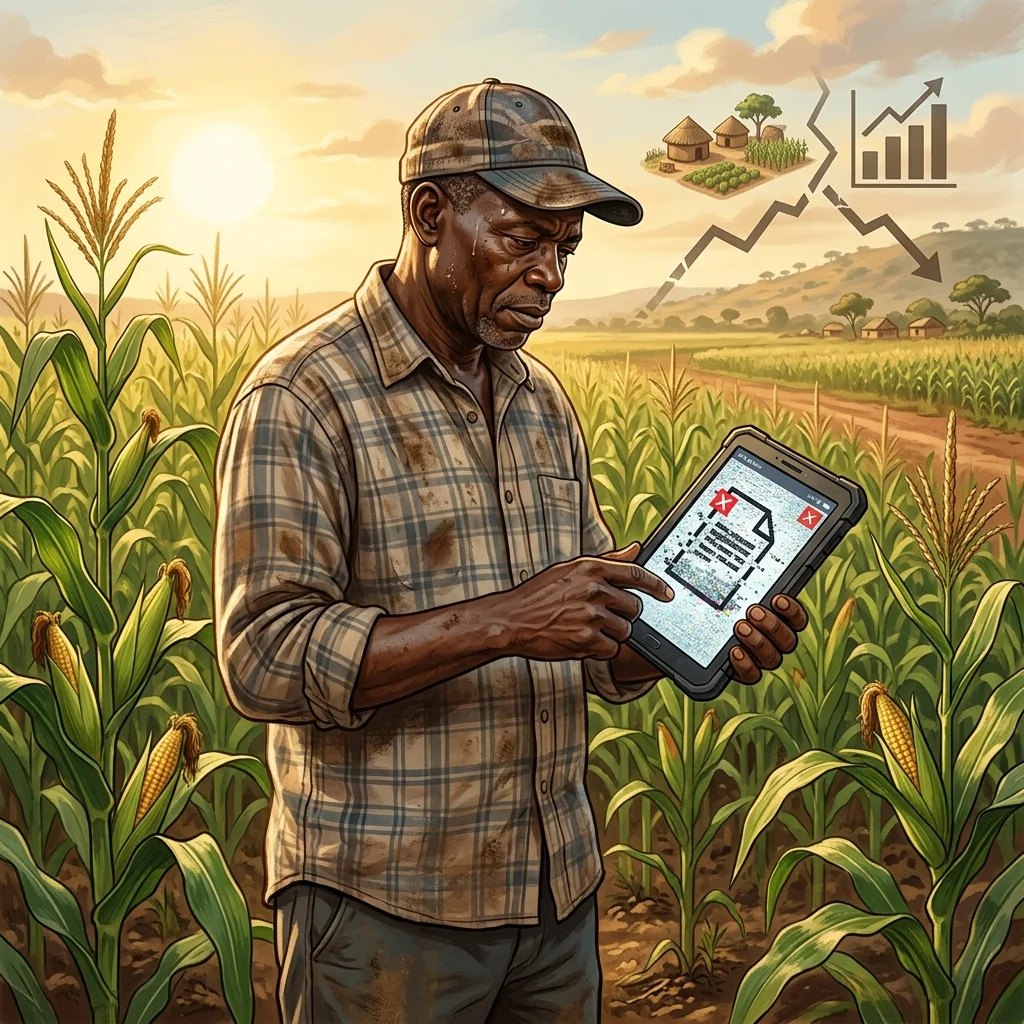
Despite vast agricultural potential, Africa struggles to attract the investment
Africa's $300 Billion Agricultural Opportunity Hides Behind a Wall of Unreadable Data
Despite holding 60% of the world's uncultivated arable land, Africa receives less than 10% of global agricultural investment. The culprit isn't just policy or infrastructure—it's buried in millions of unreadable PDFs, scanned reports, and proprietary formats that investors simply cannot process.
[IMAGE: A collage of a lush African farm next to a blurry, pixelated document showing garbled text, symbolizing data vs. reality.]
Introduction: The Missing Link in Africa’s Agricultural Promise
Africa holds 60% of the world’s uncultivated arable land, yet receives only a fraction of global agricultural investment. Every year, development banks, impact funds, and agri-tech startups pour billions into feasibility studies, yet the continent still struggles to attract the capital its agricultural sector desperately needs. Analysts often cite political instability, weak infrastructure, and fragmented supply chains as primary barriers. But a largely overlooked factor is the state of agricultural data itself—often locked in unreadable PDFs, scanned documents, and proprietary formats that make automated analysis impossible.
This article explores how "unreadable content" acts as an invisible tax on investment, limiting capital flow to a sector that could feed billions. From land deeds stored as binary files to crop surveys trapped in non-extractable PDFs, the problem is systemic and costly. For development agencies, agri-tech startups, and impact investors, cleaning up data is the first step toward unlocking Africa's agricultural riches.
Section 1: The Data Dilemma – Why Binary PDFs Are a Barrier
Many agricultural records in Africa are stored as non-extractable PDFs—land deeds, crop surveys, government reports—files that contain raw binary data with no extractable text. When an investor opens one of these files, they see what looks like a document, but the computer sees only a collection of pixels. Automated analysis, keyword searching, and data aggregation become impossible. Analysts must either manually re-enter the information or, more commonly, skip it entirely.
This is not just a technical annoyance. It creates severe information asymmetry. A potential investor trying to verify soil quality maps or historical yield trends for a proposed cocoa farm in Côte d’Ivoire may find that the only available records are scanned PDFs from the 1990s, with no machine-readable metadata. The due diligence process grinds to a halt. The cost of verifying even basic facts skyrockets. In many cases, investors simply move on to regions with cleaner data—often outside Africa.
The problem extends beyond land records. Supply chain documents—certificates of origin, phytosanitary reports, warehouse receipts—are frequently stored as image-based PDFs or proprietary formats from legacy software. When a buyer needs to trace a shipment of Ethiopian coffee from farm to port, the relevant documents may be scattered across different government agencies, each using a different non-extractable format. The result is a fragmented information environment where no one can see the full picture.
[IMAGE: A screenshot of a computer screen showing a corrupted PDF error, with a map of Africa faintly in the background.]
The economic logic behind data accessibility is straightforward: machine-readable data lowers transaction costs. When data is structured and extractable, algorithms can process it in milliseconds. Risk assessment, due diligence, and supply chain financing become faster and cheaper. When data is trapped in binary PDFs, every transaction requires human intervention, introducing delays and errors. This is the invisible barrier that stalls agricultural investment in Africa.
Section 2: The Investment Blind Spot – Hidden Costs of Poor Data
Investors in African agri-commodities—cocoa, coffee, cashews, maize, and sesame—consistently rate data transparency as a top risk factor. In a 2023 survey by the African Development Bank, over 70% of agri-investors said they had abandoned at least one potential deal because they could not obtain reliable, machine-readable data about the target farm or cooperative.
Unreadable data increases the cost of capital. When due diligence becomes slower and less certain, funds demand higher returns to compensate for opacity. A project in Ghana with machine-readable land records and digitized yield data can attract financing at interest rates 200–300 basis points lower than an otherwise identical project using paper-based or non-extractable records. That difference can make or break a smallholder cooperative’s ability to invest in irrigation, storage, or transport.
Case studies from Ethiopia and Ghana illustrate the point. In Ethiopia’s coffee sector, the government’s decision to digitize land tenure records into structured, machine-readable formats in 2019 led to a 30% increase in certified organic investment within two years. Investors could quickly verify plot boundaries, ownership history, and crop types. In contrast, Ghana’s cocoa sector, where many land records remain as scanned PDFs stored in district offices, has seen flat investment despite high global demand for sustainable cocoa.
[IMAGE: A simple infographic showing a bar chart comparing investment levels in regions with structured vs. unstructured data.]
The economic logic is clear: clean data enables smarter supply chain financing. When lenders can access real-time, extractable data on crop yields, inventory levels, and purchase orders, they can offer invoice factoring, warehouse receipt financing, and other short-term credit products. Without that data, they default to high-interest unsecured loans—or no loans at all. For smallholder farmers, who typically operate on thin margins, the lack of affordable credit perpetuates a cycle of low productivity and low income.
The problem is not limited to land and yield data. Market price information is another critical dataset that is often inaccessible. Many African commodity exchanges publish daily price reports as PDFs on their websites. While these files look official, they cannot be automatically ingested into trading algorithms or supply chain management software. Traders must manually transcribe prices, introducing errors and delays. This information asymmetry hurts African farmers most—they often have the least ability to access and process unreadable data.
Section 3: Long-Term Impact on Supply Chains and Resilience
Supply chains depend on real-time data for inventory, logistics, and traceability. Unreadable content creates bottlenecks at every stage. A logistics company trying to optimize truck routes across Zambia may need to combine data from multiple sources: crop forecasts (PDF), road condition reports (scanned images), and warehouse capacity (proprietary database). Each format barrier adds days to the planning process.
Without extractable data, it is difficult to build the digital infrastructure that enables climate-resilient agriculture. Weather stations across Africa collect valuable data, but many transmit their readings in non-standard formats or as image-based reports. When a drought hits East Africa, relief agencies and insurers cannot quickly aggregate weather data to trigger early warning systems or index-based insurance payouts. The human cost is measured in lost harvests, bankrupt farms, and food insecurity.
[IMAGE: A simple flowchart showing how unreadable data creates bottlenecks between farmer, aggregator, logistics provider, and investor, with broken arrows.]
Traceability—a prerequisite for premium certification like Fair Trade, Rainforest Alliance, or organic—depends entirely on machine-readable data. Buyers in Europe and North America require verifiable, digital records of every step in the supply chain. When African producers cannot provide those records in an automated format, they lose access to high-margin markets. The cost of manual traceability is prohibitive for most smallholders, locking them into lower-paying commodity channels.
The long-term impact on Africa’s agricultural resilience is profound. Climate change is already shifting growing zones, altering pest patterns, and increasing weather volatility. Farmers and policymakers need to analyze decades of historical data to adapt planting strategies, invest in drought-resistant varieties, and plan infrastructure. But if that historical data is trapped in non-extractable formats, the learning curve becomes impossibly steep. Africa risks making adaptation decisions based on incomplete or outdated information.
Section 4: Breaking the Barrier – From Binary PDFs to Actionable Insights
The path forward requires coordinated action across multiple fronts. First, governments and development agencies must adopt and enforce digital data standards. The FAO’s Statistical Data and Metadata Exchange (SDMX) and the International Aid Transparency Initiative (IATI) provide proven frameworks for structuring agricultural data. Regulators should mandate that all land deeds, crop surveys, and trade certificates be published in machine-readable formats (CSV, JSON, XML, or at minimum, text-based PDF with searchable layers).
Second, technology can play a critical role. AI-driven text extraction and optical character recognition (OCR) tools have improved dramatically. Modern OCR can convert scanned PDFs into structured data with over 99% accuracy for typed documents. Agri-tech startups and development programs should invest in batch-converting legacy records. Services like Google’s Document AI, Amazon Textract, and open-source Tesseract are affordable and scalable.
[IMAGE: A before-and-after illustration showing a messy scanned PDF on the left and a clean, organized spreadsheet on the right, with an arrow labeled "AI-powered extraction" in between.]
Third, investors and lenders should build data quality into their due diligence scorecards. When evaluating an agricultural project in Africa, they should ask: Are the underlying records machine-readable? Can we automate the verification process? If not, the investment should carry a higher risk premium, reflecting the hidden cost of unreadable data. This market signal will incentivize data owners to clean up their records.
Fourth, supply chain participants must collaborate on shared data standards. Industry bodies like the African Cashew Alliance, the Cocoa Association of Africa, and national coffee boards can create data templates that all members agree to use. When data flows uniformly across the supply chain, from farm to export, the entire ecosystem becomes more transparent and investible.
Finally, capacity building is essential. Many smallholder cooperatives and government agencies lack the technical skills to digitize their records. Training programs, funded by development banks, should teach basic data management, including how to create machine-readable PDFs, how to use cloud-based storage, and how to share data via APIs. These skills are not expensive to develop, but their impact on investment flows can be transformative.
Conclusion: The First Step Toward Unlocking Africa’s Agricultural Riches
Unreadable data is a silent saboteur of agricultural investment in Africa. It inflates due diligence costs, increases risk premiums, and creates blind spots that keep capital away from the farms, cooperatives, and supply chains that need it most. The scale of the opportunity is staggering—hundreds of billions of dollars in underutilized land, growing global demand for food, and a young, entrepreneurial population ready to innovate. But none of that potential can be realized if the information foundation is cracked.
[IMAGE: A hopeful image of a farmer using a tablet in a green field, with a clear data dashboard visible on the screen showing crop metrics and financial charts.]
The solutions are within reach. Digital standards, AI-driven extraction, collaborative industry platforms, and targeted capacity building can transform Africa’s agricultural data landscape within a decade. The cost of inaction is not just missed investment—it is continued poverty, food insecurity, and vulnerability to climate shocks. For development agencies, agri-tech startups, and impact investors, cleaning up data is the first step toward unlocking Africa's agricultural riches. The invisible barrier can be dismantled—one machine-readable file at a time.
---
This article is part of a series on digital transformation and agricultural investment in emerging markets.