The food and agribusiness sector is undergoing a radical transformation driven
How Retailer Private Label Strategies Are Reshaping Food Innovation: Trends for 2024 and Beyond
Summary: The food and agribusiness sector is undergoing a radical transformation driven by precision agriculture, vertical farming, alternative proteins, and AI-driven innovation. At the same time, retailers are rethinking private label strategies—moving beyond cost-cutting to become vehicles for premium, sustainable, and tech-enabled products. Natural Grocers' launch of a smoked salmon product under its own label exemplifies this shift, challenging traditional CPG brands and reshaping supply chains. This article explores the hidden economic logic behind the convergence of agri-tech and private label branding, offering a deep audit of market dynamics, industry developments, and future implications for retailers, producers, and consumers.
---
Introduction: The New Face of Private Labels
For decades, private label products occupied the lowest shelf position in grocery stores—functional, low-cost alternatives to national brands, often packaged in plain white boxes with minimal design. Consumers bought them to save money, not to experience innovation. That era is ending.
Today, retailers across the United States and Europe are repositioning their store brands as hubs of premium quality, sustainability, and technological sophistication. The strategic pivot is unmistakable: private labels are no longer just cheap substitutes; they are becoming innovation laboratories that compete directly with legacy CPG giants.
[IMAGE: Split image showing on the left side an old generic private label package (white box, no logo, simple text) and on the right side a modern premium private label package with sleek design, metallic accents, and a "sustainably sourced" badge, alongside a subtle digital data overlay.]
A concrete example emerged in February 2025, when Natural Grocers, a U.S.-based health-focused retailer, launched its own smoked salmon product under its private label banner. The move, highlighted by Agribusiness Academy, signals more than a simple SKU expansion—it represents a deliberate strategy to enter high-margin, high-quality perishable categories traditionally dominated by CPG powerhouses like StarKist, Bumble Bee, or premium brands such as Ducktrap.
This shift is not happening in isolation. It is being powered by a convergence of agricultural technology trends—precision agriculture, vertical farming, alternative proteins, and artificial intelligence—that give retailers the toolkit to source, produce, and market products with unprecedented control over quality, traceability, and sustainability. The result: a fundamental reshaping of the competitive landscape in food retail.
---
The Four Pillars of Agri-Food Transformation Driving Private Label Innovation
1. Precision Agriculture: Traceability Becomes a Brand Asset
Precision agriculture—using satellites, IoT sensors, drones, and data analytics to optimize crop management—is enabling retailers to source raw ingredients with documented provenance. When a retailer can trace a salmon fillet back to a specific farm that uses low-density pens, antibiotic-free feed, and real-time water quality monitoring, that story becomes a powerful brand differentiator.
Private label products can now claim “traceable from farm to shelf” not as a marketing gimmick but as a verifiable reality. This allows retailers to command premium pricing and build consumer trust, especially among health-conscious and environmentally aware shoppers. For a retailer like Natural Grocers, whose entire brand identity rests on natural and organic standards, precision agriculture data provides the evidence needed to back up those claims.
2. Vertical Farming: Local, Year-Round, and Supply Chain Resilient
Vertical farming—growing crops in stacked, indoor, controlled environments—has matured from a niche experiment into a commercially viable source of fresh produce. Retailers are increasingly partnering with or acquiring vertical farms to supply their private label salad greens, herbs, and microgreens.
The advantage for private labels is threefold: year-round availability reduces seasonal gaps; local production slashes transportation costs and carbon footprint; and controlled environments eliminate pesticide use and ensure consistent quality. Retailers like Whole Foods and Kroger have already integrated vertical farm suppliers into their private label lines. This model gives retailers direct control over the supply chain, bypassing traditional commodity markets and the volatility they bring.
[IMAGE: Infographic showing four icons—a satellite for precision ag, a vertical farm tower, a petri dish with plant cells for alternative proteins, and a neural network symbol for AI—all connected by arrows to a central "Private Label" badge with a premium-looking shield.]
3. Alternative Proteins: New Categories for Retailers to Own
The alternative protein revolution—plant-based, cultivated, and fermentation-derived products—is creating entirely new food categories that have no entrenched CPG incumbents. This is a golden opportunity for retailers to establish private label dominance from the start.
Retailers are launching private label plant-based burgers, milks, and yogurts that compete directly with Beyond Meat or Oatly, but with better margins and greater control over ingredients. The next frontier is alternative seafood: plant-based tuna, salmon, and shrimp. Natural Grocers' smoked salmon launch, while still made from real fish, could be seen as a precursor to a future where the retailer develops its own plant-based or cell-cultured smoked salmon under the same private label umbrella. By owning these categories early, retailers can shape consumer preferences and lock in loyalty before CPG brands can respond.
4. AI-Driven Food Innovation: Speed and Personalization
Artificial intelligence is transforming every stage of food product development—from concept generation and formulation to demand forecasting and personalized nutrition. Retailers with access to massive transactional data (what their customers buy, when, and in what combinations) have a distinct advantage.
Using AI, retailers can identify underserved flavor profiles, optimize packaging sizes, predict which health claims will resonate, and even recommend recipes. Some retailers are experimenting with AI-powered private label products that adapt to regional tastes or dietary restrictions. For example, a retailer could use machine learning to formulate a private label granola bar that meets the most common allergen and nutritional preferences of its online shoppers—all without a traditional R&D department.
The convergence of these four pillars means that retailers no longer have to rely on CPG manufacturers to innovate. They can build their own pipelines, from farm to factory to shelf, and do it faster, cheaper, and more sustainably.
---
Case Study: Natural Grocers’ Smoked Salmon — A Premium Private Label Play
In early 2025, Natural Grocers launched a private label smoked salmon product, a move that may seem modest on the surface but carries significant strategic weight. Smoked salmon is a high-margin, high-perishable category with strong brand loyalty. Traditional CPG players such as StarKist (through its Bumble Bee brand) and smaller premium producers have long dominated the space.
[IMAGE: High-end product photography of Natural Grocers smoked salmon packaging on a wooden cutting board, with a fork, lemon slices, and capers, emphasizing a premium culinary aesthetic. No text overlay.]
By introducing its own version, Natural Grocers is making a calculated bet that its health-focused, environmentally conscious customer base will trust the retailer’s quality standards as much as, if not more than, a national brand. The product likely emphasizes sustainable sourcing—wild-caught Alaskan salmon or certified responsible aquaculture—and aligns with the retailer’s broader commitment to transparency.
The economic logic is straightforward: by owning the product, Natural Grocers captures the margin that would otherwise go to the CPG brand. It also controls the quality narrative: if the salmon is exceptionally fresh, sustainably caught, and free of additives, the retailer gets full credit. If something goes wrong, it owns the problem—but that risk is manageable with proper supply chain oversight.
Moreover, the launch sends a signal to CPG competitors. Retailers are no longer passive distributors; they are becoming active brand guardians. When a retailer launches a private label smoked salmon, it chips away at the shelf space, brand awareness, and customer loyalty that CPG companies have spent decades building. Over time, CPG brands may find themselves squeezed out of premium spots, relegated to price promotions while the retailer’s own brand commands the prime endcaps.
This case also reflects a broader industry pattern: retailers using private labels to pilot innovative food technologies before CPGs can react. For instance, if Natural Grocers decides to later launch a plant-based smoked salmon analog (using texture-based proteins or fermentation-derived ingredients), it already has the brand, the packaging, and the customer trust in place. CPG companies would have to start from scratch.
---
The Hidden Economic Logic: Retailers as Brand Guardians
Behind the visible product launches lies a deeper structural shift in the economics of food retail. The traditional model gave CPG brands enormous power: they controlled R&D, manufacturing, marketing, and consumer insights. Retailers were essentially landlords of shelf space, earning thin margins on distribution.
Today, technology is democratizing the means of production and information. With precision ag, vertical farming, and AI, retailers can access the same—or better—raw materials and data as CPG companies. Meanwhile, the rise of omnichannel retail, direct-to-consumer platforms, and digital marketing means that retailers can build their own brand equity without relying on national advertising.
The result is a reversal of the traditional power dynamic. Retailers are becoming brand guardians: they set the quality standards, define the sustainability criteria, and control the consumer relationship. CPG brands, in turn, are being pushed into a role of contract manufacturers or niche specialists.
This has profound implications for supply chains. Producers (farmers, fishermen, food processors) now have an alternative distribution channel that bypasses CPG intermediaries. A salmon farm in Norway can negotiate directly with a U.S. retailer like Natural Grocers, using blockchain traceability and third-party certifications to prove its credentials. The retailer then wraps that farm’s story into its private label packaging, creating a direct farm-to-shelf narrative that resonates with modern consumers.
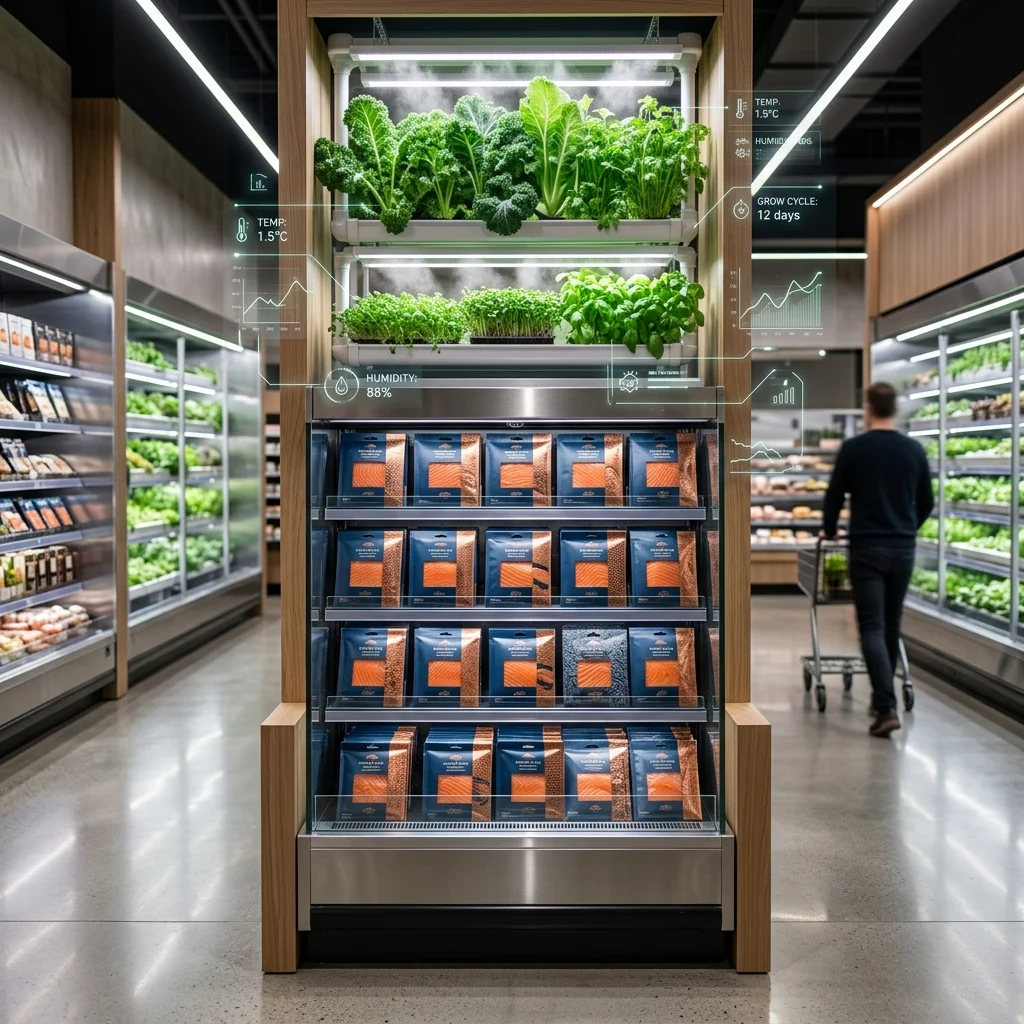
[IMAGE: Modern grocery store aisle with a prominent display of premium private label smoked salmon packaging, surrounded by subtle imagery of vertical farm greens (lettuce, basil) and digital agriculture data overlays (transparent charts, QR codes on packaging). No text, no watermark. Clean, high-end retail aesthetic with hints of technology.]
Consumers benefit from higher quality, better transparency, and often lower prices because the margin is redistributed away from CPG brand premiums. However, they also face a new challenge: the retailer now owns both the product and the shelf, which can reduce choice if private labels crowd out smaller independent brands.
Regulators are beginning to take notice. In the European Union, competition authorities are examining whether retailer-owned brands create unfair advantages, particularly when retailers use their control over shelf placement and data to favor their own labels over competitors. The U.S. Federal Trade Commission has also signaled interest.
---
What This Means for 2024 and Beyond
The convergence of agri-tech and private label strategy is set to accelerate. Here are the key trends to watch:
- Category Expansion: Retailers will move beyond traditional private label staples (milk, bread, canned goods) into high-value perishables like seafood, premium meats, fresh prepared meals, and specialty cheeses. Expect more smoked salmon, grass-fed beef, and organic ready-to-eat meals under retailer brands.
- Tech-Enabled Sourcing: Retailers will invest in direct relationships with tech-forward producers—vertical farms, cell-cultured meat startups, precision aqua-culture operations—and use blockchain or AI to prove sustainable claims on packaging.
- Personalized Private Labels: With AI and customer data, retailers will launch micro-batches of private label products tailored to local demographics or individual subscription boxes. Imagine a private label granola formulated specifically for customers in your zip code using locally sourced oats and fruit.
- CPG Response: Expect incumbent CPG companies to fight back by doubling down on innovation, acquiring agri-tech startups, or launching their own direct-to-consumer channels. Some may pivot to become “co-manufacturers” for retailer brands, accepting lower margins to maintain volume.
- Regulatory Scrutiny: As private labels grow to account for 20-30% of grocery sales in many markets, antitrust concerns will rise. Retailers will need to demonstrate that their private label strategies do not stifle competition or mislead consumers.
---
Conclusion
Natural Grocers’ smoked salmon launch is more than a new product—it is a snapshot of a food system in transition. Retailers are shedding their passive role and stepping into the spotlight as innovators, brand builders, and supply chain orchestrators. Armed with precision agriculture, vertical farming, alternative proteins, and AI, they are challenging the CPG status quo in ways that were unimaginable a decade ago.
For producers, this means new opportunities to bypass intermediaries and build direct relationships with powerful retailers. For consumers, it means more choices, better quality, and greater transparency—but also a need to remain vigilant about market concentration. For CPG companies, the message is clear: the private label revolution is no longer about cost-cutting. It is about innovation, trust, and control over the food we eat.
The future of food innovation may well be decided not in the R&D labs of multinational CPG giants, but in the private label development teams of your local grocery chain. And if Natural Grocers’ smoked salmon is any indication, that future is arriving quickly.