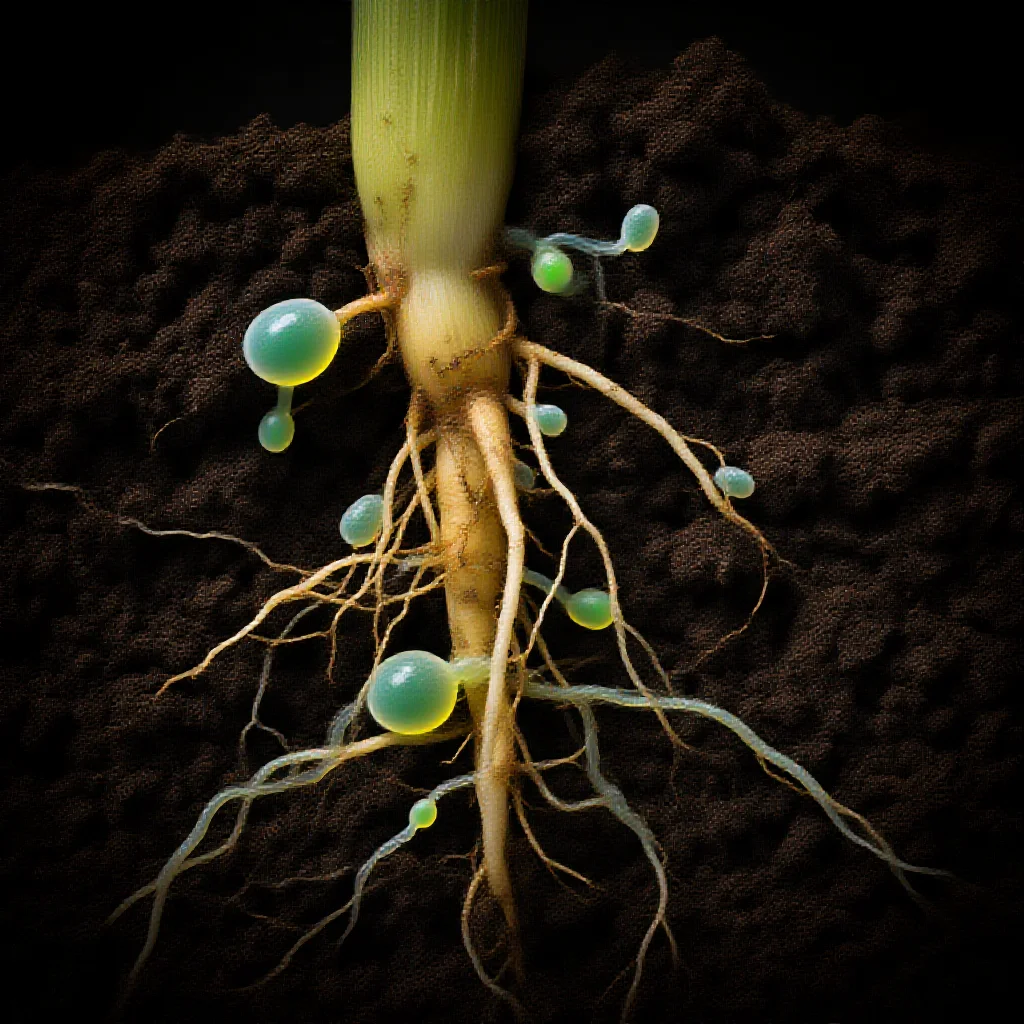
The strategic collaboration between Resurrect Bio and Corteva Agriscience,
Beyond Pesticides: How the Resurrect Bio-Corteva Alliance Signals a Microbial Revolution in Agriculture

Introduction: The Announcement and Its Surface-Level Significance
On March 25, 2025, Resurrect Bio and Corteva Agriscience announced a strategic collaboration. The stated objective is to develop novel corn traits by leveraging beneficial microbes, with a focus on unlocking natural plant defenses to enhance crop resilience and productivity. The partnership combines Resurrect Bio's proprietary microbial discovery platform with Corteva's seed technology and global commercial capabilities. This alliance represents a significant, high-profile event within the agricultural technology sector, signaling a concerted move by a major industry incumbent toward a biology-first research and development paradigm.
!Logos of Resurrect Bio and Corteva Agriscience side by side on a neutral background.

The Core Axis: The Economic Logic of the 'Microbiome Economy'
This collaboration is not merely a licensing agreement; it is a strategic bet on biology as the next foundational platform for agricultural value creation. The economic logic underpinning the deal signifies a pivot in R&D investment priorities. For decades, agricultural innovation has been dominated by chemical synthesis and direct genetic modification of plants. This partnership explicitly channels resources toward discovering and harnessing natural microbial consortia. The shift moves value creation from the factory—producing synthetic pesticides and fertilizers—to the field and the laboratory, where microbial ecosystems are mapped, understood, and engineered for function.
This pattern is part of a broader market trend where established agribusiness entities partner with agile biotechnology startups. Such alliances allow incumbents like Corteva to de-risk innovation by accessing novel, high-throughput discovery platforms without bearing the full burden of foundational science development. Conversely, platform companies like Resurrect Bio gain access to global distribution networks and deep agronomic expertise, accelerating the path from discovery to commercial-scale application.
Dual-Track Analysis: A 'Slow Analysis' Case for Industry Transformation
The announcement, while timely, lacks immediate, market-moving data points such as specific trait efficacy or projected commercial timelines. This absence makes the event a prime subject for a "slow analysis" audit of long-term industry transformation. The strategic play extends beyond a single product pipeline; it concerns the gradual alteration of Corteva's core product portfolio and competitive moat over the next decade.
Evidence for this transformative trajectory is found in broader industry movements. The agricultural microbials market is projected to grow significantly, with credible reports indicating a compound annual growth rate exceeding 14% from 2023 to 2030, driven by demand for sustainable solutions (Source 1: [Market Research Firm Data]). This trend is validated by analogous partnerships, such as Bayer AG's collaboration with Ginkgo Bioworks on nitrogen-fixing microbes and Syngenta's work with Biome Makers on soil health diagnostics. The Resurrect Bio-Corteva deal is a direct participant in this validated trend, reinforcing the microbial approach as a central pillar of future agricultural R&D.
Deep Entry Point: Reshaping the Underlying Agricultural Supply Chain
The most profound implication of this collaboration may not be confined to the seed bag. Its potential lies in reshaping the underlying agricultural input supply chain. The successful development and widespread adoption of microbial traits that enhance nutrient use efficiency or confer biotic stress resistance would directly reduce demand for certain synthetic fertilizers, insecticides, and fungicides.
This shift would disrupt established chemical synthesis and logistics chains. Value could gradually transfer from traditional chemical manufacturing segments to the owners of biological discovery platforms and the licensors of seed-embedded microbial traits. The industry's profit pools would consequently be altered, diminishing the economic weight of pure-play chemical production in favor of biological intellectual property and integrated seed-microbe systems. This represents a fundamental reallocation of power and capital within the agricultural input sector.
Technological Convergence: Platform + Distribution as the New Model
The alliance exemplifies a model of technological convergence essential for commercializing complex biological innovations. Resurrect Bio provides the discovery engine—a platform capable of identifying, isolating, and characterizing microbial strains with desired functionalities. Corteva contributes the integration and distribution vehicle—the seed technology to reliably deliver these microbes, the agronomic data to validate their performance, and the global commercial machinery to scale them.
This model addresses the historical challenge of microbial agriculture: consistency and delivery. A microbe discovered in a lab is of limited value unless it can be formulated, applied, and shown to perform reliably across diverse geographies and soil types. The convergence of a specialized discovery platform with an integrated seed company's capabilities creates a more viable pathway from discovery to field impact than either entity could achieve independently.
Conclusion: Neutral Projections on Market and Industry Trajectory
Based on the strategic alignment and industry context, several neutral projections can be made. First, the agricultural inputs market will see an accelerated blending of biological and chemical product portfolios, with integrated solutions becoming a competitive norm. Second, the valuation of microbial discovery platforms will continue to rise, prompting further mergers, acquisitions, and partnerships as incumbents seek to secure technological moats. Third, while synthetic inputs will remain critical for the foreseeable future, their growth trajectory will flatten in specific segments as effective microbial alternatives achieve commercial scale.
The Resurrect Bio-Corteva collaboration is a definitive marker on the road to this future. It is a transaction that validates the economic viability of the microbiome economy and sets in motion a long-term, structural evolution of how crop resilience is engineered and sold. The ultimate measure of success will be the degree to which it reduces the agricultural sector's operational dependency on synthetic chemistry, thereby altering the fundamental architecture of global food production.