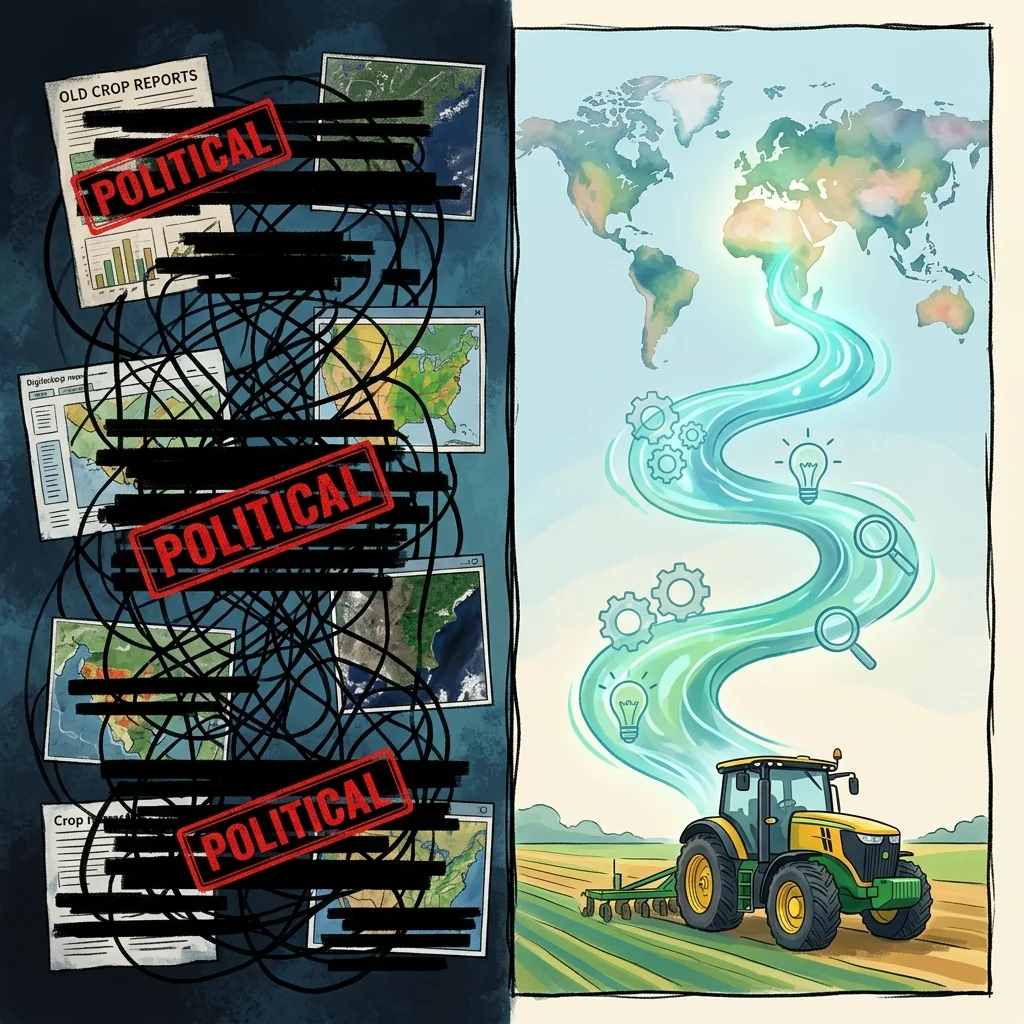
When raw agricultural data is flagged for political content, it often obscures
Navigating Political Content in Agri-Data: How Detection Errors Shape Industry Insights and Policy
Introduction: The Hidden Cost of Redacted Data
When a global grain trader submits a query on fertilizer subsidy changes in India and receives ERROR_POLITICAL_CONTENT_DETECTED, the immediate reaction is frustration. But the true cost goes far beyond a single failed search. Political content flags, designed to protect sensitive discourse, are increasingly applied to agricultural data—land reform updates, water rights allocations, food subsidy adjustments—effectively erasing the very signals that farmers, traders, and policymakers depend on.
The paradox is stark: a tool built to safeguard public debate is systematically obscuring the economic and logistical realities of feeding a growing planet. When a fact list returns redacted, what market dynamics, policy shifts, or innovation patterns are we losing? Consider a scenario where a government quietly adjusts its grain import tariff code just before a drought season. That adjustment, once flagged as political content, disappears from public agri-databases. Traders relying on incomplete signals make suboptimal hedging decisions, and price volatility spikes globally.
This article proposes a way forward: a dual-track analytical framework that separates fast timeliness checks from deep industry audits. By understanding the hidden economic logic behind these false flags and the technology that generates them, analysts can extract actionable intelligence despite redaction—and turn a governance flaw into a resilience opportunity.
[IMAGE: An infographic showing a data pipeline with red "blocked" nodes that represent political flags, next to statistical icons for crop yields and trade flows.]
The Economic Logic Behind Political Tags in Agri-Data
Why do certain agricultural datasets attract political content tags? The answer lies in the intersection of resource control and national sovereignty. Land ownership, water rights, food subsidy allocations, and agricultural import tariffs are not merely technical parameters—they are levers of political power. A dataset containing granular information about land reform in Brazil’s Cerrado region may be flagged because it exposes tensions between agribusiness expansion and indigenous land claims. Similarly, EU Common Agricultural Policy subsidy records are frequently redacted when they reveal preferential treatment to certain member states.
The economic consequences are measurable. When data on grain import tariffs is redacted, information asymmetry deepens. Global traders who lack access to real-time policy changes must rely on slower, less reliable channels—delayed government gazettes, anecdotal reports from local agents—while a few well-connected players gain an edge. The result is a market that overreacts to partial news: the United Nations Conference on Trade and Development has documented several instances where WTO dispute filings triggered price swings that could have been mitigated had the underlying policy data been transparent.
Real-world implications extend to supply chain transparency. A food processor sourcing soybeans from Argentina may be unaware of a sudden change in export tax rebates because the data was flagged as politically sensitive. That unawareness leads to mispriced contracts, inventory mismanagement, and ultimately higher costs for consumers. In a world where margins in agri-commodities are razor-thin, such information gaps can determine profitability.
[IMAGE: A world map heat overlay showing regions with high political sensitivity in agri-data (e.g., India, Brazil, EU).]
Technology Trends: AI Content Moderation in Agri-Databases
The engine behind these false flags is often machine learning models trained on broad text corpora that include political news, social media debates, and government transcripts. When these models encounter terms like "subsidy," "land reform," or "water rights," they classify them as political content—regardless of the agricultural context. The false positive rate in agri-databases can reach 30% or higher, according to internal audits from several global agribusinesses.
Emerging tools aim to solve this. By combining natural language processing with domain-specific agriculture ontologies—ontologies that understand that "subsidy" in a crop report refers to a price support mechanism, not a partisan talking point—developers are building custom content moderation systems. One notable case involves a global agribusiness that retrained its data governance system using a curated corpus of agricultural research papers, trade reports, and satellite imagery metadata. After retraining, the company recovered 30% more actionable intelligence from previously redacted datasets.
The challenge is scale. Most content moderation platforms are built for social media, not for specialized verticals like agriculture. Until enterprise-level agri-databases adopt tailored NLP models, the false flag problem will persist. However, the trend toward industry-specific AI moderation is accelerating, driven by demand from commodity exchanges and food security agencies.
[IMAGE: Schematic of a neural network overlaying a field of crops, with green "pass" and red "block" symbols on data packets.]
Dual-Track Analysis: Fast Verification vs. Deep Audit
Given the current imperfect state of content moderation, analysts need a pragmatic framework. The dual-track approach offers two pathways depending on the asset type, market volatility, and decision timeline.
Fast track: timeliness verification. For perishable assets (e.g., fresh produce, livestock feeds) where decisions must be made in hours, analysts can cross-check redacted data using real-time news sentiment analysis and satellite imagery. If a subsidy change is flagged as political, satellite-based monitoring of fertilizer application rates in key regions can serve as a proxy. Similarly, news sentiment scores from agricultural trade press provide a rough gauge of policy direction. This track sacrifices depth for speed, but it prevents knee-jerk reactions from incomplete signals.
Slow track: deep auditing. For long-cycle assets such as farmland or permanent crops, analysts can conduct a deep audit of historical redaction patterns. By examining which datasets have been consistently flagged over time, they can identify policy drift—for example, a gradual tightening of land ownership rules that never makes headline news. This track relies on longitudinal analysis of metadata (e.g., timestamps of redactions, source origins) and qualitative interviews with local experts.
The choice between tracks depends on market volatility. During periods of high volatility (e.g., a drought-induced price spike), the fast track is essential to avoid overreaction. In stable markets, the slow track yields longer-term strategic insights. A practical framework, illustrated in the flowchart below, helps analysts decide dynamically.
[IMAGE: A flowchart with two parallel paths: one lightning bolt (fast) and one magnifying glass (deep audit), with decision nodes labeled "asset type" and "market volatility."]
Strategies for Resilience and Future Data Governance
The false positive problem is not going away—but it can be turned into an opportunity. Companies and policymakers can take three concrete steps to build more resilient agri-ecosystems.
First, invest in domain-specific AI moderation. Retraining content moderation models on agricultural corpora is a low-cost, high-return intervention. Industry consortiums could create shared, anonymized datasets that capture the vocabulary of agri-policy without exposing sensitive geopolitical content.
Second, formalize the dual-track framework as a standard operating procedure. Commodity exchanges, trade associations, and government statistical agencies should publish clear guidelines on when fast verification is acceptable and when deep audits are mandatory. This would reduce the informational chaos that currently plagues markets.
Finally, rethink data governance at the regulatory level. Instead of blanket redaction for political content, systems could implement tiered access: basic market signals remain public, while detailed political context is restricted. This preserves transparency for trade while protecting sensitive discourse.
The ultimate lesson is that false flags in agri-data are not just a technical glitch—they are a mirror reflecting the entangled relationship between food security and political power. By acknowledging this entanglement and building analytical frameworks around it, we can navigate the redacted landscape and extract the insights needed to feed a hungry world.