This article, published by the Brookings Institution on May 11, 2026, presents
New Brookings Mapping Reveals Critical Blind Spot: Care Services Missing from Climate Adaptation Plans
Published May 11, 2026 — A first-of-its-kind analysis of National Adaptation Plans and Nationally Determined Contributions finds that social infrastructure—childcare, healthcare, elder care—is largely ignored, undermining resilience in vulnerable regions, especially Africa.
---
The Hidden Link Between Care and Climate Adaptation
When governments draft climate adaptation strategies, they typically reach for hard infrastructure: seawalls to hold back rising tides, irrigation canals to buffer against drought, early warning systems to alert communities before a storm hits. These investments are visible, measurable, and politically appealing. But they miss a critical component of resilience—the everyday work of caring for people.
“Care services” may sound soft, but they represent a hard reality: childcare, healthcare, elder care, and the vast universe of unpaid domestic work that keeps families and communities functioning. Climate shocks do not just destroy roads and crops; they multiply care demands. A heatwave sends children and the elderly to clinics. A flood displaces families, disrupting schooling and forcing parents to scramble for temporary childcare. A prolonged drought pushes women—who globally perform three-quarters of unpaid care work—to walk farther for water, spend more hours nursing sick family members, and sacrifice time that could otherwise go to paid labor or climate-smart farming.
Yet this linkage has rarely been systematically examined in the policy documents that shape billions of dollars in climate finance. Until now.
A groundbreaking study published today by the Brookings Institution offers the first systematic mapping of how care services are—or more accurately, are not—integrated into National Adaptation Plans (NAPs) and Nationally Determined Contributions (NDCs). Authored by Kendall Trelegan, Laura Martinez, and Caren Grown, the analysis draws on a review of over 150 country submissions to the UN Framework Convention on Climate Change. Its conclusion is stark: care is a blind spot.
[IMAGE: A split image: left side showing a flooded village with a makeshift clinic; right side showing a woman balancing farm work and childcare, with an overlay of policy document snippets featuring the words "National Adaptation Plan" blurred in the background.]
---
What the Mapping Reveals: Gaps in National Adaptation Plans and NDCs
The Brookings team combed through every NAP and NDC submitted as of early 2026, searching for explicit references to care services—including terms like childcare, elder care, caregiving, unpaid care work, and community health workers. The findings are sobering.
Fewer than one in five countries mention any form of care service in their adaptation documents. When care does appear, it is often narrowly framed: maternal health in the context of heat stress during pregnancy, or post-disaster trauma counseling. Childcare as a structural enabler of women’s economic participation? Almost absent. Elder care as a growing need under climate migration? Nonexistent. The vast ecosystem of unpaid care work, which the International Labour Organization estimates accounts for 9% of global GDP when valued, is entirely invisible.
Regional disparities are glaring. Nations in South Asia and Southeast Asia, where climate vulnerability is high and care deficits are chronic, show slightly higher—but still inadequate—rates of integration. Africa, however, stands out as the region with the lowest explicit care referencing, despite being home to many of the world’s most climate-vulnerable populations and a heavy dependence on smallholder agriculture.
This is not just an accounting oversight. The gender dimension of the gap is profound. Women in African agriculture perform up to 70% of the labor in food production, yet they also bear the overwhelming share of unpaid care work. Climate-induced increases in care burdens—whether from more frequent child illnesses, the need to fetch water over longer distances, or the emotional toll of displacement—directly reduce women’s capacity to adopt climate-smart farming techniques, participate in community resource management, or engage in paid off-farm employment. When adaptation strategies ignore care, they inadvertently entrench the very vulnerabilities they aim to solve.
[IMAGE: A bar chart comparing the percentage of NAPs and NDCs that reference care services by region (Africa highlighted in red, with a value around 8%, while South Asia shows ~15% and Europe ~12%). Caption: "Only 8% of African NAPs/NDCs explicitly mention any care service, compared to a global average of 18%. Data: Brookings Institution, 2026."]
---
The Economic Case: Care as Infrastructure for Resilience
If the humanitarian argument for integrating care into climate adaptation is clear, the economic case is equally compelling. Trelegan, Martinez, and Grown argue that care services constitute social infrastructure—assets that generate returns comparable to, and sometimes exceeding, those of physical infrastructure.
Consider the evidence: A well-funded network of community health workers in drought-prone regions of Kenya reduced child mortality from diarrheal diseases by 45% during a prolonged dry spell, according to a 2024 study cited in the Brookings report. In Bangladesh, the introduction of subsidized childcare centers in cyclone-affected coastal areas allowed mothers to attend early warning training sessions and engage in disaster preparedness planning, raising household evacuation compliance by 30%. The returns on investment in care extend far beyond health: improved early childhood development boosts lifetime earnings, while reduced care burdens enable women to shift from subsistence to climate-smart commercial agriculture, increasing both household income and adaptive capacity.
The Brookings mapping identifies a handful of pioneering country examples that demonstrate the approach works. Rwanda integrates community health workers directly into its NDC implementation framework, linking them to climate-resilient agriculture extension. Nepal signals an intention to expand childcare services in areas affected by melting glaciers and landslides. But these are exceptions. The vast majority of countries treat care as a post-disaster humanitarian concern, not a preemptive adaptation investment.
The cost-effectiveness argument is sharp. Investing in care services upfront—building daycare centers in climate-vulnerable communities, training more nurses for heatwave response, subsidizing care infrastructure for women farmers—costs a fraction of the humanitarian aid bill after a disaster. A 2023 analysis by the UN Women and UNDP suggested that every dollar spent on social infrastructure for resilience saves between four and six dollars in emergency relief and lost productivity.
[IMAGE: An infographic showing a dollar sign flow: $1 invested in care services leads to $4-6 savings in disaster relief, plus icons for increased women’s labor force participation, better child health, and higher agricultural productivity.]
---
Africa Agriculture Investment and the Care Nexus
The Brookings authors place special emphasis on the implications for Africa. Agriculture is the backbone of most African economies, and climate adaptation investments on the continent are overwhelmingly directed at physical capital: irrigation systems, drought-resistant seeds, soil conservation, and market infrastructure. These are essential. But without parallel investment in care services, their effectiveness is undermined.
A female smallholder farmer in northern Ghana, for example, may receive training in new drought-tolerant cassava varieties. But if she cannot afford or access childcare, she must bring her young children to the training site, or skip the training altogether. If a heatwave strikes and her child falls ill, she abandons the farm to seek healthcare. If her aging mother-in-law, who previously helped with childcare, migrates to a city for relief work, the care gap widens further. The agricultural investment is wasted not because the seeds failed, but because the social fiber that enables productive work was neglected.
The Brookings mapping shows that Africa agriculture investment plans—including those embedded in NAPs and NDCs—rarely connect to care services. Donor-funded programs like the World Bank’s Climate-Smart Agriculture initiatives or the African Development Bank’s Technologies for African Agricultural Transformation (TAAT) do not explicitly budget for childcare, community health, or elder care. This is a missed opportunity not only for gender equity but for adaptation effectiveness.
Trelegan, Martinez, and Grown call for a paradigm shift. They argue that donors and national governments must treat care as a core component of adaptation finance, alongside water, agriculture, and infrastructure. This means setting targets for care service coverage in adaptation plans, creating dedicated budget lines, and requiring gender-responsive care assessments in all climate investment projects.
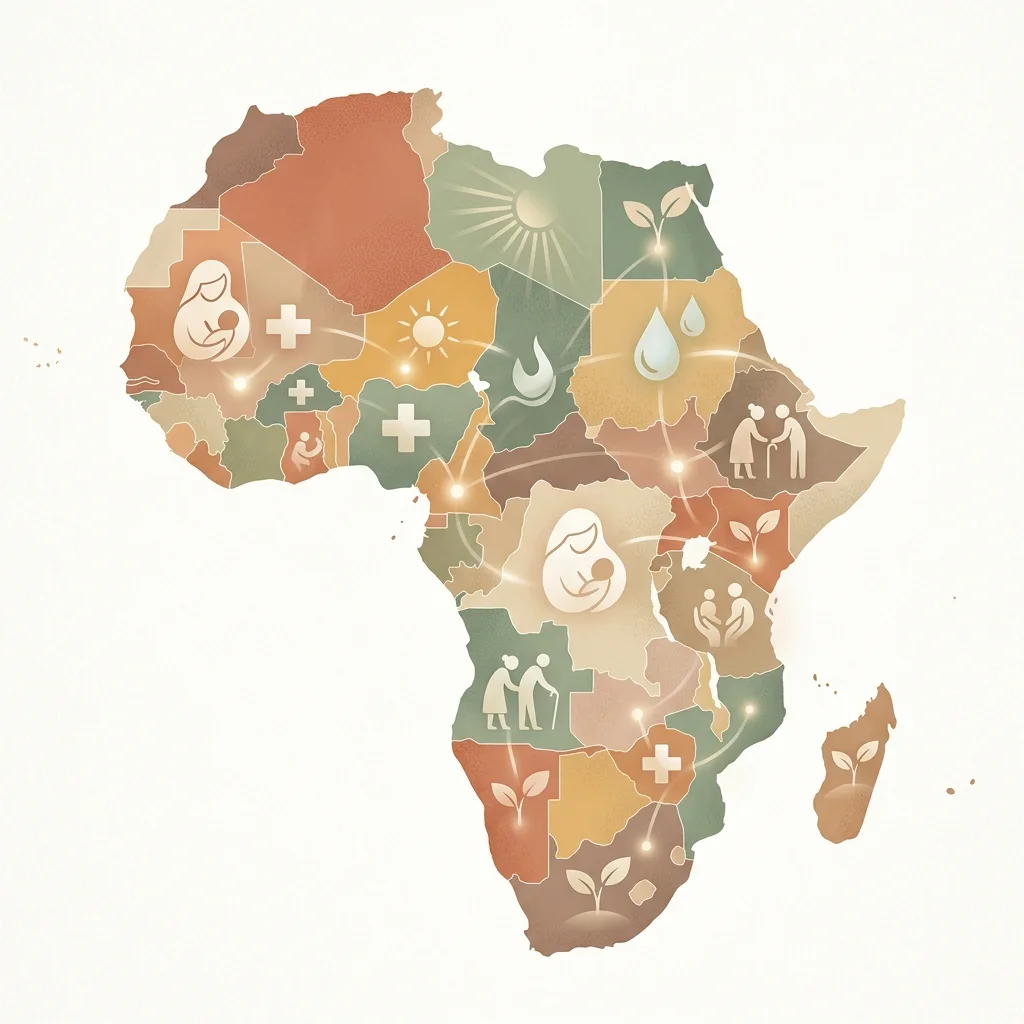
[IMAGE: A stylized map of Africa in muted earth tones, overlaid with translucent icons representing care services (a mother holding a child, a medical cross, an elderly person with a caregiver) and climate adaptation symbols (sun rays, water droplets, a sprouting plant). No text or watermarks. The composition should feel analytical and hopeful.]
---
Toward Integrated Adaptation: Practical Recommendations
The Brookings study concludes with a set of actionable recommendations for governments, donors, and multilateral climate funds.
First, require care-service checklists in NAP and NDC revisions. Just as adaptation plans assess physical infrastructure, they should evaluate the availability of childcare, healthcare, and elder care in vulnerable communities and propose targeted investments.
Second, allocate adaptation finance to social infrastructure. The Green Climate Fund, Global Environment Facility, and bilateral donors should create a dedicated window for care-centered adaptation projects, with specific metrics for gender outcomes.
Third, invest in data. The very scarcity of care references in policy documents reflects a lack of evidence on the economic returns of care in adaptation contexts. National statistical offices should track time-use data and care-service availability alongside climate vulnerability indicators.
Fourth, champion early-adopter countries. Rwanda, Kenya, and Bangladesh offer transferable lessons. Development partners should support South-South knowledge sharing on integrating care into adaptation planning.
Finally, build political will. The gender and resilience communities have long worked in parallel. The Brookings mapping provides the empirical evidence to unite them around a common agenda.
---
Conclusion: The Missing Piece in Climate Adaptation
The publication of the Trelegan, Martinez, and Grown analysis marks a turning point. For the first time, we have a systematic, cross-country map of where care services fit—and where they are lost—in national climate adaptation frameworks. The finding that only a handful of countries explicitly reference care, even as climate shocks intensify care needs, is not merely an academic observation. It is a policy failure that undermines resilience, especially for women and children in the world’s most vulnerable regions.
As climate adaptation budgets grow, the temptation to focus on concrete, steel, and seeds will remain strong. But this research shows that social infrastructure is not a luxury add-on; it is a prerequisite for human capital development, gender equity, and effective climate response. For Africa, where agriculture and resource investment are top priorities, the omission of care is particularly costly.
Investing in care services is not charity. It is a high-return strategy that strengthens the very fabric of resilient communities. The Brookings mapping makes the case undeniable. The question now is whether policymakers will see—and act on—the care gap.
---
This article is based on the Brookings Institution report “Mapping Care Services in Climate Adaptation: Why NAPs and NDCs Must Prioritize Social Infrastructure,” published May 11, 2026. Authors: Kendall Trelegan, Laura Martinez, and Caren Grown.
Keywords: climate adaptation, care services, National Adaptation Plans, Nationally Determined Contributions, gender, resilience, Africa agriculture investment, social infrastructure