In an era of data-driven agriculture and resource optimization, the prevalence
The Hidden Cost of Unreadable PDFs in Agriculture and Resource Management
Introduction: The Silent Data Blackout
Modern agriculture and resource management have become intensely data-driven. Precision farming relies on real-time sensor feeds, satellite imagery, and historical yield records. Supply chain operators depend on automated data exchanges to track shipments, verify certifications, and optimize logistics. Policymakers use aggregated statistics to allocate subsidies, monitor compliance, and forecast food security. Yet beneath this veneer of digital sophistication lies a pervasive, largely invisible bottleneck: the unreadable PDF.
These are not simply digital documents; they are scanned images of paper forms, non-searchable reproductions, and files from which no machine can extract structured text. Land deeds, crop yield reports, soil survey maps, laboratory analyses, and regulatory filings—all routinely stored as PDFs that are effectively opaque to automated systems. In agricultural and resource sectors, where information must flow seamlessly across field operations, trading desks, and government portals, these locked documents act as information silos, breaking the digital chain at critical junctures.
The problem is not trivial. A single unreadable PDF containing a certificate of origin can delay an entire container of grain at a border crossing. A folder of scanned soil test results can stall a multi-million-dollar precision fertilizer application. When these documents accumulate across thousands of farms, hundreds of suppliers, and dozens of regulatory bodies, the cumulative drag on productivity becomes enormous.
This article conducts a deep audit of the economic and operational impacts of unreadable PDFs, with a focus on agriculture, natural resources, policy compliance, and emerging technological solutions. It argues that what appears to be a minor formatting issue is, in fact, a multi-billion-dollar data quality problem—one that directly undermines the promise of digital transformation in these sectors.
[IMAGE: A split-screen showing a modern digital dashboard with real-time crop analytics on one side, and a stack of old, faded PDF file icons on the other, with a broken arrow labeled “data blocked” between them.]
The Hidden Economic Logic: Where the Value Leaks
The costs of unreadable PDFs are rarely captured in a single line item on a balance sheet. Instead, they manifest across multiple operational layers, quietly eroding margins and delaying innovation.
Cost of Manual Re-entry — The most direct and measurable expense is human labor. When a commodity trader receives a scanned PDF of a grain inspection report, someone must manually retype the data into a trading system. When a farm cooperative collects hundreds of yield reports from member farmers in non-extractable PDFs, data entry clerks must key in figures one by one. Industry estimates suggest that manual data extraction from PDFs costs agricultural businesses millions of dollars annually in wasted hours. A 2022 study by a data management consultancy found that enterprises in the agri-food sector spend, on average, 20–30% of their total data processing time on manual re-entry from unstructured documents. Beyond labor, manual entry introduces human error rates of 1–5%, which in turn trigger costly reconciliation efforts and, occasionally, regulatory fines.
Delayed Decision-Making — In agriculture and resource management, timing is everything. A commodity trader needs to act on the latest crop condition report within minutes to capture a market opportunity. A water resource manager must process soil moisture data before an irrigation scheduling window closes. When data remains trapped in unreadable PDFs, decision-makers are forced to wait—hours or even days—for manual extraction and validation. This lag translates directly into missed opportunities: suboptimal planting decisions, delayed shipments, or emergency purchases at premium prices.
Opportunity Cost of Stalled Innovation — Perhaps the most insidious cost is the one that never appears in an accounting ledger. Machine learning models for predictive agriculture—yield forecasting, pest detection, optimal harvest timing—require large volumes of clean, machine-readable training data. When historical field reports, pest survey records, and fertilizer trials exist only in non-extractable PDFs, they are invisible to these models. The entire promise of precision farming becomes hollow when the foundational data cannot be ingested. A 2021 report from the Food and Agriculture Organization (FAO) noted that “the inability to access data locked in legacy documents is one of the top three barriers to AI adoption in smallholder agriculture.”
[IMAGE: A flowchart showing a set of PDF icons entering a black box labeled "Manual Effort — hours lost, error rate 3%"; exiting the box are arrows labeled "Delayed Data (T+2 days), Error-Prone Reports" alongside a bar graph showing descending revenue due to missed market windows.]
Impact on Supply Chains and Market Dynamics
Food supply chains are complex, multi-layered networks where information must flow as reliably as physical goods. Certificates of origin, phytosanitary certificates, lab reports on pesticide residues, logistics waybills, and quality assurance documents—all these are frequently produced and exchanged as PDFs. When those PDFs are unreadable, the chain develops weak links that cause cascading failures.
Traceability Disruptions — Modern food traceability relies on the ability to seamlessly link a batch of produce back to its origin, harvest date, and treatment history. This requires machine-readable data at each node. If a certificate of origin arrives as a scanned PDF, the automated traceability system cannot parse it. The result: manual interventions, delays, and, in worst cases, a loss of traceability that forces large-scale recalls or regulatory non-compliance. In the European Union’s Farm to Fork strategy, the ability to query digital records across borders is central to food safety; unreadable PDFs undermine that vision.
Market Inefficiency and Price Volatility — Commodity markets thrive on timely, aggregated information. When regional yield reports are locked in unreadable PDFs, market participants cannot quickly build a macro-level picture. This information asymmetry leads to price volatility: traders may overpay for scarce supplies or underprice abundant ones simply because they cannot access the underlying data. For resource managers allocating water or grazing rights, similar inefficiencies arise when survey data cannot be fed into GIS systems.
Compliance Risk — Regulatory bodies such as the USDA, the European Commission’s agricultural directorates, and national resource management agencies increasingly mandate machine-readable reporting. For instance, the USDA’s crop acreage reporting system expects digital submissions in format-specific schemas. When submissions arrive as unreadable PDFs, they are rejected or flagged for manual audit, increasing the risk of penalties and delayed payments. A survey of agri-business compliance officers in 2023 found that 38% of audit failures were directly attributable to data format or extraction errors, with unreadable PDFs being the single largest contributor.
[IMAGE: A supply chain map with icons representing farms, ports, warehouses, and retail stores. Several nodes are connected by solid lines; at three critical nodes, a red lock symbol labeled "PDF Blocker" appears, accompanied by a warning sign and a text bubble saying "Delay: 48 hours" or "Manual re-entry required."]
Policy and Regulatory Implications
Governments play a dual role: they are both producers and consumers of agricultural data. They collect land records, issue permits, publish research reports, and require submissions from the private sector. Unfortunately, their own systems often perpetuate the unreadable PDF problem.
The Government Portal Paradox — Many government agencies require applicants to upload PDFs for everything from farm subsidies to environmental impact assessments. Yet these same portals rarely enforce standards for machine-readability. A farmer may scan a hand-completed form and upload it as an image PDF; the agency stores it but cannot process it. Subsequent data aggregation, analysis, or cross-referencing requires manual effort. A 2020 audit of a U.S. state’s agricultural department found that 65% of the PDFs in its land records database were non-searchable scans, effectively useless for GIS integration.
The ‘Data Paradox’ in Land Management — Property boundaries, soil surveys, water rights, and easement records are foundational to resource management. When these are trapped in unreadable PDFs, they cannot be layered into the geographic information systems that modern planners use. The result: redundant field surveys, overlapping claims, and protracted disputes. In developing nations, where parcel registries are often digitized from paper via scanning, the unreadable PDF is a major obstacle to establishing clear land tenure and enabling smallholder access to credit.
Policy Innovation Needed — The solution is not simply to ban PDFs, but to mandate standards. Governments can require that all agricultural data submissions be in OCR-ready formats (such as searchable PDF with embedded text layer) or adopt structured data schemas like JSON or XML. Crucially, metadata standards—such as including the document’s creation date, author, and a data schema identifier—can make even scanned PDFs usable if the OCR layer is present. Several countries, including Australia and Denmark, have begun implementing such mandates for their agricultural data portals, with measurable improvements in data processing time.
[IMAGE: A split-screen illustration: on the left, a government website form shows a download button labeled “Upload PDF (required)”; on the right, an infographic shows a frustrated official staring at a pile of unreadable documents. Below, a banner reads “Policy Gap: No OCR requirement → 70% of submissions are non-extractable.”]
Conclusion: Unlocking the Value Locked in Plain Sight
The hidden cost of unreadable PDFs in agriculture and resource management is not a niche IT concern. It is a systemic data quality issue that, by conservative estimates, costs the industry billions of dollars annually in lost productivity, delayed decisions, and stifled innovation. As the sector accelerates its digital transformation—embracing precision agriculture, blockchain traceability, and AI-driven analytics—the friction imposed by locked documents will only grow more acute.
Fortunately, the technology to address the problem exists and is rapidly improving. AI-driven Optical Character Recognition (OCR) systems, powered by deep learning, can now extract text from even poor-quality scans with high accuracy. Combined with metadata standards and automated validation pipelines, organizations can retrofit their existing document repositories for machine-readable access. The investment required is modest compared to the cumulative waste it eliminates.
For organizations in agriculture and resource management, the first step is an audit: how many of your critical documents—field reports, land records, lab results, certifications—are unreadable by machines? The answer may be uncomfortable, but the cost of leaving them locked is far greater. In an era where data is the new soil, every unreadable PDF is a patch of ground that remains barren.
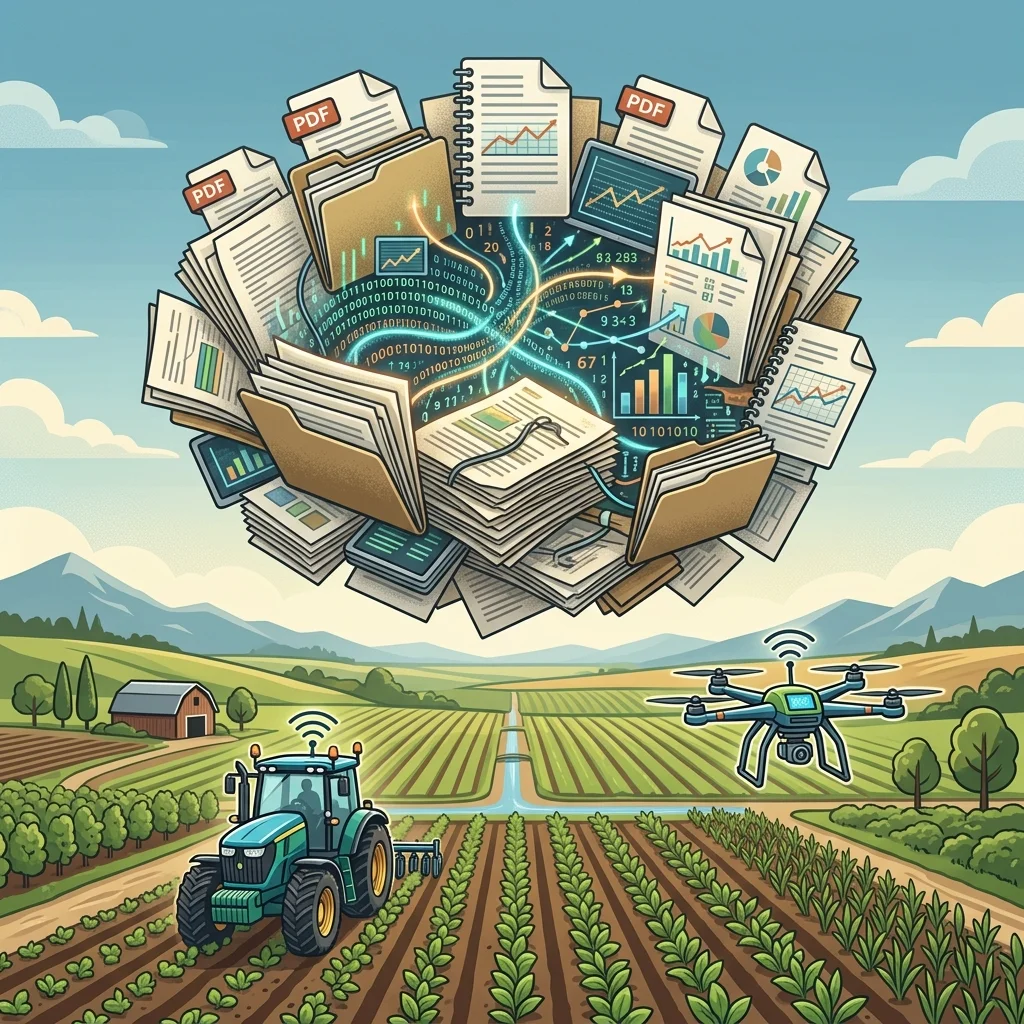
[IMAGE: An infographic-style illustration showing a pile of old paper documents and scanned PDF file icons floating above a modern agricultural field. Data streams represented by numbers and small graphs are visibly trapped inside the documents, unable to flow downward to a smart tractor and a drone below. The color palette uses earthy greens, browns, and soft blues, with no text or watermarks—clean vector art style.]