A landmark study published in Frontiers in Sustainable Food Systems claims
Mapping the Global Investment Landscape in Agricultural Research and Innovation for the Global South
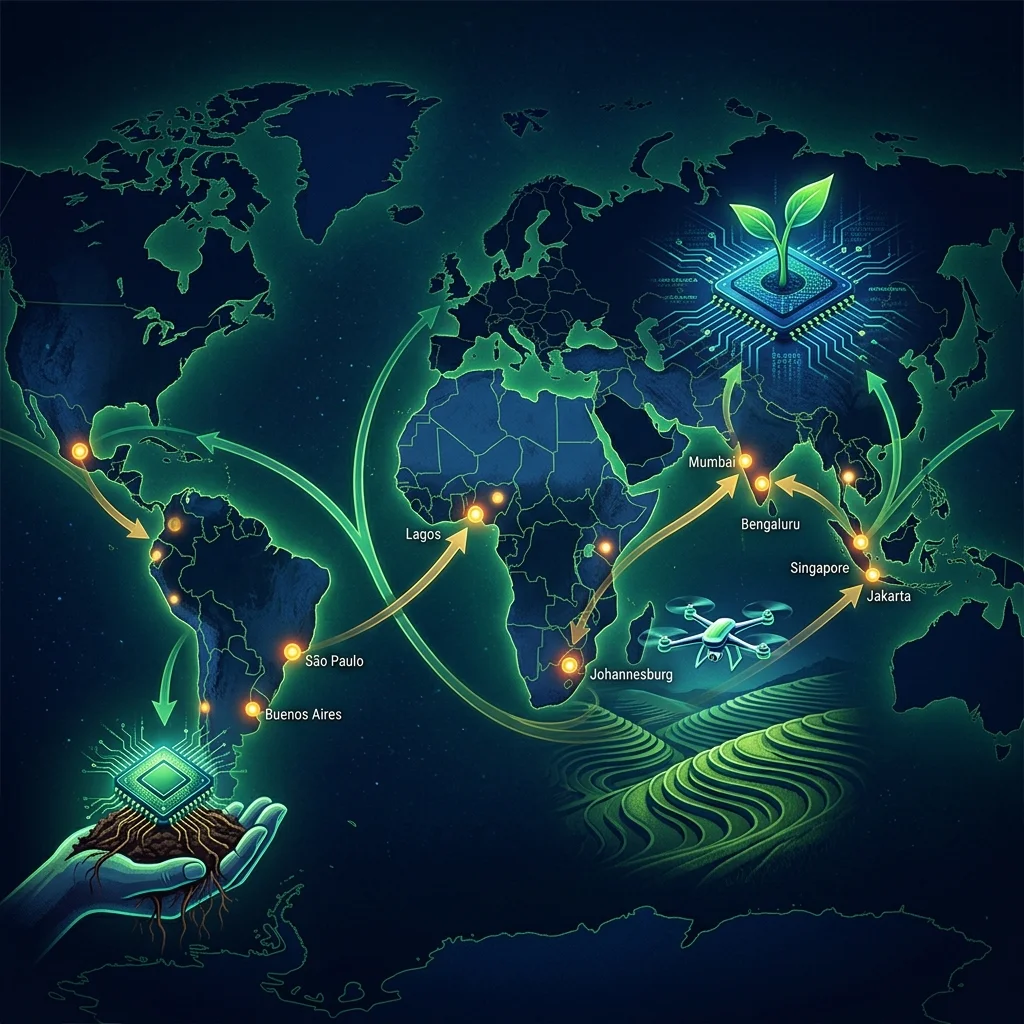
For decades, policymakers, development agencies, and investors have been navigating the complex terrain of agricultural research and innovation in the Global South without a reliable map. The question of how much is actually spent—and where those funds flow—has remained largely unanswered, leaving critical decisions about food system transformation to instinct rather than evidence. A landmark study published in Frontiers in Sustainable Food Systems now claims to fill this void, offering what its authors describe as the first comprehensive attempt to track global investment patterns in agricultural research and innovation for developing regions, with a particular focus on sustainable agricultural intensification.
Understanding where the money goes is not merely an academic exercise. These investment flows shape which technologies reach smallholder farmers, how quickly sustainable intensification can scale, and whether the world’s most vulnerable food systems can adapt to climate change, population growth, and shifting dietary demands. This article decodes the study’s implications for resource allocation, examines the hidden economic logic behind investment choices, and explores what the emerging patterns mean for technology adoption, supply chain resilience, and policy coordination across the Global South.
[IMAGE: A stylized infographic showing a blank map of the Global South gradually filled with scattered investment dots, with varying sizes representing different funding amounts.]
Why This Data Was Missing—And Why It Matters
The fact that this study is billed as a “first attempt” reveals a systemic transparency gap that has persisted for decades. Investment data in agricultural research and development is notoriously fragmented. Public budgets are tracked by national governments with varying degrees of rigor; philanthropic grants flow through foundations that often report incompletely; bilateral aid is dispersed across dozens of agencies and projects; and private sector R&D—particularly from agri-tech startups and multinational corporations—remains largely proprietary. Each of these funding streams is monitored in isolation, if at all, creating silos that obscure the total picture.
Without a comprehensive baseline, governments and development organizations cannot identify underfunded priorities, overlap between initiatives, or critical misalignments between research agendas and the actual needs of farmers. For example, a donor might pour millions into digital soil mapping while another funds the same work in the same region, while drought-tolerant seed varieties for staple crops remain critically under-resourced. The study’s attempt to map these flows systematically is therefore more than an accounting exercise—it is a precondition for evidence-based decision-making.
The focus on “sustainable agricultural intensification” adds particular urgency. Many donors and institutions publicly commit to supporting farming systems that boost productivity while preserving natural resources, yet without investment data, accountability remains weak. Are funds actually flowing toward integrated soil fertility management, agroecological practices, and climate-resilient crop breeding—or are they being funneled into conventional input-intensive approaches? The new study provides the first empirical basis to answer such questions.
[IMAGE: A complex flow diagram with disconnected boxes labeled “Public,” “Private,” “Philanthropy,” “Bilateral,” connected by dashed lines to a central question mark, with arrows of varying thickness emerging from the center.]
The Core Axis: Economic Logic Behind Investment Patterns
While the full dataset from the study warrants careful analysis, early evidence points to several structural features that define the current investment landscape. The most prominent pattern is a heavy reliance on public sector funding across the Global South. In sub-Saharan Africa, for instance, national agricultural research systems (NARS) remain the backbone of R&D, supported by international development banks and bilateral agencies. Private investment, by contrast, is highly concentrated in a handful of upper-middle-income countries and in specific commodity chains.
Regional disparities are stark. South Asian countries such as India and Bangladesh have built relatively robust public research ecosystems, particularly around rice and wheat, thanks to decades of investments stemming from the Green Revolution. Sub-Saharan Africa, however, remains severely underfunded. Even when accounting for differences in GDP and agricultural output, research intensity—measured as agricultural R&D spending relative to agricultural GDP—is significantly lower in most African nations than in Asia or Latin America. This gap perpetuates a cycle of low productivity, limited innovation adoption, and persistent food insecurity.
Private investment tends to gravitate toward high-value export crops—such as cocoa, coffee, avocados, and cut flowers—and toward digital agricultural platforms that can demonstrate clear revenue models. This market logic makes sense from a return-on-investment perspective, but it creates a systematic neglect of staple crops (maize, cassava, millets, sorghum) and farming systems that are critical for food security but less commercially attractive. The hidden economic logic here is simple: investors respond to perceived risk, institutional capacity, and potential returns. In environments where land tenure is insecure, infrastructure is weak, and regulatory frameworks are uncertain, private capital either stays away or seeks the safest bets.
Sustainable intensification investments, meanwhile, often favor long-term public goods—soil health restoration, water-use efficiency, biodiversity conservation—over short-term yield gains. This creates an inherent tension with market-driven funding, which typically demands measurable returns within three to five years. The study likely reveals that public and philanthropic sources bear the overwhelming burden of financing these long-horizon research areas, while private capital remains concentrated on technologies with quick commercial payoffs, such as precision agriculture sensors and drone-based crop monitoring.
[IMAGE: A bar chart comparing per-capita agricultural R&D spending across sub-Saharan Africa, South Asia, Latin America, and East Asia, with a line overlay showing the share of private investment in each region.]
The Hidden Tension: Productivity vs. Sustainability
One of the most striking findings to emerge from the mapping exercise is the strategic trade-off embedded in current investment patterns. On one side of the ledger, there is a well-established pipeline of productivity-focused research: high-yielding variety development, synthetic fertilizer optimization, and pest management using chemical inputs. These have historically driven the gains of the Green Revolution and remain dominant in public research budgets. On the other side, there is a growing but still marginal portfolio of sustainability-oriented research: agroecological system design, biological nitrogen fixation, integrated pest management, and climate-adaptive breeding for stress tolerance.
The study’s investment data makes visible a critical reality: funding for sustainable intensification is not a simple substitute for productivity research. Instead, it occupies a contested space where donors and governments must choose between short-term yield gains and long-term system resilience. This tension plays out differently across regions. In South Asia, where irrigated rice-wheat systems already achieve high yields, the challenge is to maintain productivity while reducing environmental costs—requiring investment in water-saving technologies and soil carbon management. In sub-Saharan Africa, where average yields remain a fraction of potential, the immediate imperative is raising productivity to meet growing food demand, yet doing so without repeating the ecological mistakes of the Green Revolution.
The data gaps that the study seeks to close are particularly acute in this domain. Without knowing how much is being spent on, say, agroforestry research in East Africa versus maize-breeding programs, policymakers cannot make informed trade-offs. The study’s ambition to map these flows represents a first step toward rationalizing resource allocation—but it also reveals how deeply the current system is skewed by historical path dependence and political economy.
Implications for Technology Adoption and Supply Chain Resilience
The patterns of agricultural research investment do not merely determine what gets invented; they also shape which innovations actually reach farmers. Technology adoption in the Global South depends not only on the existence of improved seeds, tools, or practices but also on the extension systems, input supply chains, and credit markets that enable diffusion. Investment data from the study implicitly signals where these enabling conditions are weakest.
For example, if the mapping shows that private capital is heavily concentrated in digital platforms—apps that deliver weather information, market prices, or credit scores—while public funding for adaptive breeding of local crop varieties remains stagnant, the implication is clear: the digital divide may narrow, but the genetic diversity that underpins resilience to climate shocks may continue to erode. Similarly, if investment in post-harvest storage and processing technologies is minimal compared to pre-harvest research, then supply chain losses will remain high, negating productivity gains.
The study also sheds light on the geography of agricultural innovation hubs. Early signals suggest that investment in agricultural R&D for the Global South is not evenly distributed but clusters in a few “innovation islands”: India’s biotechnology corridors, Kenya’s agri-tech startup scene around Nairobi, Brazil’s Embrapa system, and a handful of CGIAR centers. While these hubs generate valuable technologies, their spillover effects to smaller, more fragile states depend on deliberate policy coordination—which itself requires the kind of visibility that the study provides.
[IMAGE: A heatmap of the Global South with brighter colors indicating higher agricultural R&D investment density, overlaid with icons representing major research centers and startup clusters.]
Policy Coordination and the Path Forward
The ultimate value of this mapping exercise will be measured by whether it enables better coordination among the diverse actors who fund agricultural research and innovation. Currently, public agencies, private foundations, multilateral development banks, and corporate R&D units operate with limited information about each other’s priorities. The result is duplication in some areas, gaps in others, and a persistent disconnect between research agendas and the needs of smallholder farmers.
The study’s publication opens the door for several concrete policy actions. First, it establishes a baseline against which future investment trends can be measured, allowing stakeholders to track whether commitments to sustainable intensification are translating into actual spending. Second, it provides a framework for identifying areas of underinvestment—such as orphan crops, women-led farming systems, or climate-adaptive livestock genetics—that can inform targeted funding initiatives. Third, it creates the evidentiary foundation for a more coordinated global architecture for agricultural research, where the comparative advantages of different funders can be leveraged rather than ignored.
For the Global South, the implications extend beyond donor coordination. National governments can use the data to benchmark their own research spending against regional peers, to negotiate more effectively with international partners, and to design policies that attract private investment into areas that serve public goods. Supply chain actors—from seed companies to food processors—can align their R&D strategies with the emerging investment landscape, identifying opportunities where public and private efforts complement each other.
Of course, data alone does not change behavior. The study’s authors acknowledge that mapping investment is only the first step in a longer process of transparency and accountability. The next challenge is to keep the data current, to deepen it by capturing sub-national and commodity-specific flows, and to connect it to outcome metrics that measure whether research investments are actually improving food system resilience.
As climate change accelerates and global food demand rises, the stakes for getting agricultural R&D investment right could not be higher. The Global South is where most of the world’s food-insecure populations live, where the majority of agricultural growth will need to occur, and where the environmental costs of unsustainable farming are most visible. A clear map of where money flows is not a solution in itself, but it is an indispensable tool for navigating the complex choices ahead. This study has turned on the lights—now the work of reordering the investment landscape can begin.
[IMAGE: A simplified Sankey diagram showing funds flowing from public, private, philanthropic, and bilateral sources into four categories: staple crop research, high-value crop research, digital agri-tech, and sustainable intensification, with varying thicknesses representing relative magnitudes.]