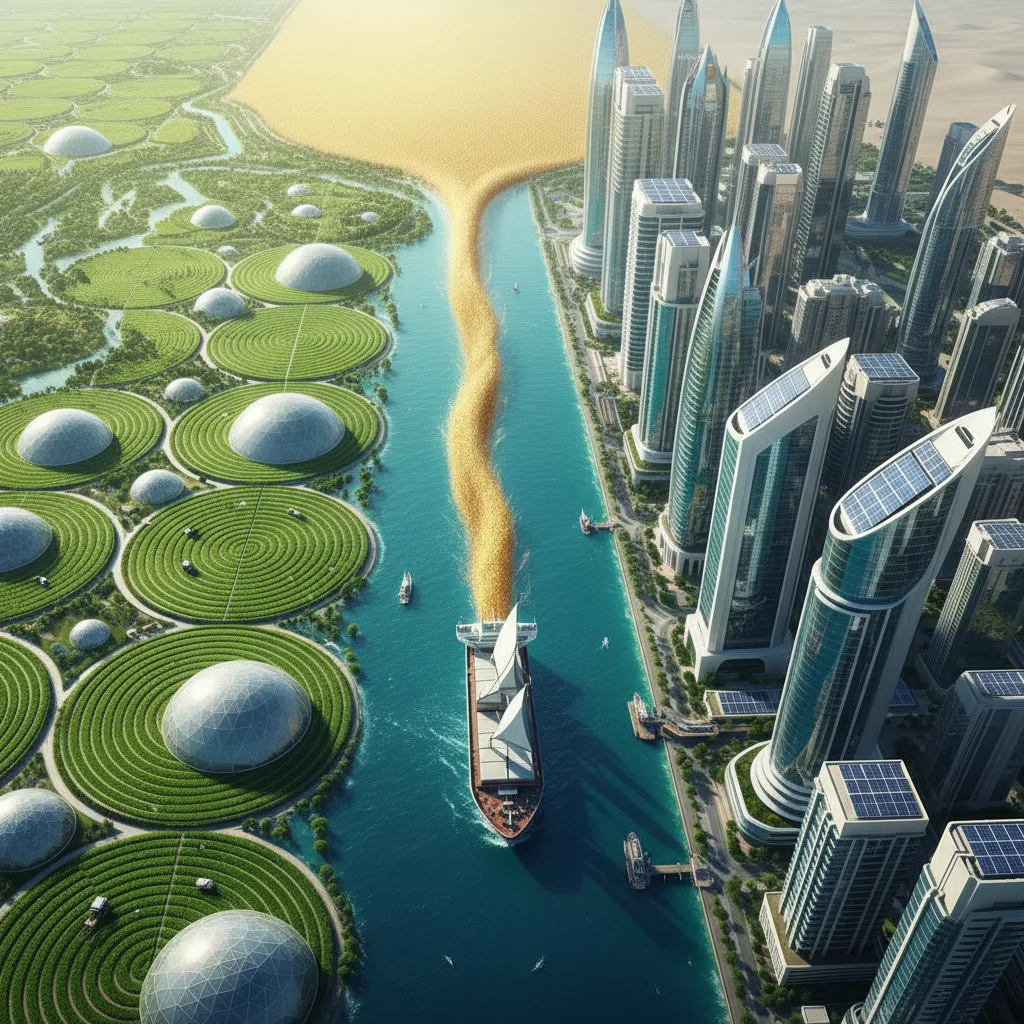
While headlines often focus on land acquisitions, a deeper economic logic
Beyond Land Grabs: The Strategic Synergy of GCC Capital and Sub-Saharan Africa’s Agricultural Revolution
For years, headlines have painted a simple picture: wealthy Gulf states are buying up vast tracts of African farmland, displacing local communities and extracting resources. The narrative is compelling but incomplete. Beneath the surface of land acquisitions lies a far more sophisticated economic calculus—one that is reshaping global food systems, deploying cutting-edge agritech, and forging logistics corridors that could redefine food security for both regions.
Gulf Cooperation Council (GCC) nations—Saudi Arabia, the UAE, Qatar, Kuwait, Oman, and Bahrain—import 80 to 90 percent of their food. Climate change is shrinking their already marginal arable land, and desertification is accelerating. At the same time, Sub-Saharan Africa holds nearly 60 percent of the world’s uncultivated arable land, yet produces far below its potential. The convergence is not accidental; it is driven by a strategic rethinking of how food security is achieved in an era of climate volatility, supply chain disruption, and geopolitical realignment.
[IMAGE: Map of GCC food import dependency vs. Sub-Saharan Africa arable land underutilization, with flow arrows]
The Hidden Economic Logic: Why GCC Nations Are Looking South
The conventional explanation—food import dependence—only scratches the surface. GCC states have long relied on global markets for staples like wheat, rice, and animal feed. But that passive model is breaking down. Export restrictions during the 2008 food crisis, the COVID-19 pandemic, and the Russia-Ukraine war exposed the fragility of relying on a handful of suppliers. The result: a strategic pivot from being passive importers to active agri-investors.
Sovereign wealth funds are leading this charge. The Qatar Investment Authority (QIA), Abu Dhabi Investment Authority (ADIA), and Saudi Arabia’s Public Investment Fund (PIF) have all established dedicated agriculture and food portfolios. Their targets are not just land—they are entire value chains: irrigation infrastructure, storage facilities, logistics hubs, and processing plants. These are long-term, patient investments designed to secure stable, traceable food supplies for decades.
A deeper driver is the water-energy-food nexus. Gulf nations face acute freshwater scarcity. By investing in rain-fed agriculture in Sub-Saharan Africa, they effectively engage in virtual water trade—importing the water embedded in crops without ever pumping a single cubic meter from their own depleted aquifers. This is not a land grab; it is a hydrological arbitrage, and it is entirely rational.
Geopolitically, the shift is equally significant. Diversifying away from traditional exporters—India, Brazil, Australia, and the United States—reduces dependency on any single trading partner. African agricultural corridors offer an alternative supply route that is both closer (shorter shipping distances from East Africa to the Gulf than from South America or Australia) and politically aligned through platforms like the Arab-African summits and Saudi Arabia’s Vision 2030.
[IMAGE: Infographic showing comparative shipping distances from major food exporters to the Gulf]
The Technology Bridge: Agritech as the Real Deal-Maker
If land was the headline, technology is the substance. The most transformative GCC investments in African agriculture are not in buying hectares but in deploying innovation. Startups backed by Gulf capital—such as Pure Harvest (UAE-based, specializing in controlled-environment agriculture) and iyris (formerly Red Sea Farms, developing salt-tolerant crops)—are bringing cutting-edge farming techniques to African soil.
Pure Harvest, for instance, has piloted high-tech greenhouse operations in Nigeria and Kenya, using hydroponics and climate-control systems to produce tomatoes, peppers, and leafy greens year-round. These ventures bypass the traditional land-grab model entirely: they lease small plots, create local jobs, and transfer technology to African partners. The goal is not ownership of vast acreage but control over production processes.
Digital platforms are another critical bridge. Blockchain-based land registries, initially piloted in Rwanda and Ghana, are now being scaled with GCC funding to provide transparent, tamper-proof records of land ownership. This reduces the legal risk for foreign investors while protecting smallholders from fraudulent dispossession. Commodity tracking systems—powered by IoT sensors and satellite imagery—allow Gulf traders to monitor crop health, predict yields, and verify sustainability claims in real time.
Climate-smart interventions are the most practical layer. Drought-resistant seeds developed in Saudi Arabia’s agricultural research centers are being trialed in Sudan and Ethiopia. Solar-powered irrigation pumps, funded by UAE-based clean energy funds, are replacing diesel generators in off-grid farming communities. Precision farming apps, many of them adapted from Israeli and GCC startups, give smallholder farmers data on soil moisture, pest cycles, and optimal planting windows—delivered through simple mobile interfaces.
A flagship example is the UAE’s agricultural technology park in Ethiopia’s Gambela region, launched in partnership with the Ethiopian government. The park combines research facilities, demonstration farms, and a supply chain hub designed to export high-value crops like avocados, coffee, and cut flowers directly to Gulf markets. Saudi Arabia has similarly invested in grain silos and wheat storage facilities in Sudan, aiming to restore that country’s historic role as a breadbasket for the Arabian Peninsula.
[IMAGE: Infographic showing a smartphone app connecting a smallholder farmer in Kenya to a Gulf trader, with data streams for weather, soil, and pricing]
Infrastructure Corridors: The New Logistics of Food Security
Technology alone cannot bridge the gap. The real bottlenecks in African agriculture are physical: poor roads, unreliable ports, and a near-total absence of cold chain logistics. A farmer in rural Uganda may produce excellent avocados, but if they rot before reaching the airport, the investment is worthless. GCC sovereign wealth funds are now financing the infrastructure that makes agribusiness viable.
The port of Doraleh in Djibouti, a strategic gateway for Ethiopian exports, has seen significant Qatari and Emirati investment. Lamu port in Kenya, part of the Lamu Port-South Sudan-Ethiopia Transport (LAPSSET) corridor, is another target. These ports are being upgraded with dedicated cold storage facilities, grain handling terminals, and container yards designed to move agricultural produce efficiently from farm to ship.
Railways are the next piece. The proposed railway from the Sahel region to the Red Sea—linking landlocked Chad, Niger, and Burkina Faso to Sudanese ports—is being discussed with Gulf financing. If realized, it would transform the economics of Sahelian agriculture, allowing perishable goods to reach Gulf markets within days rather than weeks. The African Continental Free Trade Area (AfCFTA) provides the regulatory framework to make these corridors work, allowing processed goods to move duty-free between African nations before being exported.
A critical long-term shift is the move from raw commodity exports to processed goods. Instead of shipping raw cocoa beans from Ghana to Europe, Gulf investors are financing local milling, fermentation, and packaging facilities in West Africa. This adds value locally, creates jobs, and reduces the volume-to-value problem that plagues African exports. For the Gulf, it means importing higher-value products with longer shelf lives and lower shipping costs.
But the dependency risk is real. Infrastructure built solely for export can distort local food systems. If a cold storage facility is only used for Gulf-bound avocados, it does nothing for the local maize supply. Balancing these priorities requires deliberate policy design—free trade zones that allow local processors to access the same infrastructure, and public-private partnerships that mandate a percentage of output be reserved for domestic markets.
[IMAGE: Diagram of a proposed logistics corridor from the Sahel to the Red Sea, with key ports, rail lines, and agro-processing zones]
The Smallholder Paradox: Inclusion or Extraction?
Over 60 percent of Africa’s farmland is managed by smallholder farmers—men and women cultivating less than two hectares each. Gulf investments, if poorly structured, could bypass or even displace these farmers. The history of large-scale foreign agricultural investments in Africa is littered with failures: broken promises of jobs, environmental degradation, and land conflicts.
Yet the evidence from recent GCC-backed projects tells a more nuanced story. When investments are structured as contract farming partnerships rather than outright land acquisitions, smallholders can benefit. In Tanzania, a UAE-funded horticulture project works with 15,000 smallholders, providing seeds, training, and guaranteed purchase prices. Farmers report income increases of 40 to 60 percent. In Zambia, a Saudi-backed soybean initiative uses an outgrower model, where smallholders grow on their own land but receive centralized processing and export services.
The key is institutional design. Transparent land governance, enforceable contracts, and independent monitoring are essential. Gulf sovereign wealth funds, which operate under long-term mandates and reputational pressure, are increasingly adopting ESG (environmental, social, governance) criteria. The Qatar Investment Authority, for example, now requires all agriculture investments to include a smallholder engagement plan and environmental impact assessment.
Nevertheless, risks remain. Without strong local regulatory frameworks, contract farming can become a form of neo-colonial extraction, where farmers bear the risk of crop failure while investors capture most of the profit. Land tenure systems in many African countries are weak, making it easy for investors to acquire land that local communities have used for generations without formal title. The challenge is not to stop investment, but to ensure it follows rules that benefit both sides.
[IMAGE: Photo collage showing a smallholder farmer using a smartphone for market prices on one side, and a large-scale GCC-funded agri-processing facility on the other, with a caption about contract farming models]
A Roadmap for Sustainable Synergy
The GCC–Sub-Saharan Africa agricultural partnership is still in its early stages, but its trajectory is clear. It is not a zero-sum resource grab but a complex, multi-layered relationship that touches on technology, infrastructure, finance, and human livelihoods. For it to fulfill its promise, four principles must guide the next phase.
First, technology transfer must be genuine. Agritech investments should prioritize adaptation to African contexts—durable equipment, offline-capable apps, and low-cost solutions that smallholders can actually use. Second, infrastructure must be dual-purpose. Logistics corridors and processing hubs should serve both export and domestic markets, ensuring food security gains for African populations alongside GCC supply chains. Third, land governance must be strengthened. International best practices—free, prior, and informed consent; transparent registries; and independent dispute resolution—should be non-negotiable conditions for any investment. Fourth, local value capture must be maximized. Processing, packaging, and logistical services should be built in Africa, by Africans, with Gulf capital acting as an enabler rather than a controller.
The hidden axis of food security between the Gulf and Sub-Saharan Africa is not a story of exploitation. It is a story of strategic alignment—two regions with complementary deficits and surpluses finding a way to balance them. If managed wisely, it could become a model for how climate change, technology, and investment can reshape global agriculture for the better. The world is watching.
[IMAGE: A panoramic satellite-style view showing a stark contrast: on the left, a lush, high-tech African farm with irrigation circles and greenhouses under a bright sun; on the right, a modern Gulf city skyline with solar panels. In the middle, a golden line of grain flowing from an African field into a ship bound for the Gulf]