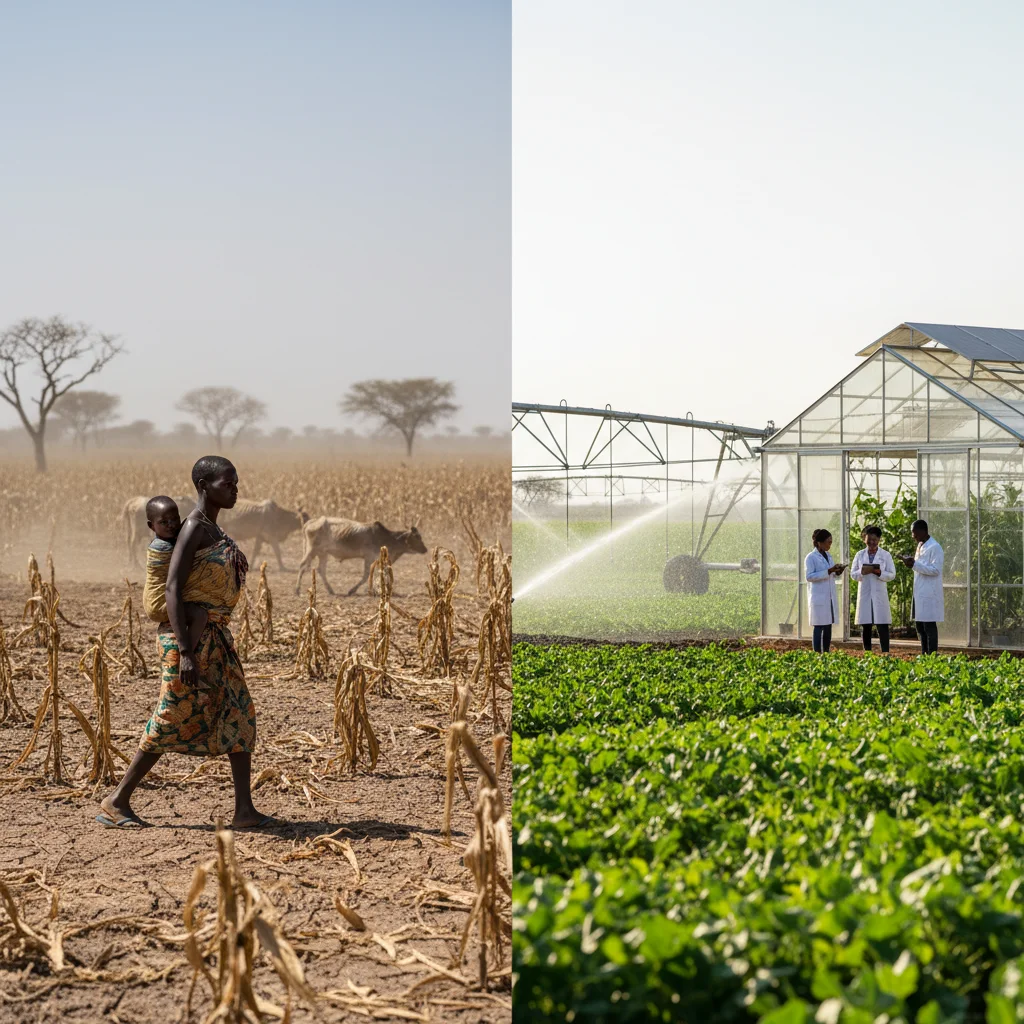
Despite decades of effort, Africa’s agricultural sector faces a deepening
CAADP and Africa’s Agricultural Crisis: Facts, Trends, and Investment Needs
Introduction: The Scale of Africa’s Agricultural Emergency
In 2000, African nations collectively spent an estimated US$18.7 billion on food imports (Source: FAO data). During the same period (1997–99), 200 million people on the continent were chronically undernourished, up from 173 million in 1990–92 (Source: FAO State of Food Insecurity). Sub-Saharan Africa accounted for 194 million of those undernourished individuals, representing 34% of the region’s population.
These figures expose a structural paradox: while the absolute value of Africa’s agricultural exports rose from US$12 billion in 1990 to US$14 billion in 2000, the continent’s share of global agricultural trade collapsed from 8% (1971–80) to 3.4% (1991–2000) (Source: World Bank trade statistics). Meanwhile, dietary energy supply in Sub-Saharan Africa increased only marginally—from 2,120 kcal per capita per day (1990–92) to 2,190 kcal (1997–99)—a gain insufficient to reverse rising hunger (Source: FAO food balance sheets). The continent is producing less relative to a growing population and global markets, while becoming increasingly dependent on external food sources.
---
Declining Global Competitiveness: A Structural Shift
Africa’s diminishing share of global agricultural exports is not a short-term fluctuation but a long-term structural trend. Between the 1970s and the 1990s, the continent’s export share fell by more than half, despite higher absolute export values. In 1998, Africa accounted for only 4.6% of global agricultural imports but 16.3% of developing-country agricultural imports (Source: FAO Trade Yearbook). This indicates that Africa’s import burden is disproportionately heavy within the developing world—it imports far more than its relative economic weight would predict.
Food imports constituted approximately 15% of total African imports in 2000. In East Africa, the share of gross export revenues required to pay for food imports rose from 12% in the early 1990s to over 30% by the end of the decade (Source: World Bank). This trend erodes the foreign-exchange reserves available for capital goods, infrastructure, and technology—inputs necessary for long-term productivity growth. The result is a self-reinforcing cycle: low productivity forces imports, imports drain capital, and capital shortages prevent productivity investment.
Sub-Saharan Africa’s cereal imports in 2000 were estimated at 17 million tons, including 2.8 million tons of food aid (Source: FAO). The region’s self-sufficiency ratio for cereals stood at roughly 85%. Projections indicate that if that ratio is maintained until 2015, Sub-Saharan Africa would need to produce 118 million tons of the projected 139 million tons of cereal demand—a production increase of more than 30% over 15 years (Source: CAADP projections). Without a sustained investment surge, that gap will widen.
---
The Human Toll: Undernourishment and Food Emergencies
The rise in chronic undernourishment is not an abstract statistic. From 1990–92 to 1997–99, the number of chronically undernourished people in Sub-Saharan Africa increased from 168 million to 194 million (Source: FAO). In 2001, between 23 million and 28 million Africans were classified as suffering from food emergencies (Source: WFP). In the mid-1990s, 21.5 million of the 32 million worldwide disaster victims receiving World Food Programme relief were in Africa (Source: WFP annual reports).
Food aid flows—2.8 million tons in 2000—provide temporary relief but do not address underlying supply deficits. The reliance on food aid reflects a production shortfall that cannot be closed by emergency distributions alone. Moreover, food aid can depress local prices, discourage domestic production, and create dependency. The quantitative evidence strongly suggests that without a fundamental shift in agricultural investment, the absolute number of undernourished will continue to rise in parallel with population growth.
---
CAADP: A Framework, Not a Blueprint
In response to these trends, the New Partnership for Africa’s Development (NEPAD) launched the Comprehensive Africa Agriculture Development Programme (CAADP). The document itself is explicit about its limitations: "This document is not a blueprint, nor is it a manual for stepwise action to uplift African agriculture. It is also not a shopping list of projects – indeed, it has no specific project on offer for investors" (Source: CAADP document, NEPAD). Instead, CAADP provides a strategic framework organized around five pillars:
- Improved water management – expansion of irrigated area and sustainable water use.
- Rural infrastructure – roads, storage, and market access to reduce post-harvest losses.
- Productivity increase – adoption of improved seeds, fertilizers, and farming techniques.
- Disaster readiness – early warning systems and risk management against droughts and floods.
- Research and technology – long-term investment in agricultural science and extension services.
The fifth pillar was added after advocacy from the NEPAD Steering Committee and the June 2002 meeting of Africa’s ministers responsible for agriculture. As the document notes, "It has been the strong view of the NEPAD Steering Committee and of the June 2002 meeting of Africa's ministers responsible for agriculture that the CAADP needs to include a pillar on this crosscutting need, even though its benefits only occur in the long term" (Source: CAADP document). This addition signals recognition that short-cycle interventions cannot overcome decades of underinvestment in research and human capital.
CAADP does not prescribe specific projects or funding mechanisms. Its function is to align national agricultural strategies around these pillars and to serve as a basis for coordination among donors, governments, and regional bodies. The framework’s effectiveness depends entirely on the degree to which it translates into budget allocations and policy reforms at the national level.
---
The Trade Deficit: Imports vs. Exports and the Investment Gap
The structural asymmetry between Africa’s agricultural imports and exports is not a temporary imbalance but a chronic deficit. In 2000, Africa’s food import bill of US$18.7 billion exceeded its agricultural export earnings of US$14 billion by nearly US$5 billion (Source: FAO). This deficit is financed by other export sectors (minerals, oil, commodities) or by external borrowing and aid—neither of which is sustainable.
The deficit is compounded by the composition of trade. Africa exports low-value, unprocessed commodities (cocoa beans, coffee, cotton) and imports high-value processed foods (cereals, dairy, vegetable oils). Value addition occurs almost entirely outside the continent. For example, Sub-Saharan Africa produces about 70% of the world’s cocoa but captures less than 5% of the final chocolate retail value (Source: UNCTAD commodity reports). Closing the trade deficit requires not only increasing production volumes but also upgrading processing capacity and capturing a larger share of the value chain.
The share of gross export revenues spent on food imports in East Africa rising from 12% to over 30% illustrates the vulnerability of economies that depend on a narrow base of primary exports. Any price shock in export commodities directly translates into reduced food purchasing power. Investment in domestic production is therefore not merely an agricultural policy—it is a macroeconomic stability imperative.
---
Conclusion: Investment, Not Aid, as the Condition for Change
The data compiled across two decades (1971–2000) reveals a coherent pattern: Africa’s agricultural sector is trapped in a low-productivity equilibrium. Rising undernourishment, falling global market share, and a widening food import bill are symptoms of inadequate investment in the four pillars of land productivity, water management, infrastructure, and research.
CAADP provides a diagnostic structure, but its authors acknowledge it is not a detailed implementation plan. The framework’s value lies in forcing a shift from project-based emergency responses to long-term capital formation. If African governments and their development partners allocate resources in line with the five pillars—particularly the research and technology pillar, whose benefits only appear after a decade or more—the continent could begin to reverse the export-share decline and reduce import dependency. If investment remains at current levels, the projections are unambiguous: by 2015, Sub-Saharan Africa will need to produce 118 million tons of cereals just to maintain an 85% self-sufficiency ratio, a target that appears distant given the 1997–99 baseline of approximately 90 million tons (Source: CAADP projections).
The empirical record from 1971 to 2000 shows that short-term food aid and isolated projects have not altered the underlying trajectory. A sustained, multi-decade commitment to productivity-enhancing investment—financed through national budgets, regional cooperation, and private capital—is the only intervention that the data supports as a viable solution to Africa’s agricultural crisis.