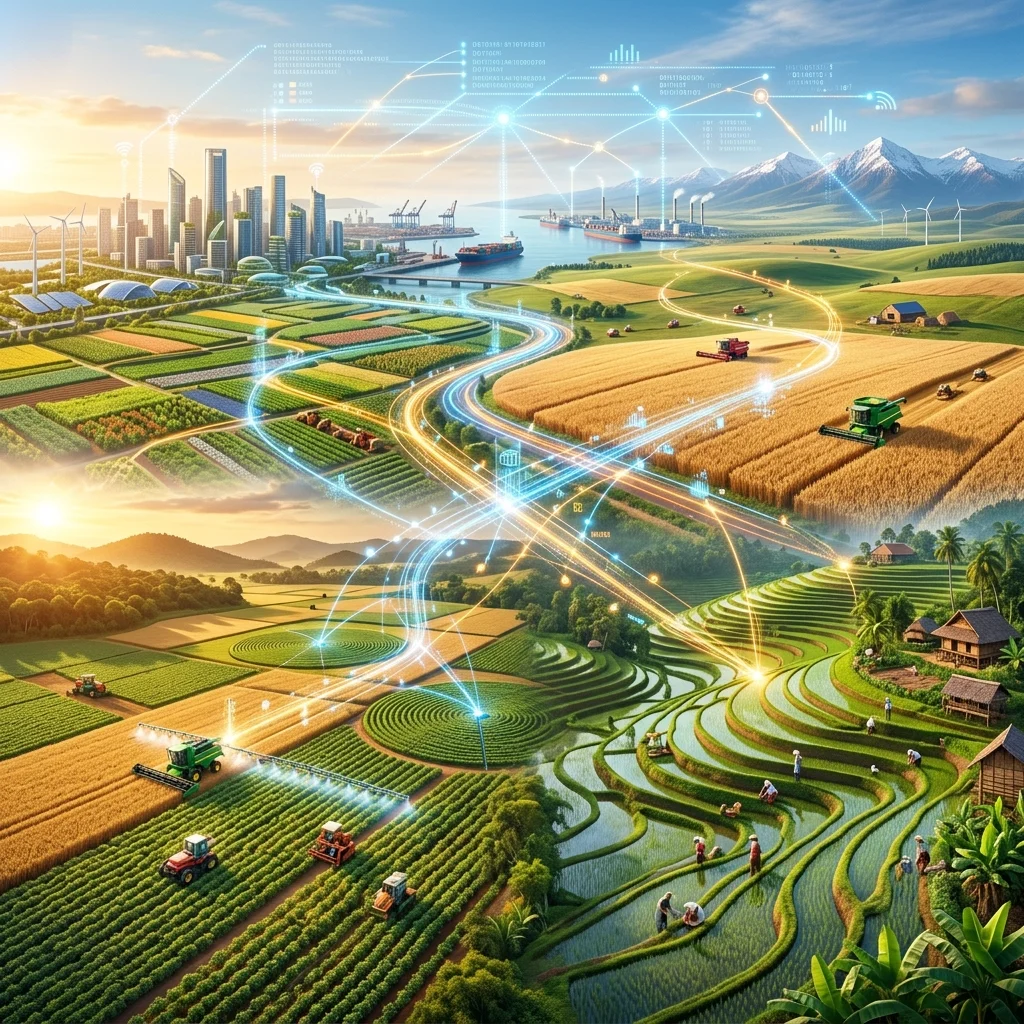
The BRICS nations are spearheading a transformative agrarian shift, challenging
BRICS Revolution: The Global Agrarian Shift – How Emerging Economies Are Reshaping Food Security and Agricultural Markets
Introduction: The BRICS Agrarian Revolution – A New World Order in Food?
The world’s food system is undergoing a tectonic shift, and the epicenter lies not in Geneva or Washington but across the sprawling farmlands of Brazil, Russia, India, China, and South Africa. Together, the BRICS bloc commands over 40% of global agricultural land and accounts for roughly 35% of the world’s food production. Yet for decades, these nations remained price-takers in a system dominated by Western agribusinesses, commodity exchanges, and trade rules. That era is ending.
Recent policy moves, joint investments, and technology-sharing agreements among BRICS members signal a coordinated effort to rewrite the rules of global food governance. A 2025 study published in SAGE Open (DOI: 10.1177/09749284241307937) provides a stark analytical lens: this is not a random set of reforms but a deliberate agrarian revolution aimed at dismantling the traditional Western-centric agricultural order. From strategic grain reserves to cross-border biotech partnerships, BRICS countries are engineering alternative supply chains that could redefine food security for billions.
[IMAGE: World map highlighting BRICS countries with agricultural overlays – crop icons, land-use shading, and population density gradients.]
This article draws on that seminal research to unpack the economic logic, technological leapfrogging, and policy nationalism driving the BRICS agrarian shift. For farmers in the global South, investors eyeing emerging markets, and policymakers everywhere, understanding these hidden patterns is no longer optional — it is essential.
The Economic Logic: From Commodity Dependence to Strategic Autonomy
For much of the 20th century, BRICS nations served as raw material appendages to Western food systems. Brazil exported soybeans to be processed by European and American crushers; India shipped tea and spices to London auction houses; Russia sold wheat through Swiss traders. The value addition — processing, branding, logistics — occurred elsewhere, leaving producing countries vulnerable to price swings and foreign intermediation.
That model is collapsing. The economic logic of the BRICS agrarian shift is rooted in a straightforward strategy: move up the value chain and build domestic processing capacity. The BRICS New Development Bank (NDB) has emerged as a key financier, funding everything from grain silos in South Africa to port expansions in Brazil and cold-chain logistics in India. By 2024, NDB had approved over $8 billion in agricultural infrastructure projects across member states, directly challenging the traditional role of the World Bank and regional development banks in shaping farm-sector investments.
[IMAGE: Infographic comparing commodity trade flows before and after BRICS cooperation – arrows shift from traditional Western hubs (Chicago, Rotterdam) to intra-bloc routes (Mumbai–Beijing, São Paulo–Moscow).]
This transition is reinforced by strategic food import substitution and selective export controls. When global wheat prices spiked in 2022–2023, Russia and India coordinated export bans that shielded domestic markets while forcing importing nations to negotiate directly with producer governments rather than commodity traders. The result: a self-reinforcing cycle of economic sovereignty. Countries that once competed for Western market access now trade agricultural inputs — fertilizers, seeds, machinery — among themselves, reducing dollar-denominated transactions and bypassing traditional trading hubs.
The 2025 SAGE study highlights how this “commodity-to-autonomy” pivot is not merely defensive. BRICS nations are actively creating new commodity benchmarks: China’s Dalian Commodity Exchange now sets price references for soybeans that rival the Chicago Board of Trade, while India’s National Commodity and Derivatives Exchange is expanding into pulses and spices. These alternative price-discovery mechanisms weaken the West’s grip on agricultural pricing power.
Technology Trends: How Precision Agriculture and Biotech Are Leveling the Field
Technology has long been a point of weakness for BRICS agriculture, with average yields lagging behind those of the United States or Europe. But the gap is closing, and fast. The driver is a combination of rapid adoption of precision farming tools and collaborative biotech research that leapfrogs traditional development cycles.
Across the BRICS landscape, drones now monitor crop health in Brazil’s Cerrado, AI-powered soil sensors guide irrigation in China’s arid northwest, and satellite imagery helps Indian farmers predict pest outbreaks. The Internet of Things (IoT) is enabling real-time decisions that boost yields by 15–25% while cutting water and fertilizer use — critical as climate change intensifies droughts and heatwaves common across BRICS territories.
[IMAGE: Split-screen image: traditional manual farming on one side (e.g., Indian farmer with bullock cart), a high-tech drone and sensor-equipped field on the other, both set in a BRICS landscape with recognizable terrain.]
Even more transformative are the biotech partnerships emerging within the bloc. Brazil and India have established joint research programs to develop drought-resistant soybean and rice varieties suited to their shared tropical climates. Chinese gene-editing firms are licensing technologies to South African maize breeders at costs far below those charged by Western patent holders. These “South-South” technology transfers are narrowing the innovation gap while avoiding the intellectual property constraints that have historically locked developing nations out of cutting-edge biotechnology.
Data sharing is another underappreciated front. The BRICS Agricultural Research Platform (founded in 2017) now connects over 200 research institutes across member nations, enabling the rapid exchange of crop models, weather data, and disease surveillance information. According to the 2025 SAGE analysis, this collaborative infrastructure has accelerated the release of climate-resilient crop varieties by an average of three to four years compared to national-only programs. For farmers, that means faster access to seeds that can withstand erratic rainfall or rising temperatures — a lifeline in an era of food insecurity.
Policy Updates: The Rise of Food Sovereignty and Resource Nationalism
If technology is the engine of the BRICS agrarian revolution, policy is the steering wheel. A wave of new regulations across member states is systematically asserting domestic control over critical agricultural resources — land, water, seeds, and genetic material.
Land ownership rules have been tightened. Brazil now requires foreign entities to seek congressional approval for agricultural land acquisitions above a certain size, while South Africa’s Land Reform and Redistribution Act prioritizes previously disadvantaged communities. Russia has banned the use of foreign-owned seeds for strategic crops like wheat and potatoes, mandating that at least 75% of planting material be domestically bred by 2030. China’s 2024 Seed Industry Revitalization Plan similarly pushes for self-sufficiency in core crop varieties.
Water rights are being renegotiated. India’s interlinking of rivers project and China’s South–North Water Transfer scheme demonstrate a willingness to redirect water at a national scale, often at the expense of downstream neighbors. While these projects are controversial, they reflect a broader BRICS trend: treating water as a sovereign resource to be allocated according to domestic food security priorities, not international market signals.
[IMAGE: A conceptual illustration of grain reserves silos in multiple BRICS countries, connected by glowing lines, with a clock showing coordinated release timing.]
Most visible to international markets are the coordinated grain reserve strategies. BRICS nations have been stockpiling strategic reserves — India’s Food Corporation of India holds over 60 million tonnes of grain, China’s state reserves are estimated at 200 million tonnes, and Russia has reopened Soviet-era storage facilities. During the 2024 El Niño-induced drought, the bloc coordinated a voluntary export restraint mechanism that prevented a repeat of the 2008 food crisis. While temporary export bans are not new, what distinguishes the current era is the collective, pre-planned nature of these interventions. As the SAGE study notes, “BRICS is not merely reacting to crises; it is building a parallel architecture of food security governance.”
Seed patents and intellectual property have become a new battleground. Several BRICS countries are adopting “compulsory licensing” provisions that allow local firms to produce patented seeds without permission during national food emergencies — a direct challenge to the WTO’s TRIPS agreement. This resource nationalism extends to genetic resources: Brazil and India are leading efforts to create a multilateral benefit-sharing system for genetic materials sourced from their territories, ensuring that profits from bioprospecting stay within the bloc.
Conclusion: A New Architecture for Global Food Security
The BRICS agrarian revolution is not a short-term adjustment; it is a foundational reordering of how food is produced, traded, and governed. By leveraging collective land, market power, and technological synergies, emerging economies are building a parallel system that competes directly with Western-dominated agricultural markets. For farmers, this means new export corridors, better access to technology, and more predictable policy environments — but also greater exposure to bloc politics. For investors, the shift demands a rethinking of supply chains: companies that once relied on Chicago or Rotterdam as hubs must now navigate Moscow, Brasília, and New Delhi. For policymakers outside the BRICS circle, the message is clear: food security is becoming a multipolar game.
The 2025 SAGE publication (DOI: 10.1177/09749284241307937) provides a critical roadmap for understanding these dynamics. Its findings underscore that the agrarian shift is driven by a coherent, long-term strategy — not luck or market cycles. As the BRICS bloc deepens its agro-commodity alliances and continues to invest in domestic capacity, the global food system will never look the same. The revolution is already underway; the only question is who will adapt in time.