This article explores the transformation of agricultural development in emerging
Agricultural Transformation in Emerging Markets: From Green Revolution to Digital Innovation
Agricultural development in emerging markets has entered a new era, moving beyond the yield-focused paradigm of the mid-20th century Green Revolution toward more inclusive, sustainable, and technology-driven systems. Countries such as Brazil, India, Vietnam, and Kenya have transformed from subsistence-based economies into global export powerhouses, supplying coffee, rice, soybeans, and horticultural products to markets worldwide. This shift is not merely a continuation of past productivity gains; it represents a fundamental restructuring of how food is grown, traded, and financed. This article examines the economic logic and innovation patterns reshaping the sector, with particular attention to digital platforms, financial inclusion, and policy reforms that are driving productivity, reducing poverty, and creating resilient supply chains.
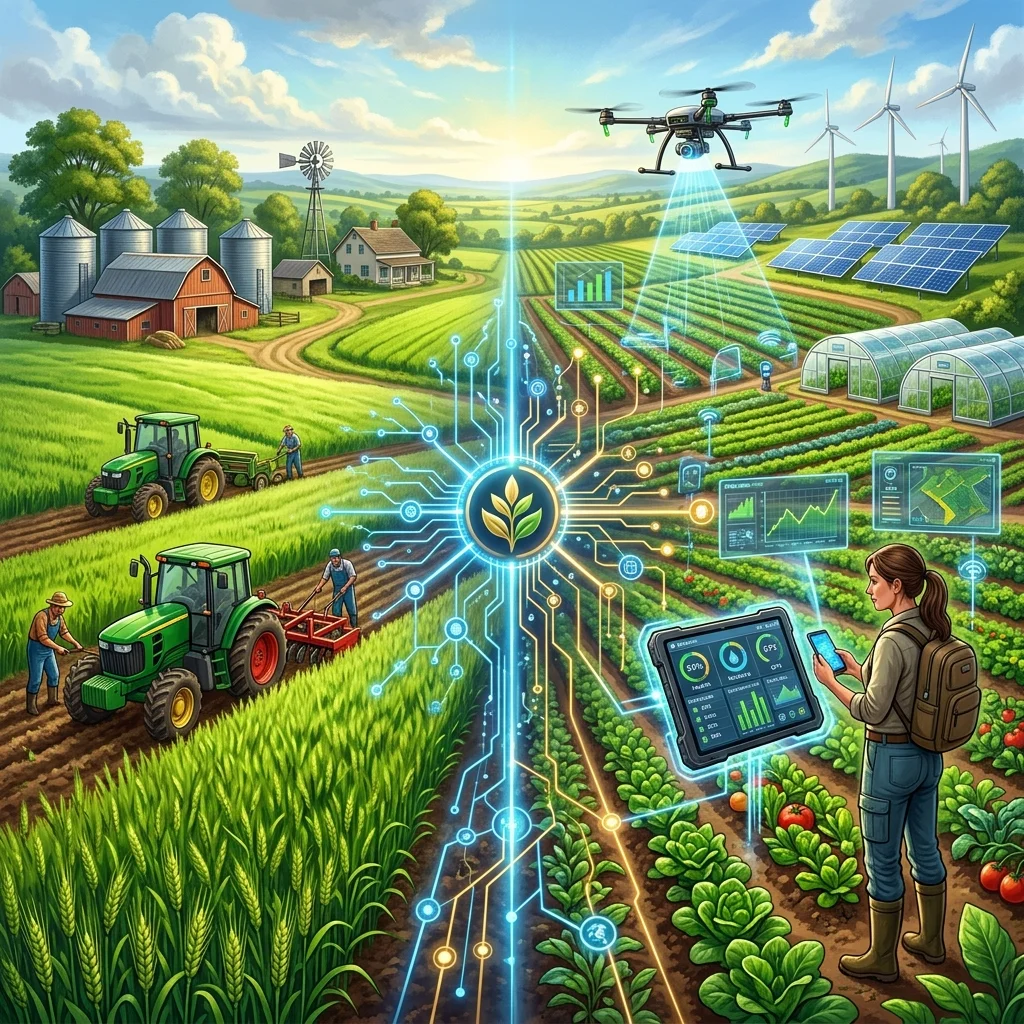
[IMAGE: Split landscape digital painting showing traditional Green Revolution on left (tractors, silos, lush fields) and modern digital agriculture on right (farmer with smartphone, drone, solar panels, data screens), merging at center with glowing digital network.]
The Legacy of the Green Revolution and Its Unfinished Business
The Green Revolution of the 1950s–1970s introduced high-yield crop varieties, chemical fertilizers, synthetic pesticides, and expanded irrigation infrastructure. These interventions dramatically boosted cereal production in Asia and Latin America, averting widespread famine and laying the foundation for modern agricultural systems. In India, wheat yields more than tripled between 1965 and 1995; in Mexico, similar gains occurred with maize. The economic impact was profound: agricultural growth proved to be two to three times more effective at reducing poverty than growth in non-agricultural sectors, according to World Bank studies.
Yet the Green Revolution left significant unfinished business. Its environmental costs—soil degradation, groundwater depletion, loss of biodiversity, and greenhouse gas emissions from fertilizer overuse—are now widely recognized. Socially, the benefits were distributed unevenly: large, well-connected farmers adopted new technologies faster, while smallholders and marginal farmers in rain-fed areas often remained excluded. Today, despite decades of progress, emerging markets continue to face persistent structural barriers.
Poor rural infrastructure remains a critical bottleneck. In sub-Saharan Africa, less than 25% of rural roads are paved, and post-harvest losses for perishable crops can exceed 40% due to inadequate storage, cold chains, and transport. Access to formal finance is severely limited: fewer than 20% of smallholder farmers in Africa have access to credit from banks, forcing many to rely on informal moneylenders at high interest rates. Policy inconsistency—sudden changes in trade tariffs, fertilizer subsidies, or minimum support prices—creates uncertainty that discourages long-term investment. Meanwhile, environmental degradation accelerates: soil erosion affects an estimated one-third of global agricultural land, water scarcity threatens major breadbaskets, and climate change introduces greater variability in rainfall and temperature.
The challenge, therefore, is not simply to produce more food, but to do so in a way that is economically inclusive, environmentally sustainable, and resilient to shocks. This requires a renewed toolkit that goes beyond the Green Revolution’s focus on inputs and varieties.
[IMAGE: Historical photo of a farmer using traditional plowing methods or a field during the Green Revolution era, showing lush green crops and irrigation canals.]
Digital and Financial Innovations – Bridging the Gaps
Public-private partnerships and financial inclusion have emerged as two of the most effective strategies for overcoming the infrastructure and capital constraints that have historically held back smallholder farmers. Digital technologies, in particular, are enabling new models of service delivery that were previously unfeasible in remote, low-infrastructure environments.
India’s eNAM: Digitizing Market Access
The National Agriculture Market (eNAM) platform, launched by the Government of India in 2016, exemplifies how digital agriculture can transform market access. eNAM creates a unified online marketplace that connects farmers directly with buyers—traders, processors, exporters—across multiple states. Farmers bring their produce to a participating mandi (market yard), where it is graded, weighed, and uploaded to the platform. Buyers from anywhere in the country can bid in real time, driving price discovery and reducing information asymmetry.
As of 2024, eNAM covered over 1,360 mandis in 22 states, with more than 1.7 crore (17 million) farmers registered. Studies indicate that farmers using eNAM have seen price increases of 5–15% on average compared with traditional auctions, while also reducing transaction costs and the number of intermediaries. The platform also integrates payment settlement, ensuring timely remittances. However, challenges remain: digital literacy among older farmers, internet connectivity in remote areas, and resistance from local trader lobbies have limited broader adoption. Yet eNAM demonstrates that even within a complex federal system, digital platforms can improve supply chain resilience and market transparency.
[IMAGE: Screenshot of eNAM platform interface showing auction dashboard, or a photo of a farmer checking prices on a smartphone at a market yard.]
Kenya’s M-Pesa: Financial Inclusion for Smallholders
Mobile money services like M-Pesa have revolutionized financial inclusion in East Africa, and their application to agriculture is particularly powerful. Launched in 2007 by Safaricom in Kenya, M-Pesa allows users to deposit, withdraw, transfer money, and pay bills using a basic mobile phone. Today it has over 50 million active users across multiple countries.
For smallholder farmers, M-Pesa has opened access to credit, savings, and insurance products that were previously out of reach. Through partnerships with microfinance institutions and agri-tech companies, farmers can now receive digital loans tied to their transaction history and farm data. For example, the platform “M-Shwari” offers interest-earning savings accounts and small loans, while “Kilimo Salama” (a weather-index insurance product) uses M-Pesa to deliver payouts automatically when rainfall falls below a threshold. This reduces the moral hazard and transaction costs associated with traditional insurance.
The economic impact is significant: a study by the Massachusetts Institute of Technology found that access to M-Pesa lifted an estimated 194,000 Kenyan households out of poverty between 2008 and 2014, largely through enabling risk management and investment. For agricultural supply chains, mobile money reduces the risk of cash theft, speeds up payments, and allows farmers to buy inputs on credit—critical for smallholders who lack collateral.
Brazil’s Soybean R&D: The Power of Sustained Innovation
While digital platforms address market and financial gaps, Brazil’s experience with soybean development underscores the importance of long-term research and development (R&D) investment. Until the 1970s, Brazil was a minor soybean producer, constrained by acidic soils and tropical climates unsuitable for traditional varieties. Through a sustained public-private partnership involving Embrapa (Brazilian Agricultural Research Corporation), universities, and agribusiness firms, the country developed new cultivars adapted to low-latitude conditions, along with no-till farming techniques and biological nitrogen fixation methods that reduced fertilizer costs.
Today, Brazil is the world’s largest soybean producer and exporter, with annual output exceeding 150 million metric tons. The R&D investment—amounting to roughly 1.5–2% of agricultural GDP annually—has generated returns estimated at 25–50% per year. This success story highlights that digital innovation alone cannot solve structural challenges; it must be complemented by scientific research, technology transfer, and human capital development. Brazil’s soybean revolution also demonstrates how emerging markets can leapfrog developed-country models by adapting solutions to local agroecological conditions.
[IMAGE: Photo of a farmer using a mobile phone with M-Pesa interface, or a drone flying over soybean fields in Brazil with research station in background.]
Policy Reforms and Capacity Building – The Enabling Environment
Technology and finance are necessary but insufficient conditions for agricultural transformation. Without a supportive policy framework, even the most innovative platforms can falter. Consistent, long-term policies—rather than short-term populist measures—are essential for encouraging investment in agriculture. This includes predictable trade policies, stable input subsidy regimes, and clear land tenure rights. Reducing corruption at market yards and customs checkpoints can dramatically lower transaction costs; in India, the elimination of multiple middlemen through eNAM has shown that policy changes can complement digital tools.
Investment in rural infrastructure remains foundational. Roads, electricity, internet connectivity, cold storage, and irrigation systems are public goods that private markets often undersupply, especially in sparsely populated areas. Public spending on rural infrastructure in emerging markets averages only 2–3% of GDP, well below the 5–7% estimated by the Food and Agriculture Organization as necessary to achieve the Sustainable Development Goal of ending hunger by 2030. Brazil’s successful soybean expansion relied heavily on government investment in transport corridors (the BR-163 highway) and port facilities that connected interior production zones to global markets.
Capacity building through training and agricultural extension services is equally critical. Digital tools are only as effective as the farmers who use them. Many smallholders lack the basic numeracy, digital literacy, and agronomic knowledge to interpret market data, manage digital credit, or adopt sustainable practices like precision irrigation or integrated pest management. Extension services—traditionally face-to-face but increasingly delivered via mobile apps and call centers—can bridge this gap. For example, India’s “mKisan” platform sends weather alerts, pest forecasts, and best-practice videos to farmers’ phones in local languages. In Kenya, the “iShamba” app provides similar services, reaching over 100,000 farmers.
The shift toward sustainable farming practices addresses the environmental legacy of the Green Revolution. Techniques such as conservation agriculture (minimum tillage, crop rotation, cover cropping) can reduce soil erosion by 80–90%, while solar-powered irrigation systems lower energy costs and carbon emissions. Agroforestry—integrating trees with crops and livestock—enhances biodiversity, sequesters carbon, and provides additional income sources. Policy incentives, such as payments for ecosystem services or carbon credits, can accelerate adoption. Costa Rica’s program of paying farmers to reforest marginal lands has reversed decades of deforestation, while also boosting ecotourism and water security.
[IMAGE: Photo of farmers attending a training session with smartphones, or a diagram showing conservation agriculture techniques with reduced tillage and cover crops.]
Conclusion – A New Agricultural Paradigm for Emerging Markets
The transformation of agriculture in emerging markets is moving beyond the Green Revolution’s singular focus on yield maximization. Today, the most successful strategies combine digital platforms, financial inclusion, sustained R&D, and supportive policy reforms to create systems that are productive, inclusive, and resilient. India’s eNAM demonstrates how digital agriculture can democratize market access; Kenya’s M-Pesa shows that mobile money can unlock credit and insurance for the unbanked; Brazil’s soybean R&D proves that long-term investment in scientific innovation can turn a marginal crop into a global commodity.
Yet significant obstacles remain. The digital divide—between connected and unconnected regions, between literate and illiterate farmers, between men and women—must be addressed if the benefits of agri-tech are to be widely shared. Infrastructure investment, particularly in sub-Saharan Africa, needs to accelerate dramatically. And policies must resist the temptation of ad hoc interventions that undermine market confidence.
For global business stakeholders—from input suppliers to food processors to technology firms—the implications are clear. Emerging markets are no longer just sources of raw commodities; they are becoming testbeds for innovative business models that blend technology, finance, and sustainability. Companies that invest in building digital ecosystems, partnering with local institutions, and adapting solutions to smallholder realities will be best positioned to thrive in this new landscape. The agricultural revolution of the 21st century is not about a single technology or policy; it is about building a system that works for farmers, consumers, and the planet alike.