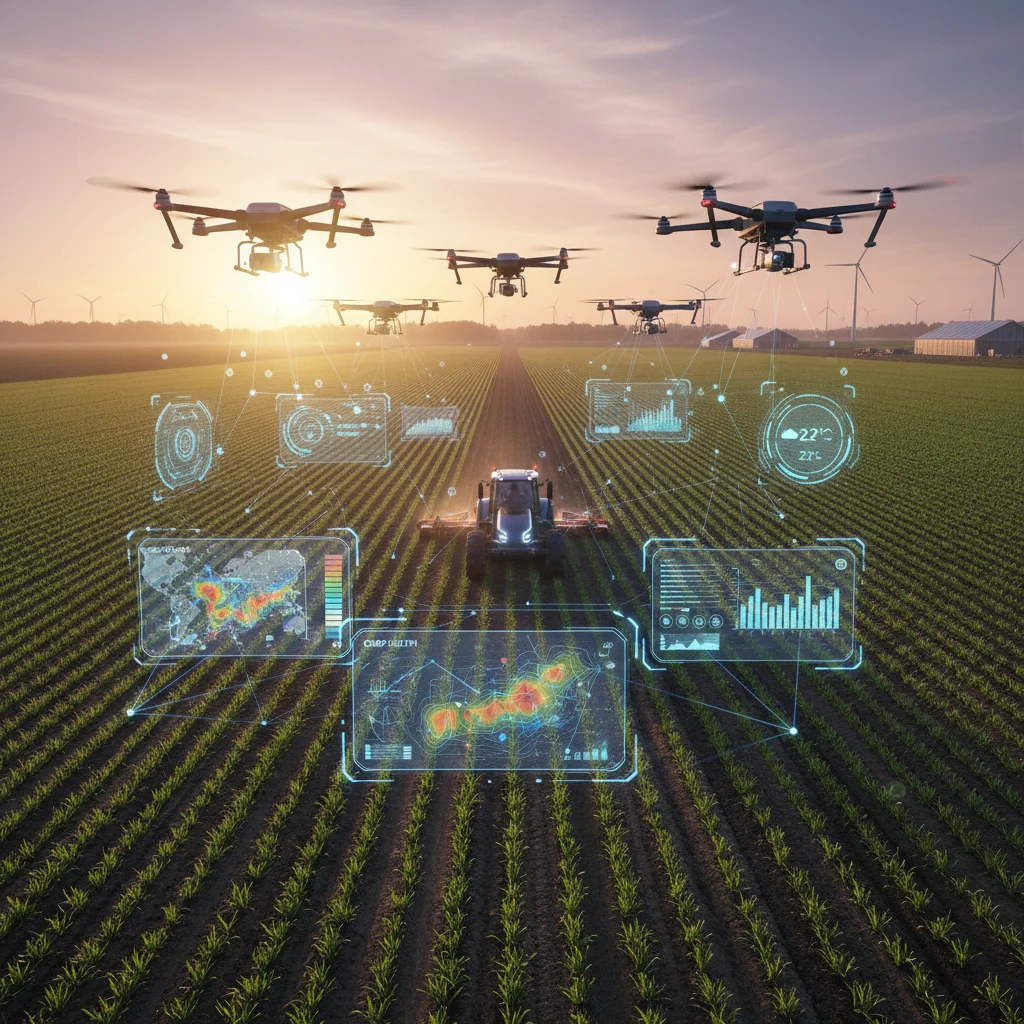
The agriculture analytics market is scaling from USD 7.53 billion in 2025
Agriculture Analytics Market Size, Share & Forecast to 2034: Data-Driven Farming Moves Toward Core Infrastructure
The agriculture analytics market is moving from a niche digital toolset to a central part of farm operations. According to the report context provided, the market was valued at USD 7.53 billion in 2025, is projected to reach USD 8.63 billion in 2026, and is expected to climb to USD 25.76 billion by 2034, reflecting a 14.65% CAGR over the forecast period. That growth trajectory suggests more than cyclical interest in software; it points to a structural shift in how farms manage inputs, risk, and productivity.
[IMAGE: Infographic-style market growth curve with agricultural icons and a digital data backdrop]
Market Snapshot: The Scale of the Agriculture Analytics Opportunity
The scale of the agriculture analytics market reflects rising dependence on data across modern farming. Farmers and agribusiness operators are increasingly using farm analytics, sensor networks, satellite imagery, and predictive models to make decisions that once relied heavily on experience alone. The result is a market that is expanding not only because of technology adoption, but because the economics of agriculture increasingly reward precision.
Several forces are reinforcing this shift. Yield pressure remains high, while labor availability is uneven in many regions. At the same time, fertilizer, water, feed, and energy costs continue to fluctuate. Climate volatility adds another layer of uncertainty, making timely decisions more valuable. In that environment, agricultural data analytics is not just a reporting layer; it is becoming part of operational control.
The forecast suggests that adoption will continue to broaden as analytics tools become easier to deploy and more closely integrated with field equipment, ERP systems, and cloud-based farm management platforms. This is why the market forecast matters: it captures a transition from isolated digital pilots to persistent operational spending.
Agriculture Analytics as the New Operating Layer of Farming
The economic logic behind analytics adoption is straightforward. Farming depends on the timing and scale of inputs, but the outcome is uncertain because weather, soil conditions, pest pressure, and commodity prices are variable. Analytics reduces that uncertainty by improving forecasting and decision-making around planting, irrigation, fertilization, harvesting, and distribution.
In practical terms, precision agriculture depends on data-driven insights that can optimize input use and improve yield consistency. A field-level recommendation system can help reduce over-application of fertilizer, detect crop stress earlier, and identify irrigation inefficiencies. For livestock operators, analytics can support feed conversion, animal health monitoring, and breeding decisions. These improvements matter because even modest gains in efficiency can materially affect margins.
This is why analytics is increasingly treated as essential infrastructure rather than an optional software layer. As farms become more connected through sensors, drones, satellites, and equipment telemetry, the value of analytics rises with the volume and quality of data available. In other words, the shift to smart farming is not only about collecting more information; it is about turning that information into operational decisions faster than before.
[IMAGE: Split-screen concept showing traditional farming on one side and sensor-driven digital farming on the other]
How Analytics Reshapes the Agricultural Supply Chain
The effects of agriculture analytics extend beyond the farm gate. Better forecasting changes how farms and suppliers manage procurement, storage, logistics, and post-harvest planning. When operators have clearer expectations for yield, disease risk, and harvest timing, they can plan seed purchases, fertilizer application, labor scheduling, and transport capacity with more confidence.
This has implications across the entire agricultural supply chain:
- Seed and input procurement: Predictive models can align purchases more closely with expected acreage and soil needs.
- Fertilizer and crop protection: Site-specific recommendations can reduce waste and improve timing.
- Water and irrigation planning: Analytics can prioritize water use where it has the highest return.
- Labor management: Seasonal labor needs can be scheduled more accurately.
- Storage and logistics: Yield estimates help determine warehousing requirements and delivery timing.
- Post-harvest operations: Better forecasts reduce bottlenecks in sorting, processing, and distribution.
For suppliers and distributors, this creates an opportunity to integrate analytics into their service models. Agribusiness firms can use insights to offer bundled advisory services, automated replenishment, or farm performance dashboards. That shift can deepen customer relationships and make analytics part of the commercial workflow rather than a standalone product.
Market Segmentation: Where Growth Is Concentrating
The agriculture analytics market is expanding across multiple dimensions, but some segments are scaling faster than others because they align with the operational needs of different farm types.
By Component: Solutions and Services
The market is typically segmented into solutions and services. Solutions include software platforms, dashboards, forecasting tools, and data integration systems. Services include implementation, consulting, model customization, maintenance, and training.
The relationship between the two is complementary. Software provides the analytical engine, but services are often necessary to adapt that engine to local crop patterns, equipment systems, and business processes. This is particularly important in agriculture, where field conditions vary widely and many operators need support in interpreting data outputs.
For vendors, this means recurring revenue is not limited to software subscriptions. Advisory and support services remain an important part of the adoption cycle, especially for first-time users.
By Deployment: Cloud and On-Premises
Deployment trends show growing momentum for cloud agriculture solutions. Cloud deployment offers scalability, lower upfront infrastructure costs, and easier access to data across multiple locations. It is especially attractive for farms and agribusinesses that need remote monitoring, real-time updates, or integration with third-party platforms.
On-premises systems still matter for organizations that require tighter control over data, limited connectivity, or highly customized internal workflows. However, the cost and maintenance advantages of cloud models continue to support broader adoption. For many users, cloud-based tools are the most practical route to deploying agricultural data analytics at scale.
By Application: Farm, Livestock, and Aquaculture
Application diversity is another reason the market is expanding. Core use cases include:
- Farm analytics for crop planning, soil management, irrigation, and yield monitoring
- Livestock analytics for health tracking, feeding optimization, and herd performance
- Aquaculture and others for water quality monitoring, feed optimization, and production forecasting
As analytics use cases diversify, vendors can address different production systems and regional agricultural profiles. This broadens the total addressable market and reduces dependence on a single crop cycle or commodity segment.
By Farm Size: Large Farms and Small & Medium Farms
Adoption also differs by farm size. Large farms typically adopt analytics faster because they manage more acreage, generate more data, and can justify larger upfront investments. They also tend to have more complex operational needs, making analytics valuable for coordination and performance control.
Small and medium farms face more adoption barriers, especially around cost, training, and return-on-investment uncertainty. Even so, cloud delivery, mobile interfaces, and subscription pricing are lowering entry barriers. As tools become simpler and more affordable, smaller operators are gaining access to capabilities that were once concentrated in large-scale operations.
[IMAGE: Modular dashboard graphic showing solution, services, cloud, livestock, and farm size categories]
Regional Structure: Why Adoption Is Uneven but Broadening
Regional adoption patterns in agriculture analytics are uneven, but the overall direction is consistent: digital tools are becoming more embedded in farm management across major agricultural economies.
North America remains a leading region due to large-scale commercial farming, high technology adoption, and strong ecosystem support from equipment manufacturers, software providers, and agribusiness firms. The region’s farms often have greater access to capital and better connectivity, making it easier to deploy analytics across operations.
Europe shows strong demand as well, especially where sustainability, traceability, and resource efficiency are major priorities. Regulatory pressure and environmental monitoring requirements can accelerate analytics adoption in crop and livestock operations.
Asia-Pacific is a significant growth region because of its large agricultural base and increasing investment in digital infrastructure. As farms modernize and governments support productivity improvements, analytics tools are becoming more relevant across a wider range of production systems.
Latin America, the Middle East, and Africa are also emerging markets for farm analytics, though adoption is shaped by infrastructure gaps, farm fragmentation, and uneven access to capital. Over time, mobile-first tools and cloud-based platforms may help broaden use in these regions.
What Is Driving Capital Allocation in the Market
The business case for agriculture analytics is increasingly tied to capital allocation. Farms and agribusinesses are under pressure to invest where returns are measurable, and analytics helps identify those returns more clearly. By quantifying yield variability, input efficiency, and operational risk, analytics supports more disciplined spending decisions.
This matters not only for farms, but also for investors, lenders, and insurers. Data-backed performance metrics can improve credit assessment, support risk pricing, and make agricultural operations more transparent. In that sense, the rise of analytics affects the financial architecture of farming as much as the operational side.
As the market matures, competition will likely shift toward platforms that can combine real-time data collection, predictive modeling, and decision support in one workflow. The winners may be those that can integrate across the full chain, from field sensing to procurement planning to post-harvest logistics.
Outlook to 2034
The projected growth of the agriculture analytics market to USD 25.76 billion by 2034 reflects a broader change in the economics of farming. Analytics is becoming part of how agricultural businesses manage uncertainty, improve margins, and respond to climate and cost pressure. Rather than functioning as a separate digital add-on, it is evolving into a practical layer of smart farming infrastructure.
For the industry, the key question is no longer whether data matters. It is how quickly analytics can be embedded into everyday decisions across crops, livestock, aquaculture, and supply chains. The answer will shape productivity, competitiveness, and resilience across the sector over the next decade.