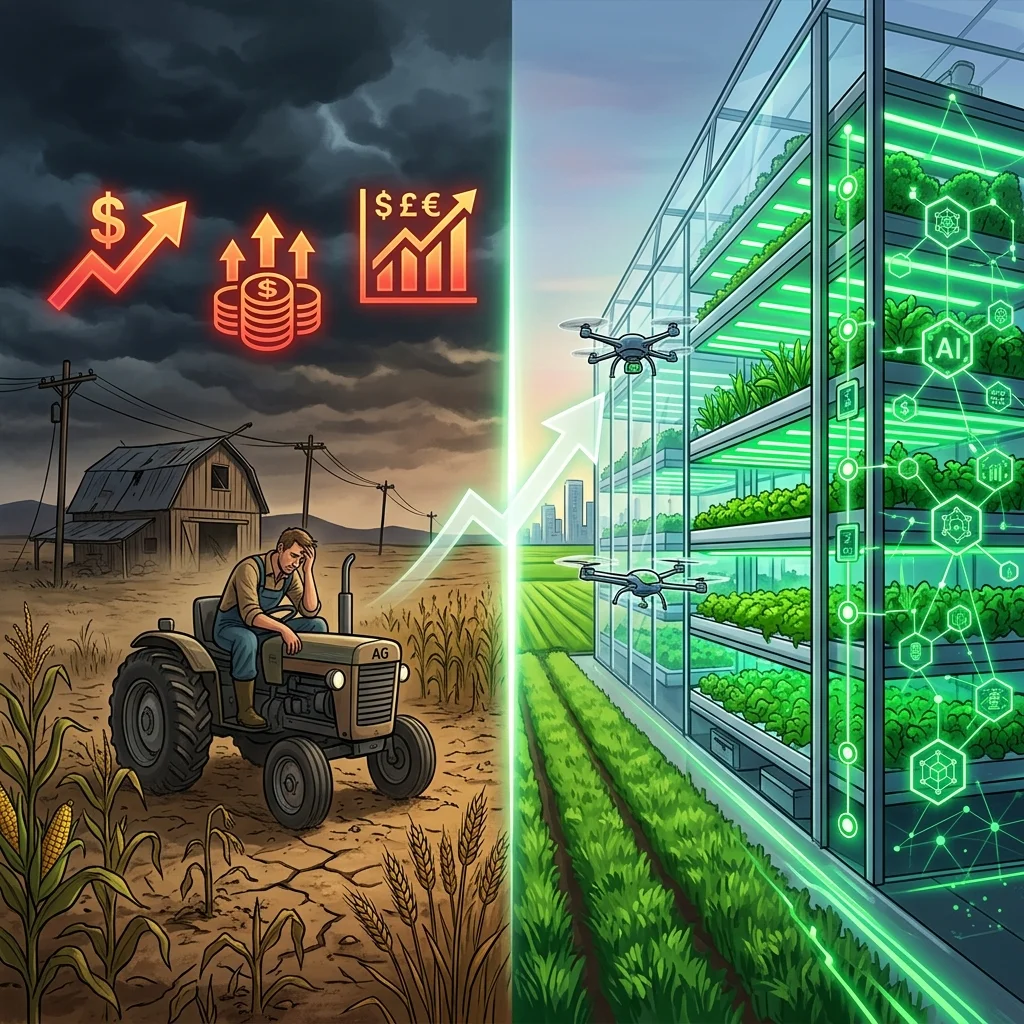
The global agribusiness market is set to grow from USD 5.5 trillion in 2025
Agribusiness Market 2026-2035: Digital Transformation, Climate Risks, and the Race for Sustainable Growth
The global agribusiness market is entering a decade of profound structural change. Valued at $5.5 trillion in 2025, it is projected to reach $8.5 trillion by 2035, growing at a compound annual growth rate (CAGR) of 5%. This expansion is fueled by the accelerating adoption of precision farming, artificial intelligence (AI), Internet of Things (IoT) sensors, and blockchain-based traceability systems. Yet beneath the growth numbers lies a contradictory reality: 41% of farms report significant climate disruptions, and 37% face rising input costs. The tension between rapid technological transformation and persistent structural vulnerabilities defines the next ten years for the agribusiness industry.
Based on the latest FAO and USDA data, and with the base year set at 2025 (historical data covering 2022–2024), the report provides a forward-looking baseline. The interim figure for 2026 is estimated at approximately $5.79 trillion. This article unpacks the key forces shaping the market — regional dynamics, value chain shifts, technology adoption rates, and the hidden fault lines that will separate winners from laggards.
[IMAGE: Bar chart showing market size 2022–2035 with CAGR arrow, highlighting the jump from $5.5T to $8.5T]
---
1. Executive Summary & Market Trajectory
The agribusiness market in 2025 stands at $5,512.5 billion, driven by rising global food demand, population growth, and the need for higher agricultural productivity. The compound annual growth rate of 5% through 2035 reflects both structural tailwinds — such as digitalization and sustainability mandates — and persistent headwinds, notably climate volatility and input cost inflation.
Precision farming adoption is one of the strongest growth catalysts. According to FAO surveys, 65% of large-scale farms globally have now adopted at least one precision agriculture tool, and 62% of agribusinesses identify precision farming as their top strategic focus. Meanwhile, AI and IoT integration is reshaping everything from crop monitoring to predictive pest management. Blockchain traceability, adopted by 46% of firms in 2025, is gaining traction as consumers demand transparency and food safety assurance.
However, growth is not uniform. The 2026 interim market size of $5,788.13 billion already hints at the early effects of climate-related disruptions — droughts, floods, and heatwaves that reduce yields and raise costs. Input costs (fertilizers, energy, labor) have risen by an average of 12% since 2022, squeezing margins across the value chain. The industry is locked in a race: technology investments must outpace the compounding risks to sustain the projected CAGR.
[IMAGE: Line graph showing CAGR trajectory with markers for climate events and input cost spikes overlaid]
---
2. Regional Power Play: North America vs. Asia-Pacific vs. Europe
Regional market shares reveal a three-way competition with distinct strategic profiles.
North America commands the largest share at 33% in 2025, fueled by advanced digital infrastructure, strong agri-tech venture capital, and concentrated large-scale farming operations. The United States alone accounts for over 80% of the region’s agribusiness output. Here, precision farming and AI adoption rates exceed 70%, and blockchain traceability is increasingly mandated by large retailers. Yet the region is not immune to climate stress: the 2024–2025 Midwest drought cycle reduced corn yields by 9%, highlighting even the most technologically advanced systems remain vulnerable.
Asia-Pacific follows closely with 31%, driven by massive population pressure and aggressive government digitization programs. India’s Digital Agriculture Mission and China’s smart farming subsidies are pushing adoption in a region that is simultaneously the most climate-vulnerable. Southeast Asia’s reliance on monsoon patterns, coupled with extreme heatwaves, means that 47% of smallholder farms in the region faced at least one climate disruption in the past two years. Despite these risks, the region’s agribusiness market is growing at 6.2% CAGR — above the global average.
Europe accounts for 25%, shaped heavily by the European Green Deal and the Farm to Fork Strategy. Organic farming now covers 10.5% of EU agricultural land, and 61% of European agribusiness firms report investing in sustainable supply chains. However, technology uptake is slower than in North America, partly due to fragmented landholdings and regulatory complexity. Precision farming adoption in Europe is 58%, trailing behind North America’s 75%.
The Rest of the World (11%) includes Latin America, where soybean and beef exports dominate, and Africa, where underdeveloped infrastructures offer significant growth potential but also the highest exposure to climate shocks. Latin American agribusiness faces deforestation-related trade pressures, while Africa’s digital leapfrogging — mobile-based farm advisory and micro-insurance — could reshape the market after 2030.
[IMAGE: World map heatmap showing market share by region, with icons for key crops (corn, rice, wheat, soy) and technology symbols (drone, IoT sensor, blockchain node)]
---
3. Value Chain Disruption: Suppliers, Retailers, and the Digital Shift
The agribusiness value chain is undergoing a fundamental rebalancing. Suppliers — including seed, chemical, and machinery companies — currently hold the largest share of value at 42%, but their dominance is being challenged. Retailers, who control 35% of the market, are rapidly gaining through e-commerce platforms and direct-to-farm sales models, bypassing traditional distributors. The remaining 23% covers agribusiness services such as logistics, insurance, data analytics, and advisory — the fastest-growing segment, expanding at 8% annually as technology adoption rises.
The COVID-19 pandemic was a watershed moment: restaurant closures caused a massive demand shift toward grocery retail and online channels. In response, agribusinesses have invested heavily in digitized logistics, cold chain infrastructure, and real-time inventory tracking. Today, 58% of companies report adopting advanced supply chain technologies, up from 34% in 2020.
Blockchain traceability is a key disruptor in the retailer segment. Large grocers like Walmart and Carrefour now require suppliers to provide end-to-end traceability for high-risk products such as leafy greens and beef. Premium pricing for blockchain-verified products can reach 15–20% above conventional markets. However, scalability remains a challenge — only 12% of small and medium-sized farms have integrated blockchain, creating a two-tier system between early adopters and the rest.
The fastest-changing link is agribusiness services. Data analytics platforms that combine satellite imagery, weather models, and soil sensors now allow insurers to offer parametric insurance products that pay out automatically when rainfall thresholds are breached. This shift reduces claim processing time from months to days and is especially critical in climate-vulnerable regions.
[IMAGE: Flowchart showing agribusiness value chain: Suppliers (42%) → Producers → Processors → Retailers (35%) → Consumers, with digital transformation arrows highlighting blockchain, AI, and e-commerce connections. Services (23%) shown as an overlay platform]
---
4. Technology Adoption: Precision Farming, AI/IoT, Blockchain, and Sustainability
Technology adoption is the engine of market growth, but adoption rates vary significantly across technologies and company sizes.
Precision farming has the highest strategic priority: 62% of agribusinesses name it as their primary focus. FAO data confirms a global adoption rate of 65% among large farms, while smallholders lag at 22%. The most common precision tools include variable-rate fertilization (48% adoption), GPS-guided machinery (41%), and drone-based crop monitoring (36%). The return on investment is clear: farms using precision methods report a 12–18% reduction in input costs and a 7% yield increase.
AI and IoT integration is adopted by 55% of firms, yet only 29% have deployed it at scale. Common applications include predictive algorithms for pest outbreaks, real-time soil moisture sensors, and autonomous tractors. IoT sensor networks in California’s Central Valley, for example, reduced irrigation water use by 25% during the 2023 drought. The challenge remains data interoperability — farms often use equipment from multiple vendors whose systems do not communicate.
Blockchain traceability reached 46% adoption in 2025, but this figure masks a steep gradient: 82% of top-10 agribusiness firms use blockchain for at least one product line, versus 12% of smallholders. The technology enhances food safety (reducing recall costs by 40% on average) and commands premium pricing. Yet the upfront cost of integrating blockchain across diverse supply chains remains prohibitive for many.
Sustainability and organic farming are emphasized by 47% of agribusinesses. The USDA reports that 61% of firms are investing in sustainable supply chain practices, including carbon sequestration programs, regenerative agriculture, and reduced chemical inputs. Organic farmland acreage globally has grown 14% since 2022, though it still represents only 1.8% of total agricultural land. The tension between sustainability ambitions and short-term profitability is most acute in developing economies, where input costs for organic certification can be 30% higher.
[IMAGE: Four-panel infographic showing adoption rates for precision farming (62%), AI/IoT (55%), blockchain (46%), and sustainability (47%), with smallholder vs. large farm breakdowns and growth arrows]
---
The agribusiness market of 2026–2035 will be defined not by a single technology or region, but by the interplay between digital acceleration and climate resilience. The 5% CAGR is achievable only if the industry simultaneously scales precision tools, strengthens supply chain transparency, and addresses the structural vulnerabilities that leave 41% of farms exposed to climate disruptions. The winners in the next decade will be those who treat technology not as a standalone investment, but as an integrated system that builds resilience from seed to shelf.