Agribusiness is undergoing a paradigm shift that goes far beyond incremental
Beyond Pesticides and Plows: How Data, Drones, and Biologics Are Rewriting Agribusiness Economics
For decades, agribusiness prosperity rested on a straightforward formula: sell more chemicals, more machinery, and more seeds. Inputs were commodities; margins depended on volume. That formula is now being rewritten. A convergence of biological innovation, precision hardware, and data-driven financing is creating an entirely new economic logic—one where value no longer resides in the substance sprayed or the iron in a tractor, but in the information, service, and sustainability outcomes those assets deliver.
This paradigm shift is not theoretical. It is being capitalised by global giants and local startups alike, from John Deere’s pay-per-use tractors to UPL’s aggressive pivot toward bio-fungicides, and from Valmont’s subscription irrigation to drone networks that bypass traditional intermediaries in Asia. Beneath these moves lies a hidden economic truth: the commoditisation of physical inputs is giving way to value creation through data, services, and sustainability. The implications for global supply chains, farmer finance, and regulatory frameworks are profound.
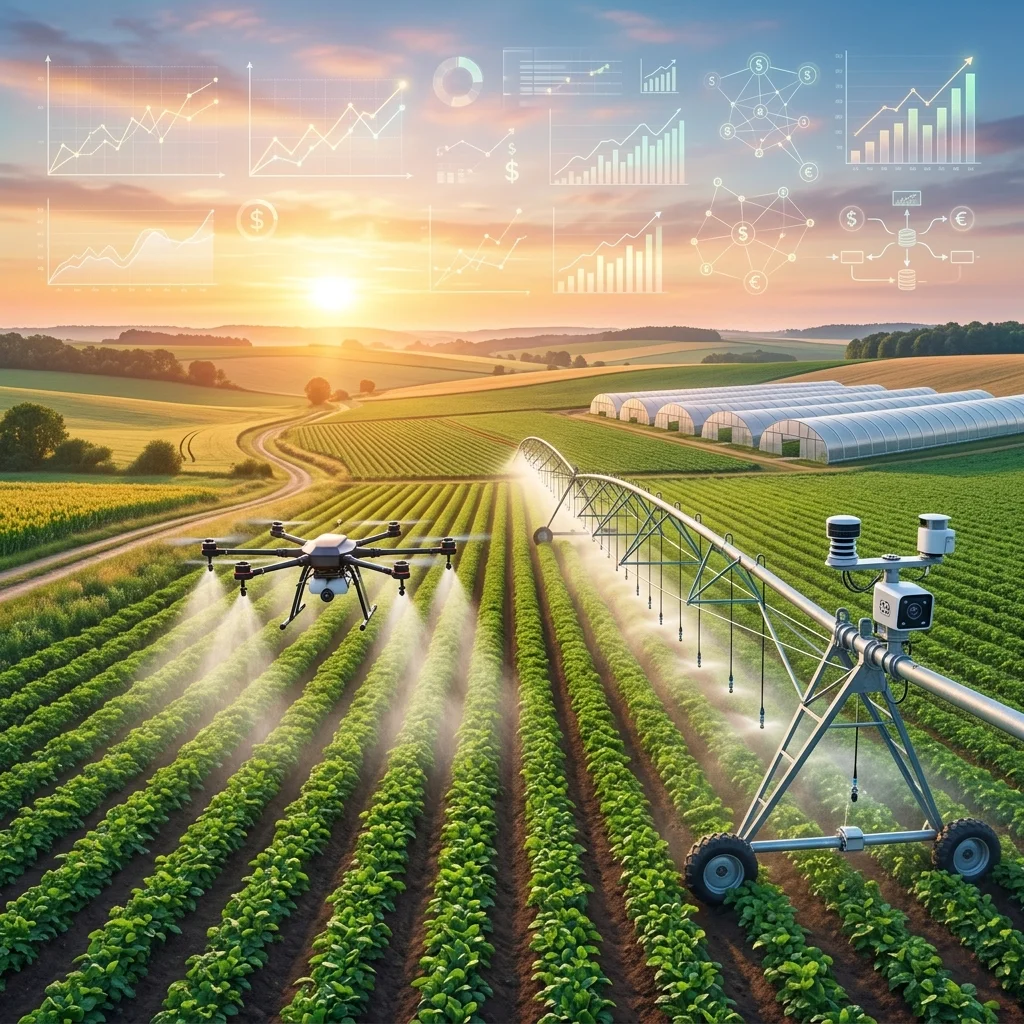
[IMAGE: A futuristic panoramic view of an agricultural landscape at sunrise, showing a mix of technologies: a drone spraying bio-pesticides over rows of crops, a center pivot irrigation system with a camera mounted on the arm, and a poly tunnel in the background. Overlay subtle data visualizations and financial graphs in the sky, representing the convergence of data and financing. No text, no watermark. Realistic yet slightly abstract style.]
The Great Unbundling: From Chemical Packages to Biological Services
The first pillar of this transformation is the unbundling of the traditional agrochemical package. For years, farmers bought herbicides, fungicides, and insecticides as standalone products, applied at fixed intervals with little regard for site-specific conditions. Today, consumer demand for residue-free food and tightening government regulations on synthetic chemicals are driving a massive shift toward biological alternatives.
Companies that built their fortunes on glyphosate and neonicotinoids are now investing heavily in bio-stimulants, bio-fungicides, and bio-insecticides. The strategic pivot is most visible at UPL, one of the world’s largest agrochemical firms. In its 2023 sustainability report, UPL explicitly set a target of generating 15% of its revenue from sustainable natural plant protection products in Africa by 2030. This is not a marginal pilot; it represents a multi-billion-dollar reorientation of R&D pipelines, acquisition strategies, and go-to-market models.
How does UPL intend to reach that target? Through a combination of internal R&D, partnerships with biotechnology startups, and acquisitions of firms holding registered biological products. Already, the company has launched bio-fungicide formulations based on Trichoderma and Bacillus strains in key markets. The economic logic is clear: biological products carry lower regulatory risk, command premium pricing, and align with the ESG mandates of institutional investors who now dominate the capital markets. For smallholder farmers in Africa and Asia, these products reduce the health risks of handling synthetic chemicals and can be applied using simpler equipment—lowering the entry barrier to precision agriculture.
Yet the most interesting insight from the biological transition is not about chemistry at all. It is about hardware. Consider Haygrove, a UK-based manufacturer of poly tunnels. The company’s structures allow farmers to grow high-value crops like berries, tomatoes, and lettuce under controlled environments, drastically reducing the need for chemical sprays. The physical asset—a poly tunnel—becomes a platform for integrated pest management (IPM). Instead of replacing one chemical with another, farmers combine physical barriers, beneficial insects, and targeted bio-fungicides to achieve pest control. The poly tunnel is not a chemical solution; it is a hardware solution that enables a biological service model. This illustrates a critical point: the unbundling of chemicals is not merely about substituting active ingredients; it is about redesigning the entire agricultural system around biology and data.
[IMAGE: Split image: left side shows a traditional chemical sprayer in a field, right side shows a bio-fungicide application in a poly tunnel with workers in protective gear. Overlay a small bar graph showing UPL’s projected revenue shift from synthetic to sustainable products.]
The Machinery-as-a-Service Revolution: Financing Becomes a Data Game
If the biological revolution is reshaping what farmers apply, the machinery-as-a-service revolution is reshaping how they apply it—and, more importantly, how they pay for it. The traditional model required farmers to raise large capital to buy tractors, combines, and irrigation systems. That upfront cost is a major barrier, especially for the 500 million smallholder farmers who produce most of the world’s food. Equipment manufacturers are now flipping the model: instead of selling a machine, they sell an outcome.
John Deere has been at the forefront of this change with its John Deere Financial arm. The company is piloting pay-for-use models in which farmers pay per acre or per hour of machine operation. The financing terms are dynamic, adjusted in real-time based on data collected from the equipment’s sensors. Usage data—how many hours the tractor runs, at what engine load, in what soil conditions—becomes a proxy for creditworthiness. Every tractor becomes a rolling credit score. For the farmer, this transforms capital expenditure into operating expenditure, freeing up cash for other inputs. For John Deere, it creates a recurring revenue stream and a deeper relationship: the company now knows precisely how its equipment performs, when it breaks, and how to improve it.
Valmont Irrigation offers an even more striking example. The company, long known for manufacturing center pivot irrigation systems, has launched a subscription service for its Valley Irrigation brand. Farmers no longer buy the pivot; they pay a monthly fee that covers hardware, software, maintenance, and real-time agronomic support. The pivot arm is fitted with cameras and sensors that monitor crop health, soil moisture, and even nutrient levels. Valmont can remotely adjust water and fertiliser application rates based on field conditions. For the grower, the subscription eliminates the headache of repair costs and obsolescence. For Valmont, it turns a one-time equipment sale into a long-term service contract with high switching costs.
The hidden economic logic here is profound: the value migrates from the iron to the information. A steel frame has diminishing marginal value over time; a data stream has increasing marginal value as more fields, more seasons, and more machine learning models are fed into it. This shift raises critical questions about data ownership and algorithmic pricing. Who owns the agronomic data generated by a John Deere tractor or a Valmont pivot? Can the manufacturer adjust subscription fees based on that data without the farmer’s consent? Regulators in the European Union and parts of the United States are beginning to grapple with these issues, but most jurisdictions lack clear frameworks. The emerging model promises lower barriers for farmers but also creates new dependencies—a farmer locked into a subscription cannot easily switch to a competitor without losing years of historical field data.
[IMAGE: Infographic comparing traditional ownership model (farmer buys tractor for $100k upfront) vs. pay-per-use model (farmer pays per acre with dynamic pricing based on sensor data). Show a John Deere tractor and a Valmont pivot with data flow arrows connecting to a cloud server. Include small text labels: "Capital Expenditure" vs. "Operating Expenditure".]
Drone Networks and the Factory-to-Farmers Model: Reshaping Input Logistics
Perhaps the most dramatic restructuring of agribusiness economics is happening in the skies. Drone technology in agriculture has matured rapidly, and nowhere is its impact more pronounced than in the Asia Pacific region. In rice paddies in Vietnam and palm oil plantations in Indonesia, drones have reduced pesticide usage by up to 80% compared to manual knapsack spraying. But the real innovation is not the drone itself; it is the logistics model it enables: the Factory-to-Farmers (F to F) model.
Historically, agrochemicals moved through a long chain from manufacturer to distributor to retailer to farmer. Each layer added margin and increased the risk of adulteration, improper storage, or incorrect application. With drones, manufacturers can produce specialised formulations designed specifically for ultra-low-volume UAV application. These formulations are concentrated, require less water, and are applied at precisely calibrated rates. The drone operator—often a local service provider—orders directly from the manufacturer. The product arrives in sealed, ready-to-use containers that are loaded into drone tanks within minutes. Intermediaries are bypassed. The result: lower costs, higher precision, and fewer counterfeit inputs.
CropLife Asia has recognised the potential and the risks. In 2022, the industry association began developing UAV operator training standards to ensure safety and efficacy. These standards cover pilot licensing, flight planning, weather monitoring, and drift control. The push for a science-driven regulatory framework is essential: without clear rules, drone application could lead to off-target drift, environmental damage, and liability disputes. Yet the economic logic is undeniable. For a smallholder farmer in Thailand earning $1,000 per hectare, spraying costs can consume 20% of revenue. Drone-based application reduces labour, water, and chemical costs simultaneously, boosting net margins by an estimated 30–40%.
The F to F model also enables new financing structures. Because the manufacturer sells directly to the drone operator, the operator can bundle the cost of the chemical with the cost of the flight into a single service fee. Farmers pay per hectare, not per litre. This aligns with the broader trend of “outcome-based agriculture,” where the farmer pays for pest control results rather than for inputs. It is a natural extension of the machinery-as-a-service revolution, but applied to the input itself.
[IMAGE: A drone flying low over a green rice paddy field in Asia, with a hopper visible underneath. In the background, a small factory building with a sign "F to F Direct Supply". Insert a flowchart overlay: Manufacturer → Drone Operator → Farmer, with arrows showing reduced steps compared to traditional: Manufacturer → Distributor → Retailer → Farmer.]
The Underpinning Economics: Commoditisation of Inputs, Valorisation of Data
Taken together, these three trends—biological substitution, machinery-as-a-service, and drone-driven logistics—share a common economic DNA. Physical inputs are becoming commoditised. A litre of insecticide, whether synthetic or biological, is a fungible product; its price is driven by supply and demand, not by proprietary differentiation. The value that agribusiness firms capture increasingly comes from three sources: data, services, and sustainability.
Data allows companies to know precisely when and where to apply inputs, reducing waste and improving efficacy. Services transform one-time purchases into recurring revenue streams with higher lifetime customer value. Sustainability creates a premium that consumers, retailers, and regulators are willing to pay. The rise of carbon farming credits, water quality trading, and biodiversity offsets is turning sustainability into a measurable financial asset. Companies that can prove they reduce environmental harm—through lower pesticide use, reduced water consumption, or soil carbon sequestration—can monetise that proof.
But there is a tension. The same data that enables precision also concentrates power. If John Deere controls a farmer’s historical yield data, field boundaries, and soil maps, the farmer cannot easily switch to a competitor. Similarly, if a drone operator owns the application records, the farmer loses the ability to choose a different service provider without losing history. Regulators in India and the European Union are exploring data portability mandates, but progress is slow.
Financing Innovations: Blending Green Bonds with Pay-for-Use
The fourth pillar of this transformation—and the glue that holds the others together—is financing innovation. Traditional agricultural loans are based on land value and historical yields. They ignore the very assets that are driving productivity: data, biological products, and drone services. New financing instruments are emerging to fill the gap.
Green bonds specifically earmarked for sustainable agriculture are one example. In 2024, the International Finance Corporation issued a $200 million green bond that included a tranche for financing bio-fungicide adoption and drone services in East Africa. The bond’s interest rate was linked to measurable environmental outcomes—reduced chemical runoff, for instance—creating a direct financial incentive for farmers to adopt the new technologies.
Another innovation is revenue-based financing for drone operators. Rather than requiring a drone operator to put up collateral for a loan, lenders use the operator’s service contracts and projected flight hours as the basis for credit. The operator repays the loan as a percentage of future revenue. This model, common in software-as-a-service financing, is now being applied to hardware. It reduces the upfront cost of drone fleets and accelerates adoption.
Valmont’s subscription irrigation model is itself a form of financing. By converting a capital expense into an operating expense, the company enables farmers who lack access to bank credit to acquire sophisticated irrigation technology. The monthly fee includes maintenance and software updates, reducing the risk of breakdowns that could devastate a crop. For insurers, this predictability is valuable: farms with Valmont subscriptions have been shown to have lower claim rates for drought-related losses.
[IMAGE: Diagram showing a circular flow: Farmer pays per-acre fee → technology provider collects data → data improves agronomic models → reduced input waste → lower environmental impact → green bond investors receive returns linked to impact. Label each arrow.]
Regulatory Gaps: The Missing Framework for a New Economy
All these innovations are running ahead of regulatory frameworks. Biological products face a registration process originally designed for synthetic chemicals. Many bio-fungicides and bio-insecticides are derived from naturally occurring microorganisms; they degrade quickly and have low toxicity. Yet they must still undergo multi-year field trials that cost millions of dollars. Startups developing novel biologicals often cannot afford the registration hurdle, stifling innovation.
Similarly, drone regulations vary wildly across countries. In India, the Directorate General of Civil Aviation has eased some restrictions for agricultural drones, but states impose their own licensing requirements. In Indonesia, drone operators must register every flight and obtain a permit for each chemical applied, creating a bureaucratic bottleneck. CropLife Asia’s push for standardised training is a step forward, but without government endorsement, it remains voluntary.
The pay-for-use and subscription models also raise questions about consumer protection and anti-trust. If John Deere owns the data and sets the algorithm, can a farmer contest a suddenly higher per-acre payment following a machinery error? The legal frameworks for “algorithmic pricing” in agriculture are virtually non-existent. Some legal scholars argue that farmers should have the right to access and audit the algorithms that determine their payments, mirroring the “right to explanation” in European data protection law.
Long-Term Implications for Global Supply Chains
The convergence of biologics, drones, and machinery-as-a-service is not just reshaping farm economics; it is rewriting global supply chains. In the old model, commodity traders bought uniform grains from large growers using standardised inputs. In the new model, differentiation is possible at the field level. A rice farmer in Vietnam who uses drone-applied bio-fungicides and Valmont-controlled irrigation can produce a zero-residue crop that commands a premium in Japanese or European markets. The supply chain can trace every input, every flight, and every data point back to the field.
This transparency is a double-edged sword. For exporters in developing countries, meeting the documentation and certification requirements of premium markets can be prohibitively expensive. Yet it also creates opportunities: digital crop passports, blockchain-based traceability, and carbon credits can become new sources of revenue. Early movers like UPL and John Deere are positioning themselves as gatekeepers of this new infrastructure.
The ultimate question is whether the benefits will reach smallholder farmers or remain concentrated among large commercial operations. The economics of drones and subscriptions favour scale—a drone operator needs a certain number of hectares to justify the investment. But the F to F model, combined with revenue-based financing, could lower the threshold. If a group of smallholders can collectively hire a drone operator and share the subscription cost of a Valmont pivot, the per-hectare cost becomes competitive.
Conclusion: A New Paradigm, Still Unwritten
The agribusiness of 2030 will look nothing like the agribusiness of 2010. The physical inputs—chemicals, tractors, irrigation pipes—will still exist, but they will be embedded in layers of data, service contracts, and sustainability metrics. The economic centre of gravity is shifting from selling stuff to selling outcomes. The companies that succeed will be those that control the data architecture, finance the transition, and navigate the regulatory maze.
For now, the transformation is still in its early stages. UPL’s 15% target is ambitious but achievable. John Deere’s pay-for-use pilots cover only a fraction of its fleet. Valmont’s subscription model is gaining traction in water-stressed regions but remains niche. And drone-based F to F models are spreading rapidly across Asia but face a patchwork of regulations.
What is clear is that the old formula—more chemicals, more machines, more land—has reached its limits. The new formula is more data, more biology, more services. The farmers, financiers, and regulators who embrace this economic rewrite will shape the future of food. Those who resist will find themselves priced out of a market that no longer values iron and sprays for their own sake, but for what they can deliver: a sustainable, data-driven harvest.