This article will examine an otherwise unreadable PDF from the Africa for
Africa for Results Initiative PDF Points to Agriculture Investment as a Policy Topic
[IMAGE: A close-up of a digital document viewer with an abstract PDF icon and faint institutional archive shelves in the background.]
1. What Can Be Verified From the File Itself
The source provided for this article is not a readable policy paper in the usual sense. It is a PDF 1.5 file hosted on a public URL under the Africa for Results Initiative domain, and the visible reference includes a clear document title: “Private Investment in Africa Agriculture Resources.” That basic metadata is important because it establishes the document as an institutional publication, even though the extracted text does not allow a normal content summary.
What can be stated with confidence is limited. The file format is PDF 1.5, the title suggests a focus on private investment and African agriculture resources, and the document appears to come from an Africa for Results Initiative repository. Beyond that, the supplied excerpt does not expose readable body text, author names, page-by-page arguments, or publication date. Any stronger conclusion would go beyond the source material.
Just as importantly, there is no visible political, legal, election, or geopolitics content in the supplied excerpt. The document should therefore be treated as an institutional signal rather than a fully readable report.
2. Why the Metadata Still Matters
Even sparse file metadata can reveal something useful about policy communication. A title like Africa agriculture resources investment points to a specific policy and development interest: how capital enters the agriculture-linked resource economy in African countries. That does not tell us what the paper argues, but it does indicate the topic area the institution wanted to foreground.
For researchers, journalists, and analysts, this kind of document is often useful as a signpost. It shows what a platform considers worth archiving and circulating. In this case, the combination of the file title, hosting institution, and PDF format suggests an attempt to frame private investment in Africa as part of a development agenda, even if the text excerpt does not let us inspect the argument itself.
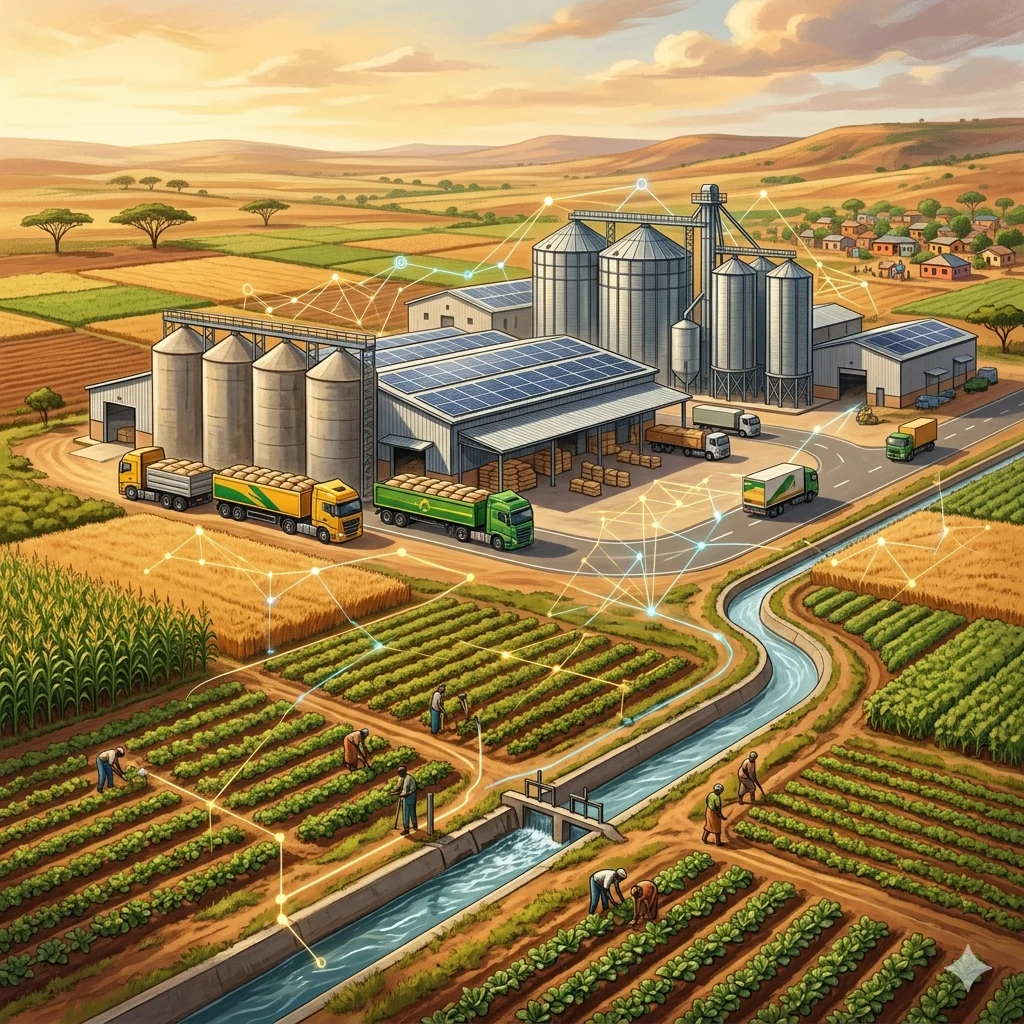
[IMAGE: A high-resolution editorial illustration of African agricultural landscapes blended with modern investment infrastructure: farmland, irrigation canals, trucks, storage silos, and a subtle financial network overlay. Warm natural tones, realistic style, professional business journalism aesthetic, no text, no watermark.]
3. Separating Fast Verification From Slower Analysis
This document belongs in the category of slow analysis. Fast analysis would only confirm the basics: file provenance, title, format, and whether the source is hosted by the expected institution. Those checks matter because they reduce the risk of misattribution.
Slow analysis asks a different question: what does the document’s existence suggest about the policy environment around private investment in Africa and agriculture resources? Here, caution is essential. The PDF excerpt does not provide enough text to support claims about market design, reform proposals, or investment outcomes. A responsible reading should therefore stay narrow and source-based.
In practical terms, that means the document can be used as a starting point for a broader review of African development finance and investment communication, but not as proof of any particular policy position. The best next step would be to locate the full PDF text, publication metadata, and any related series pages before drawing conclusions.
4. The Topic Implied by the Title: Agriculture and Capital
The title points toward a subject that is widely relevant across the continent: how capital interacts with agriculture and resource-linked production. Even without readable body text, the title implies an interest in financing, ownership, and the institutions that support farm-sector activity.
This is where private investment in African agriculture resources becomes an economic topic rather than a slogan. Agriculture rarely depends on farmland alone. It also depends on transport, storage, irrigation, processing, input supply, and market access. Those elements are often the first areas where private capital is discussed, because they shape whether agricultural activity can move beyond subsistence production into organized commercial supply.
That said, the PDF excerpt itself does not tell us which parts of the chain the authors prioritized. It would be a mistake to assume the paper focuses on farms, exporters, processors, or infrastructure without seeing the actual text. The only defensible statement is that the title places agriculture resources and investment in the same frame.
5. What Cannot Be Claimed From the Sparse PDF
Because the body text is unreadable in the supplied material, several common reporting shortcuts are not justified here. We cannot say the document proposes a specific investment model. We cannot say it endorses public-private partnerships, land reform, export promotion, or industrial processing. We also cannot say it evaluates risk allocation, currency exposure, or regional value-chain performance.
This limitation matters because titles can overstate, simplify, or merely label a topic without presenting a full argument. A title about agricultural resources and private capital may refer to a conference note, a briefing, a policy memo, or a presentation slide deck. Without the readable content, the safest interpretation is that the document signals subject matter, not conclusions.
[IMAGE: A split-screen concept: on one side a stopwatch and file metadata, on the other side agricultural supply chains and financial charts.]
6. Where a Deeper Review Would Focus
If the full document became available, the most useful review would not begin with broad claims about development impact. It would begin with four basic questions:
- What is the document type?
- Who authored it?
- When was it published?
- What surrounding series or archive context exists?
Those questions are source-driven and verifiable. They would provide a much firmer basis for analysis than extrapolating from the title alone.
7. Reading the Title as a Policy Signal, Not a Conclusion
The most careful interpretation is that the Africa for Results Initiative considered private investment in Africa agriculture resources a subject worth documenting. That is not the same as demonstrating a policy outcome. It simply shows the institution placed the topic within its archive and dissemination system.
For observers of agricultural value chains, that is still a meaningful clue. It suggests that private capital, agricultural development, and resource management are being discussed together in at least some policy circles. But the PDF excerpt does not tell us whether the document is optimistic, skeptical, technical, or descriptive.
This distinction is important for source fidelity. A sparse PDF should not be turned into a narrative about investment behavior unless the text itself supports that narrative.
8. What the Document Reveals About Communication Practices
A document with little readable text but clear institutional provenance also tells us something about information management. Organizations often publish PDFs that are easy to archive but difficult to extract or search. That can limit accessibility, especially when titles carry the main load of discovery.
From a research perspective, this means metadata becomes unusually important. The file name, PDF version, hosting domain, and title are sometimes the only usable clues. In this case, those clues are enough to identify the general subject area, but not enough to write a content summary in the normal sense.
This is why it is better to describe the item as a metadata-rich but text-poor source. That description is narrow, accurate, and useful to readers who need to know what can and cannot be inferred.
9. Conclusion: A Limited Source, a Clear Subject Area
The supplied PDF does not offer enough readable content for a detailed policy analysis. What it does offer is a clear title, a known host, and a recognizable institutional context. Taken together, those details show that the Africa for Results Initiative was circulating material on Africa agriculture resources investment and related development questions.
That is the strongest evidence available from the source. Any further claims about investment strategy, agricultural reform, or value-chain transformation would require the full text or additional publication metadata. Until then, the document should be treated as a prompt for further investigation rather than as a basis for sweeping conclusions.
In that sense, the PDF is useful precisely because it is sparse: it reveals how institutions signal priorities through archive choices, even when the body text is not readily readable.