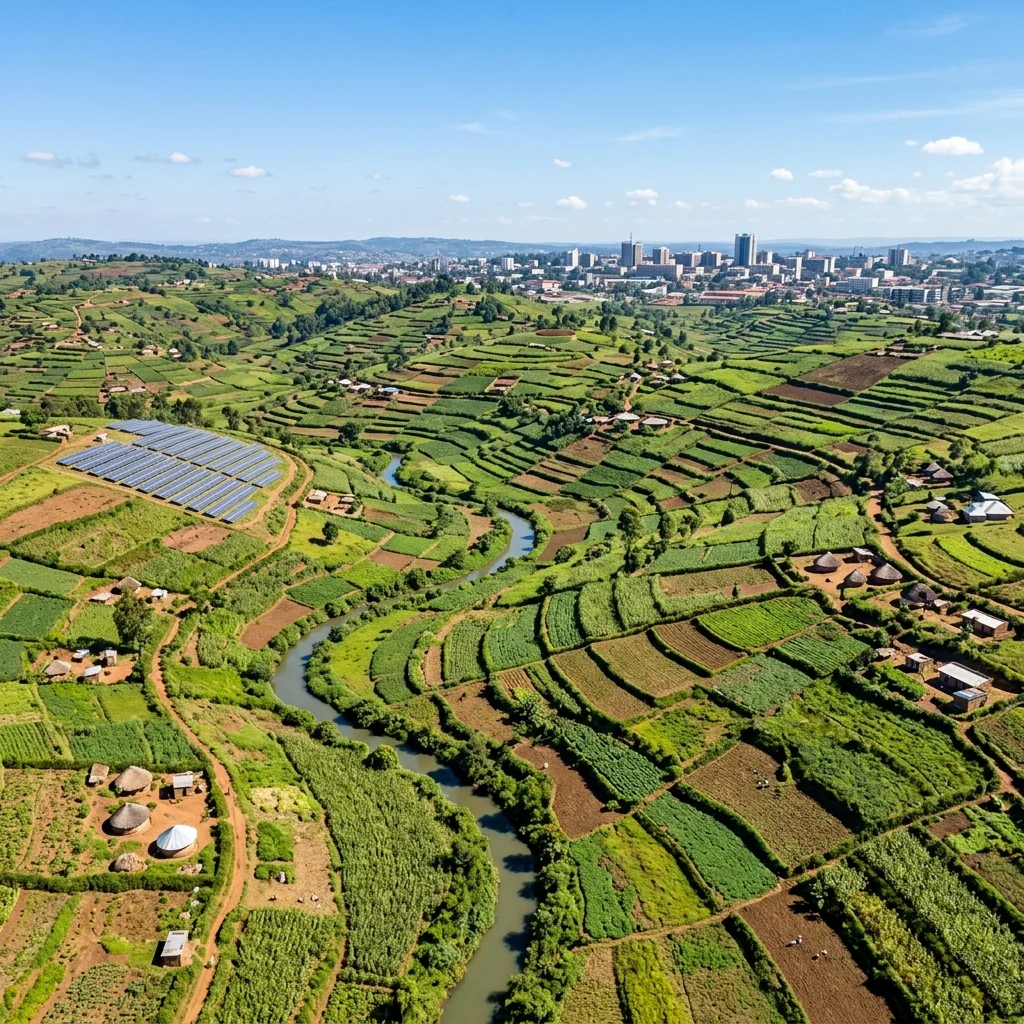
Africa holds 65% of the world's uncultivated arable land yet faces a financing
Unlocking Africa's Agricultural Future: How Sustainable Investment Can Bridge a $19.5 Trillion Gap
Africa stands at a crossroads of extraordinary potential and persistent underinvestment. The continent holds 65% of the world’s uncultivated arable land and roughly 30% of its mineral resources, yet capital flows into its agricultural sector remain disproportionately small compared to other developing regions. Agriculture accounts for 25% of Rwanda’s national GDP—a pattern repeated across dozens of African economies—making the sector central to livelihoods, food security, and export earnings. But a yawning financing gap threatens to stymie growth. The United Nations Economic Commission for Africa estimates the shortfall for African economic development at between $200 billion and $1.3 trillion annually, and projects it could reach $19.5 trillion by 2030 if current trends persist. Closing that gap requires a fundamental rethink of how investment is structured, what risk is worth taking, and how climate imperatives can be aligned with agricultural productivity.
[IMAGE: Map of Africa overlaying arable land zones with capital flow arrows and a 'gap' graphic showing the financing shortfall.]
The Great Paradox: Abundant Land, Scarce Capital
The numbers tell a story of contradiction. Africa possesses the largest reserve of unused arable land on the planet, yet the continent imports food worth roughly $35 billion each year. Smallholder farmers—who produce the majority of Africa’s food—lack access to credit, insurance, and modern inputs. Large-scale commercial farming remains rare outside South Africa, Kenya, and a few other hubs. The disconnect between resource wealth and capital flows is not accidental; it reflects structural barriers that must be understood before any investment strategy can succeed.
One fundamental issue is that agricultural investment in Africa is often perceived as high-risk and low-return. Political instability in some regions, currency volatility, weak property rights, and underdeveloped insurance markets deter institutional investors who could otherwise channel billions into the sector. At the same time, many African governments operate under heavy sovereign debt burdens, limiting their fiscal capacity to provide subsidies, guarantees, or public infrastructure that could catalyze private capital. The result is a self-reinforcing cycle: low investment leads to low productivity, which in turn reinforces perceptions of risk.
Yet the opportunity cost of inaction is staggering. If Africa could unlock even a fraction of its agricultural potential, it could become a global breadbasket, reduce poverty, and create millions of jobs—all while contributing to climate goals through sustainable land management. The key is to identify the specific barriers that keep capital on the sidelines and design instruments that address them directly.
[IMAGE: Infographic with four icons—shield (risk), document (bankability), puzzle piece (scale), chain (debt)—connected to a barrier wall.]
The Four Barriers to Agricultural Investment
At the 2024 Spring Bank meetings roundtable, policymakers, financiers, and agricultural experts identified four interconnected threats that collectively block investment in African agriculture. Understanding each is essential for crafting effective solutions.
Risk perception tops the list. Institutional investors—pension funds, insurance companies, sovereign wealth funds—are risk-averse by mandate. African agriculture presents a combination of political risk, currency depreciation, weather variability, and weak contract enforcement that many cannot accept within their portfolio constraints. Even when individual projects are sound, the perceived country-level risk often poisons the whole proposition.
Shortage of bankable projects is equally critical. Most African farmers are smallholders cultivating less than two hectares. They lack formal land titles, audited financial records, and the scale needed to attract large capital. A bankable project, from an investor’s perspective, is one with clear revenue projections, strong management, and measurable impact. The fragmented nature of African agriculture means that assembling such projects requires aggregation, technical assistance, and upfront investment in data systems—costs that few early-stage ventures can bear.
Small market and project scale compounds the problem. Transaction costs—due diligence, legal fees, monitoring—are often fixed. For a $100 million infrastructure bond, those costs are a fraction of the total. For a $500,000 loan to a cooperative of 200 farmers, they can be prohibitive. The absence of standardized, aggregated investment vehicles means that small but viable opportunities remain invisible to global capital.
Debt pressures constrain the public sector’s ability to intervene. Many African nations spend more on debt service than on health or education. They cannot afford to offer large interest-rate subsidies, loan guarantees, or price stabilization schemes that might de-risk agriculture. This fiscal reality forces governments to rely on private-sector-led solutions, but without public risk-sharing mechanisms, private capital often stays away.
These four barriers are not independent; they reinforce each other. High risk perception makes it harder to design bankable projects; lack of bankable projects perpetuates small scale; small scale keeps transaction costs high; and debt limits the public cushion needed to break the cycle. Breaking out requires a systemic approach.
[IMAGE: Flowchart showing how climate funds (from World Bank, AfDB, etc.) flow through blended finance vehicles to farm-level climate-smart projects.]
Climate Finance as the Missing Link
A powerful path forward lies in linking agriculture finance to climate finance. Climate-smart agriculture—practices such as agroforestry, drought-resistant crops, precision irrigation, and soil carbon sequestration—can simultaneously boost yields, build resilience, and reduce emissions. This alignment opens access to a growing pool of climate-directed capital, which is often more willing to accept concessional terms and longer time horizons.
The Nairobi Declaration, adopted at the Africa Climate Summit in 2023, captured this ambition in a single sentence: "No country should ever have to choose between development aspirations and climate action." The statement frames the challenge as a false dichotomy: Africa can pursue agricultural growth without sacrificing climate goals, provided the right financial architecture is in place.
Blended finance is the most promising tool to achieve this. Blended finance structures use concessional capital—from development finance institutions, philanthropies, or climate funds—to absorb first losses or provide guarantees, thereby reducing risk for private investors. For example, a green bond backed by a World Bank guarantee might fund a portfolio of climate-smart agriculture projects across several African countries. The guarantee protects investors against default, while the bond’s proceeds reach smallholders through local banks or cooperatives.
Carbon credits offer another revenue stream. Soil carbon sequestration in African farmlands has the potential to sequester billions of tons of CO₂ annually. Farmers who adopt regenerative practices—no-till farming, cover cropping, rotational grazing—can generate verified carbon credits that are sold on voluntary markets. Those revenues supplement farm income and create a direct financial incentive for sustainable land management. Major buyers, including airlines and technology firms, are already contracting for African soil carbon credits, providing a new asset class that bridges agriculture and climate finance.
[IMAGE: Photo of a smallholder farmer using a solar-powered irrigation pump in a field with drought-resistant maize; inset shows a carbon credit certificate graphic.]
The Private Sector's Pivotal Role
The scale of the financing gap—up to $19.5 trillion by 2030—means that public and concessional capital alone cannot fill it. The World Bank estimates that 90% of the investment needed for Africa’s agricultural transformation must come from the private sector. That includes commercial banks, impact investors, private equity, pension funds, and corporations along the agricultural value chain.
To attract that capital, the ecosystem must evolve. First, more bankable projects need to be created. This requires investment in project preparation facilities that provide technical assistance to smallholders, help them formalize land rights, and aggregate their outputs into investment-ready portfolios. Initiatives such as the African Development Bank’s "Technologies for African Agricultural Transformation" program are already doing this, but at a fraction of the scale needed.
Second, risk mitigation instruments must be scaled up. Partial credit guarantees, political risk insurance, and currency hedging facilities can transform an "uninvestable" project into a bankable one. The African Trade Insurance Agency and other regional bodies have pioneered such tools, but they remain underfunded relative to demand.
Third, innovative business models that reduce transaction costs are essential. Mobile-money-based lending, satellite monitoring of crop health, and blockchain-based land registries are all reducing the friction that previously kept capital out. Companies like Apollo Agriculture in Kenya and Pula in Nigeria are using data analytics to underwrite smallholder loans at scale, demonstrating that the "unbankable" farmer can indeed be served profitably.
Fourth, governments must create enabling environments. Clear land tenure laws, streamlined business registration, consistent tax policies, and investment in rural infrastructure—roads, storage, electricity—are prerequisites that no amount of financial engineering can replace. Public-private dialogues, like those fostered by the African Union’s Comprehensive Africa Agriculture Development Programme, help align expectations and build trust.
[IMAGE: Bar chart titled "Private Sector Share of Agricultural Investment Needed in Africa by 2030" showing public (10%) vs private (90%) with annotations on sources: commercial banks, pension funds, impact investors, corporate agribusiness.]
A 1% Revolution in Asset Allocation
The sheer size of global institutional capital—pension and sovereign wealth funds oversee tens of trillions of dollars—means that even a marginal shift in allocation would transform African agriculture. If just 1% of global institutional assets were directed toward sustainable agriculture on the continent, it would represent hundreds of billions of dollars, dwarfing current official development assistance.
Why hasn’t this happened? Because most institutional investors lack the vehicles, the track record, and the risk-adjusted return data to make the case to their boards. A small number of pioneering funds—such as the Livelihoods Funds, the African Agriculture Fund, and the Alliance for a Green Revolution in Africa’s investment arm—are proving the model works, but they remain niche.
To unlock the 1% shift, three things are needed: standardization of investment products (creating ETFs or bond indices for African agriculture), transparency of impact metrics (allowing investors to compare environmental and social outcomes), and policy certainty from host governments (locking in long-term regulatory frameworks). None of these is easy, but all are achievable with sustained collaboration between African governments, development finance institutions, and global asset managers.
Conclusion: From Gap to Opportunity
Africa’s agricultural financing gap is not an insurmountable problem—it is a mispriced opportunity. The continent has the land, the labor, and the growing demand to become a global leader in sustainable food production. What it lacks is the financial architecture to connect these resources with the capital that seeks both returns and impact.
Climate-smart agriculture offers a unifying framework: it addresses climate change, boosts productivity, and creates investable assets all at once. Blended finance and carbon markets provide the tools to de-risk and monetize these assets. Private sector participation, driven by a 1% shift in institutional portfolios, can supply the scale.
The path forward is clear. Governments must strengthen the enabling environment. Development finance institutions must expand guarantees and project preparation. Private investors must embrace innovation and patient capital. And all stakeholders must recognize that investing in African agriculture is not charity—it is one of the most compelling asymmetric bets in global development today. Bridging the $19.5 trillion gap means building a future where Africa feeds itself, powers its economies, and helps stabilize the global climate. That is a future worth investing in.