This article will examine how investment in Africa’s agricultural resources
Africa Agriculture Resources Investment: Capital, Technology, and Supply Chains Are Reshaping Food Production
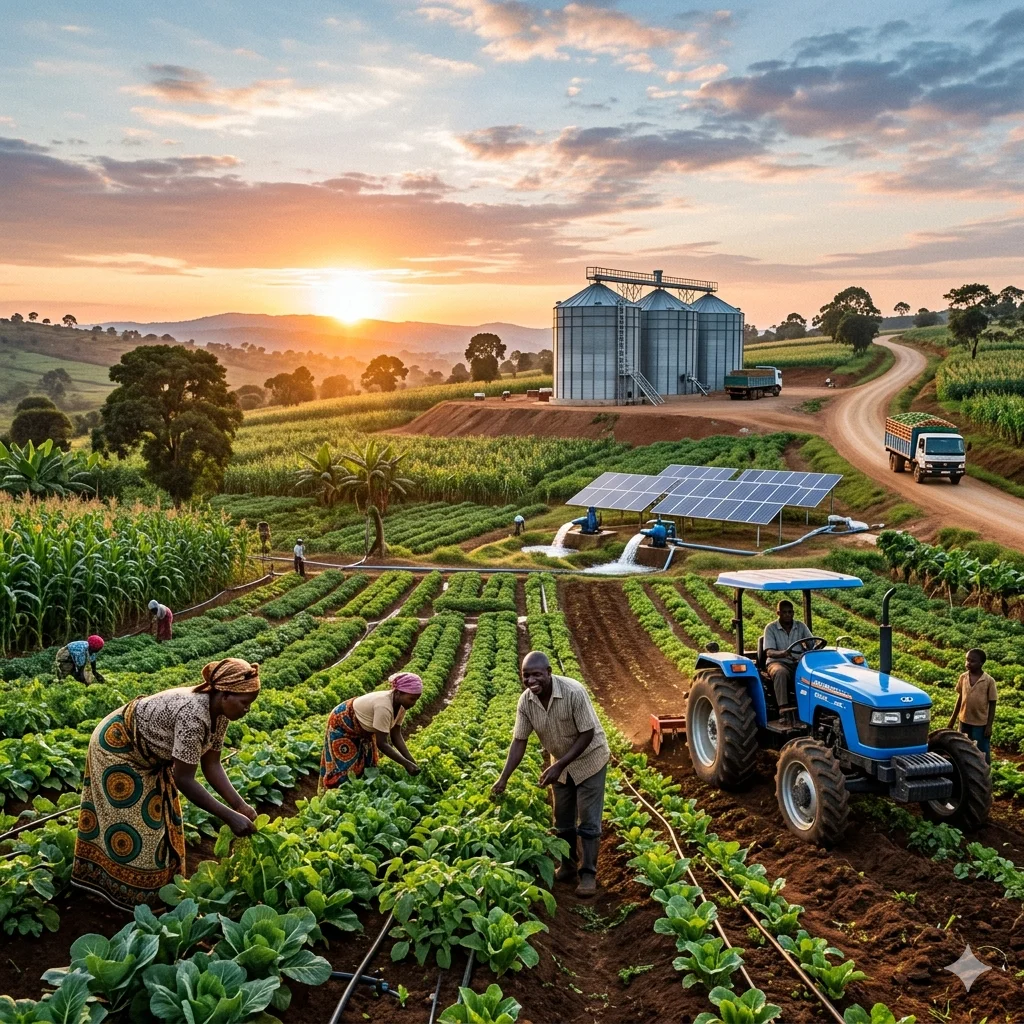
[IMAGE: A wide cinematic scene of modern African agriculture at sunrise, showing diversified farmland, irrigation systems, smallholder farmers, tractors, solar-powered water pumps, grain storage silos, and a logistics road in the background, realistic documentary style, high detail, no text, no watermark]
The Core Investment Logic: Agriculture in Africa Is More Than a Food Story
Africa agriculture resources investment is often discussed as a response to food insecurity, but the economic logic is broader. Investment in farming is ultimately about productivity, risk management, and control over the value chain. Output matters, but so do the systems that determine whether crops can be planted, irrigated, stored, transported, processed, and sold at a stable price.
The sector’s performance depends on a hidden set of inputs: land quality, water availability, energy access, roads, warehousing, and market connectivity. A farm can have suitable acreage and still produce weak returns if fertilizer arrives late, irrigation is unreliable, or buyers are too far away. In that sense, agricultural capital is not just funding production; it is funding the conditions that make production profitable.
This is why analysis of agriculture investment in Africa has to be slow rather than headline-driven. The most important changes often take place across seasons and infrastructure cycles, not quarterly reporting periods. A road upgrade, a grain silo, a solar pump network, or a cold chain corridor may not look dramatic at first, but these assets can alter crop choices, reduce losses, and improve working capital discipline over several years.
According to the World Bank, agriculture remains a major employer across Sub-Saharan Africa, and the FAO has repeatedly noted the region’s continued dependence on food imports in many countries. The African Development Bank has also highlighted the sector’s centrality to employment and rural income. Those baseline facts matter because they show that investment is not entering a marginal industry; it is entering the backbone of livelihoods and food systems.
[IMAGE: Infographic-style visual of interconnected farm, irrigation, storage, transport, and market nodes]
The Underlying Constraint Model: Resources, Not Just Capital
A common mistake in discussions of agricultural finance is to assume that more capital automatically means more output. In practice, capital only works when it matches the binding constraint in a given location. In some places the limiting factor is water; in others it is soil degradation, fragmented land tenure, fertilizer access, or weak rural transport. That is why investment outcomes vary so sharply across regions and business models.
The FAO’s soil and water assessments, together with UNEP climate-risk research, point to a basic structural reality: parts of Africa face rising rainfall volatility, heat stress, and localized water scarcity. These pressures do not affect all crops equally. Drought-tolerant staples, such as sorghum and millet, may remain more resilient in arid zones, while irrigated horticulture can be more attractive in areas with reliable water and market access. The tradeoff is clear: higher-value crops can improve margins, but they also require tighter logistics and stronger input systems.
Land tenure is another constraint that affects capital efficiency. Where land rights are unclear, long-term investment in orchards, irrigation, drainage, or soil restoration becomes harder to justify. Short-term rental arrangements can support seasonal cropping, but they often discourage investment in assets that pay back over multiple years. This is one reason why “agricultural investment” cannot be evaluated only by the amount of money deployed. The legal and institutional environment determines whether that money can create durable productivity.
There is also a financing tradeoff between scale and inclusion. Large commercial operations may be easier to underwrite because they have formal records, collateral, and logistics capacity. Smallholders, by contrast, represent a broader development impact but require more fragmented lending models, aggregation systems, and extension support. The risk-adjusted profile is therefore not uniform. Some models may be more suitable for mechanized grain production, while others are better for contract farming, input distribution, or outgrower networks. The key is not to label one segment as inherently superior, but to assess whether capital is aligned with local constraints and market structure.
[IMAGE: Farm landscape with irrigation lines, dry soil contrast, and a farmer inspecting crop rows]
Where the Real Returns Are: The Value Chain Beyond the Farm Gate
The strongest investment returns in African agriculture often appear outside the farm gate. Storage, cold chain, processing, aggregation, and distribution can create more durable value than expanding planted area alone. This is because post-harvest losses remain a major drag on revenue. The FAO has long estimated that a significant share of food is lost after harvest in low- and middle-income economies, especially where handling, storage, and transport are weak.
Concrete examples show why this matters. In East Africa, improved grain storage and warehouse receipt systems have helped farmers avoid distress sales immediately after harvest, when prices are usually lowest. Instead of selling into a glut, producers can store grain, access short-term finance, and sell later if market conditions improve. That shift does not require a dramatic increase in acreage, but it can materially change farm income.
In West Africa, cold chain investments have had a similar effect in horticulture and animal products. Where refrigerated transport and reliable power are available, vegetables, dairy, fish, and poultry can move farther from production zones without losing value. That expands the radius of viable markets and allows producers to target urban demand more consistently. The business impact is often larger than a simple yield gain because it converts perishability into market access.
A second example is aggregation infrastructure. In parts of Nigeria and Kenya, private and donor-backed warehouse, sorting, and logistics systems have improved the quality and timing of produce reaching buyers. This can reduce rejection rates, improve grading, and support contract enforcement. The result is a more transparent price signal and lower transaction costs. In many markets, that effect is more important than a subsidy to production alone.
From an investment perspective, logistics and aggregation are attractive not because they are automatically easy, but because they sit at the point where multiple constraints intersect. A warehouse can reduce losses, improve collateralization, and stabilize prices. A truck fleet or corridor upgrade can link inland production to ports or cities. A processing plant can extend shelf life and capture more value locally. These are not speculative claims; they are supported by trade and development literature on food loss, storage capacity, and market integration.
[IMAGE: Grain storage facility, refrigerated trucks, and produce sorting line in a modern agri-logistics hub]
Technology as a Force Multiplier: Agri-Tech, Data, and Precision Inputs
Technology can raise productivity in African agriculture, but only when it matches local conditions. Digital platforms, satellite monitoring, mobile extension, precision irrigation, and input-financing tools have all shown potential. The question is not whether agri-tech exists, but whether it can survive the realities of power supply, maintenance, pricing, and connectivity.
A useful way to evaluate technology is to ask where it solves a binding problem. Mobile advisory platforms are effective when farmers need timely information on weather, pest pressure, and market prices. Satellite imagery can help lenders and insurers monitor crop conditions and reduce information asymmetry. Precision irrigation systems can increase water efficiency in places where water is scarce but accessible. Input-financing platforms can help buyers and lenders extend credit against future harvests.
But these tools are not equally effective everywhere. A digital irrigation system may fail if pumps cannot be maintained locally or if spare parts are not available. An app-based advisory service may have limited impact if farmers lack smartphones, stable network coverage, or trust in the data. A pay-as-you-go input model may work in one region and fail in another if crop cycles, repayment windows, or price volatility are mismatched.
This is why technology adoption should be read through the lens of infrastructure, not just innovation. Power availability matters for storage and irrigation. Connectivity matters for digital finance and extension. Repair ecosystems matter for mechanization. Pricing matters for adoption by smallholders. The highest-value technology is not always the most advanced; it is the one that fits local operating conditions and can be maintained at scale.
The African Development Bank’s agricultural strategy papers and World Bank digital agriculture research both point toward the same conclusion: technology adoption works best when it is embedded in broader systems of finance, logistics, and service delivery. In other words, agri-tech is not a standalone fix. It is a multiplier, and multipliers only matter when the base system is functional.
Case Studies: When Infrastructure and Capital Changed Outcomes
Several African agricultural contexts illustrate how capital works best when it changes the surrounding system.
In Kenya’s horticulture export sector, investments in cold chain logistics, grading facilities, and export compliance have helped producers meet quality standards for European and regional markets. The lesson is not simply that exports are profitable. It is that perishable crops become viable only when transport, certification, and temperature control are reliable. Without those pieces, the same production volume would fetch lower prices or be lost before sale.
In Ethiopia, the development of industrial parks and logistics improvements around agro-processing has shown how value can be captured closer to production. When raw commodities are processed locally, they generate more employment and reduce dependence on long-distance bulk shipment. That does not eliminate risk, but it changes the profit structure by converting low-margin primary production into higher-value processing where infrastructure allows.
In Senegal and parts of the Sahel, solar-powered irrigation and water-harvesting projects have improved dry-season production in some areas, particularly for vegetables and staple crops near water access points. These systems are not universal solutions, and they depend on groundwater conditions, maintenance, and local management. Still, they demonstrate how resource-targeted capital can unlock output in places where rain-fed farming alone is too volatile.
These examples also show why regional comparison matters. A model that works for export horticulture in coastal East Africa may not work for rain-fed grains in the interior Sahel. Likewise, a mechanized corridor near a capital city may be attractive from a risk-adjusted perspective, but it is not the same as a smallholder aggregation model in a remote district. Good investment analysis separates crop type, geography, and market access instead of treating “African agriculture” as one uniform opportunity.
The Policy and Market Environment Still Shapes Returns
Private capital does not operate in a vacuum. Agricultural investment returns are influenced by subsidy design, import policy, land regulation, currency conditions, and public infrastructure spending. If fertilizer policy changes abruptly, if border delays increase, or if exchange-rate volatility raises input costs, even strong operational models can underperform.
This is why investors and operators increasingly evaluate public-sector reliability alongside farm metrics. Roads, customs procedures, extension systems, and water governance shape the economics of farming as much as weather does. The World Bank’s logistics and ease-of-trading datasets, along with AfDB regional infrastructure studies, suggest that the broader business environment can either amplify or cancel out gains from direct investment.
For food supply chain actors, the implication is straightforward. Returns are most durable where production, storage, processing, and distribution are developed together. If one layer is missing, losses or bottlenecks appear elsewhere in the chain. If multiple layers improve at once, the system becomes more resilient and more financeable.
Conclusion: Structural Change, Not Short-Term Narratives
Africa agriculture resources investment is best understood as a structural transformation story. The key question is not whether capital is flowing into farming, but whether that capital is being allocated to the bottlenecks that actually limit productivity: water, land governance, logistics, storage, energy, and market access. That is where long-term returns are created.
The strongest opportunities usually appear where investment can improve more than one part of the system at once. A warehouse can reduce losses and improve credit access. A road can expand market reach and stabilize pricing. A solar pump can improve irrigation and reduce energy uncertainty. A data platform can support lending and extension. When these systems interact, agriculture becomes more productive and less fragile.
For analysts, policymakers, and investors, the practical lesson is to move beyond acreage and output headlines. The real story in Africa agriculture resources investment lies in who controls the value chain, which technologies can be maintained, and which resource constraints are being solved rather than ignored.