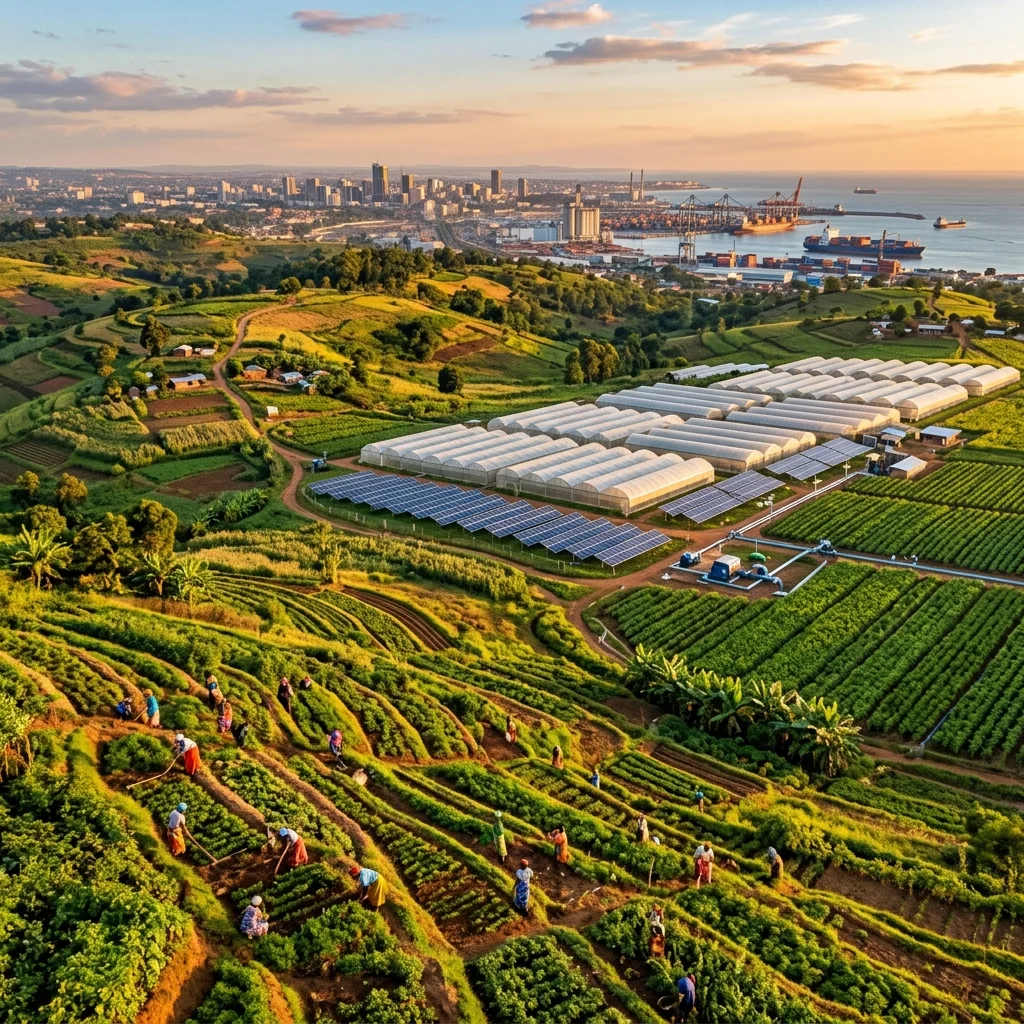
Africa’s agriculture sector holds a trillion-dollar opportunity, yet it
Africa’s Agriculture Revolution: Why Smart Capital Is Cultivating the Continent’s Food Future
By a Senior Technical/Financial Audit Journalist
---
The Untapped Wealth in Africa’s Soil
Africa holds approximately 60% of the world’s uncultivated arable land, yet the continent spends upwards of $50 billion annually on food imports—a structural paradox that defines its agricultural underperformance. Landry Signé, a Senior Fellow at Brookings, articulates this contradiction as the central thesis of his analysis: the gap between resource endowment and economic output represents one of the most significant undervalued investment frontiers in global capital markets.
The April 27, 2026, Foresight Africa event at the Spring Meetings—co-hosted by Brookings and featuring Signé alongside Alfonso García Mora of the International Finance Corporation (IFC)—catalyzed this conversation into actionable policy discourse. The core insight emerging from that dialogue is that Africa’s agriculture sector is not merely a collection of farms. It is an opportunity to construct a vertically integrated food economy encompassing seed technology, cold-chain logistics, digital supply-chain tracking, and local processing infrastructure.
The statistical baseline is stark: current agricultural productivity in Sub-Saharan Africa is approximately 20-30% of potential yields achievable with existing technology (Source: Brookings, Signé analysis). This productivity gap, combined with demographic trends—Africa’s population is projected to reach 2.5 billion by 2050—creates a demand-side inevitability that cannot be ignored by institutional investors.
---
Beyond Subsistence: The Hidden Economic Logic
The prevailing narrative of African agriculture as a subsistence activity obscures a structural economic reality: the sector suffers from a severe “missing middle” phenomenon. Smallholder farms—operating on fewer than two hectares—constitute roughly 80% of all farms in Africa. However, medium-scale commercial enterprises (50-500 hectares) remain critically underfunded, creating a capital chasm that prevents scaling and mechanization.
The IFC’s “jobs agenda” provides a rigorous framework for understanding why this gap matters. Empirical data from the IFC indicates that investment in agro-processing generates three times more employment per dollar invested than raw commodity export (Source: IFC Jobs Study, cross-referenced with Signé’s Brookings analysis). This multiplier effect operates through backward linkages to input suppliers and forward linkages to distribution networks, creating a compounding employment dynamic.
Technology is recalibrating the risk calculus. Mobile-based financing platforms have reduced transaction costs for agricultural lending by an estimated 40-60% in pilot programs across Kenya and Nigeria. Drone-based crop monitoring, satellite soil mapping, and blockchain-enabled supply-chain tracking are collectively lowering information asymmetries that historically deterred institutional capital. The pattern is clear: technology de-risks agriculture by replacing opacity with verifiable data.
---
The April 27, 2026 Event: What Was Really Said
The Brookings Spring Meetings event served as a convergence point for policy analysis and institutional strategy. Signé’s argument was explicit: “feeding the future” requires systemic de-risking—not merely more debt instruments. His framework distinguishes between micro-level risk (individual crop failure) and macro-level risk (policy instability, infrastructure deficits), arguing that the latter requires coordinated public-private intervention before micro-lending can scale sustainably.
García Mora’s contribution from the IFC anchored the discussion in climate adaptation and youth employment. Africa’s median age is 19 years—the youngest population globally. The IFC’s strategic documents, discussed at the event, link agricultural investment directly to this demographic imperative: transforming 12 million annual youth entrants into the labor force from a potential liability into productive agricultural workers requires investment in training, mechanization, and market access.
The event’s co-hosting by Brookings—a Washington D.C.-based policy institution with deep governance networks—lent the discussion institutional credibility that transcends sector-specific advocacy. The framing was not about charity; it was about capital allocation efficiency.
---
Where Smart Capital Is Flowing Now
Market data from 2024-2026 reveals distinct investment patterns that align with the Foresight Africa analysis. Private equity firms are concentrating capital in three domains:
Cold-chain logistics in East Africa has attracted approximately $400 million in committed capital since 2023, according to industry estimates. The logic is straightforward: post-harvest losses in Sub-Saharan Africa average 30-40% for perishable goods. Cold-chain infrastructure directly converts loss into margin—a mathematical proposition that appeals to institutional investors.
Regenerative agriculture startups in West Africa—particularly in Ghana, Côte d’Ivoire, and Nigeria—are drawing capital from climate-focused funds. These enterprises deploy agroforestry techniques, biochar application, and precision irrigation. The risk-return recalibration here is notable: climate-resilient crops (drought-tolerant maize, cassava varieties) demonstrate 15-25% yield stability improvements in variable rainfall conditions, reducing the volatility premium investors demand.
Large-scale irrigation concessions in the Sahel represent a longer-duration play. The World Bank’s Sahel Irrigation Initiative has mobilized $3.2 billion in committed capital, with private co-investment ratios approaching 1:1. The economic logic turns on water security: the Niger and Senegal river basins contain water resources sufficient to irrigate an estimated 2 million additional hectares, creating a fixed-asset base with 30-50 year economic lifecycles.
These patterns connect directly to the IFC’s strategic goals. Agro-processing investments in Nigeria’s cassava value chain, for instance, simultaneously address job creation (processing plants employ 500-2,000 workers each), climate adaptation (cassava is drought-tolerant), and import substitution (Nigeria imports $500 million annually in cassava derivatives despite being the world’s largest producer of raw cassava). The alignment between commercial logic and development outcomes is not accidental—it is structurally embedded in the value chain.
---
Investment Horizons and Policy Catalysts
The capital allocation timeline in African agriculture is shifting. Three to five-year private equity funds, historically dominant, are being supplemented by 10-15 year patient capital vehicles. Infrastructure funds are increasingly incorporating processing and logistics assets alongside traditional hard infrastructure. This maturation reflects a growing recognition that agricultural value chains require longer gestation periods than extractive industries.
Policy catalysts are converging. The African Continental Free Trade Area (AfCFTA), operational since 2021, is reducing intra-continental tariff barriers—a development that directly benefits processed agricultural goods with higher value-add. Countries that export raw commodities face tariffs of 15-25% within Africa; processed products face 5-10% tariffs under AfCFTA protocols. This differential creates a clear incentive for local processing investment.
The April 27 event reinforced a less-discussed dimension: the role of sovereign wealth funds. The Africa Sovereign Investors Forum—representing $90 billion in assets under management—is increasingly allocating to domestic agriculture. This capital is structurally different from foreign portfolio investment: it can accept lower returns in local currency and longer holding periods, making it ideal for infrastructure-heavy agricultural investments.
---
Market Predictions: 2026-2030
Based on current capital flow trajectories, policy catalysts, and demographic realities, three predictions emerge:
First, Africa’s agricultural processing sector will attract cumulative foreign direct investment of $25-35 billion by 2030, up from approximately $8 billion in 2023. The primary drivers will be cashew processing in West Africa, cocoa downstreaming in Côte d’Ivoire and Ghana, and horticulture in East Africa.
Second, technology-enabled agricultural services (fintech, insurtech, logistics platforms) will achieve profitability thresholds by 2028, creating an exit pathway for early-stage venture capital investors. The enabling factor is mobile penetration, which reached 52% in Sub-Saharan Africa in 2025 and is projected to exceed 65% by 2030.
Third, institutional investors—particularly pension funds and insurance companies—will increase their agricultural allocation from the current baseline of less than 1% to 3-5% of total assets, representing $40-60 billion in new capital. The catalyst will be the development of rated agricultural bond instruments, currently in pilot phase at the African Development Bank.
The Foresight Africa analysis—and the Spring Meetings event that amplified it—provides a diagnostic framework that moves beyond rhetoric. The market signals are unambiguous: Africa’s agriculture sector is transitioning from a frontier asset class to an emerging core allocation. The capital allocation decisions made in 2026-2028 will determine whether this transition is orderly or volatile. The data suggests the former.