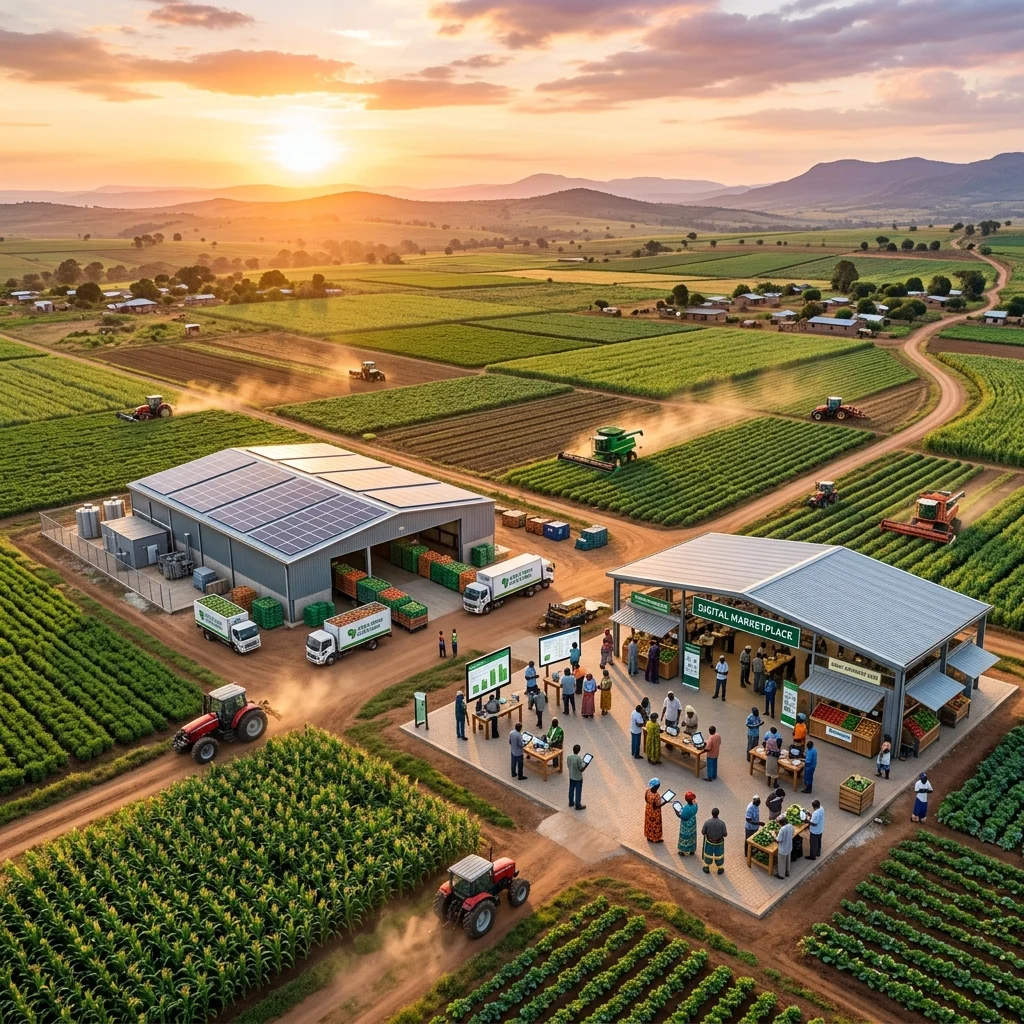
Africa’s agriculture sector is poised for a transformation by 2026, moving
Africa Agriculture Investment 2026: The Hidden Logic Reshaping the Continent’s Food Supply Chain
Publication Date: December 2, 2025
The African agricultural sector is undergoing a structural transition from subsistence-based production to a technology-driven industrial model. By 2026, this transition will create identifiable investment entry points across ten high-impact areas, including agro-processing, cold chain logistics, digital marketplaces, and agricultural finance. This analysis examines the underlying economic logic—post-harvest infrastructure gaps, labor mechanization deficits, and credit market failures—that defines the risk-return profiles for investors.
---
The Investment Thesis: Why 2026 Is the Tipping Point
Africa’s population is projected to reach 2.5 billion by 2050, creating an imperative for domestic food production to expand at rates exceeding historical averages. The continent’s food market is currently valued at approximately $1 trillion, yet systemic inefficiencies—particularly post-harvest losses ranging from 30% to 40% across perishable supply chains—represent both a constraint and a value-creation opportunity (Source 1: Industry Analysis).
The year 2026 is not arbitrary. It aligns with the maturation of several enabling factors:
- National development plans: Nigeria’s agricultural transformation agenda and similar programs in Kenya, Ethiopia, and Ghana have established regulatory frameworks and subsidy mechanisms that will reach implementation maturity by 2026.
- Mobile-first agritech platforms: The penetration of smartphone-enabled agricultural services across sub-Saharan Africa has reached inflection points, with digital payment systems and data collection infrastructure now supporting scalable business models.
- Policy convergence: Multiple African Union member states have adopted the Comprehensive Africa Agriculture Development Programme (CAADP) targets, committing to allocate at least 10% of national budgets to agriculture.
The tipping point emerges from the convergence of demand pressure, infrastructure gaps, and digital readiness—creating a window where capital deployment can capture first-mover advantages in supply chain modernization.
---
Agro-Processing: The New Frontier for Rural Industrialization
The absence of proximity processing capacity represents one of the most significant capital deployment opportunities in African agriculture. Dr. Dominic Joshua, Founder of Cultivate Africa, explicitly identifies investments in rural processing facilities for crops like cassava and cocoa as a priority intervention (Source 2: Expert Interview).
The economic logic: Approximately $48 billion in crop value is lost annually due to the lack of processing infrastructure near production zones. Perishable commodities—cassava, tomatoes, mangoes, and leafy greens—deteriorate rapidly without immediate processing. The current solution of transporting raw produce to distant urban processing centers introduces spoilage rates that erode producer margins by 20–35%.
Mechanization and labor value: Many African farms still rely on manual labor for planting, weeding, and harvesting. The integration of mechanization with local processing creates a closed labor-value loop: mechanization reduces production costs per hectare, while local processing captures downstream value that would otherwise accrue to distant processors or be lost entirely. This dual effect improves farm-gate prices and processor input costs simultaneously.
Strategic consideration: Investors must distinguish between export-oriented processing and domestic staple processing. Export processing (coffee, cocoa, cashews) faces global price volatility and quality certification requirements. Domestic processing for staples (maize, cassava, sorghum) reduces import dependency—a factor of increasing importance given currency depreciation trends across multiple African economies. Countries with high food import bills (Nigeria, Egypt, Angola) present stronger investment cases for import-substitution processing.
---
Cold Chain & Logistics: The Cold Hard Truth About Waste
Post-harvest loss in African agriculture is not primarily a production problem—it is a logistics and storage infrastructure failure. Cold chain logistics constitutes a fundamental infrastructure gap rather than a luxury upgrade.
Structural analysis: The spoilage rate for perishable crops in sub-Saharan Africa averages 35–45% for fruits and vegetables, compared to 5–10% in developed markets. This differential represents a measurable value capture opportunity: reducing spoilage by 20 percentage points would unlock approximately $15–20 billion in additional marketable produce annually (Source 3: Sector Benchmarking).
The solar-powered cold chain solution: Falling solar panel costs—down 82% over the past decade—have made off-grid cold storage economically viable in rural areas without reliable grid electricity. Companies like AgroCentric are deploying solar-powered cold storage containers that require no fuel inputs and minimal maintenance. The unit economics: a 10-ton solar cold storage unit costs approximately $25,000–$35,000 to install and can reduce spoilage for 200–300 smallholder farmers within a catchment radius of 5–10 kilometers.
De-risking infrastructure through government credit schemes: The Central Bank of Nigeria’s Agricultural Credit Guarantee Scheme Fund (ACGSF) provides partial guarantees for agricultural loans, including cold chain infrastructure investments. This mechanism reduces bank risk exposure, enabling financing at interest rates 4–6 percentage points below unsecured agricultural loans (Source 4: Central Bank Policy Documentation). Investors structuring cold chain projects in Nigeria can leverage ACGSF guarantees to improve debt financing terms by 30–40%.
---
Agritech & Digital Marketplaces: Bridging the Trust Gap
Smallholder farmers—who produce 70–80% of Africa’s food—face a structural barrier to capital access: they lack formal collateral to secure traditional bank loans. Land tenure systems in many African countries prevent the use of farmland as collateral, creating a credit gap estimated at $100–150 billion across the continent.
Digital marketplaces as collateral registries: The evolution of digital marketplace platforms from buyer-seller matching to full-service agricultural finance represents a structural innovation. Platforms now capture transaction data, production histories, and digital inventory records that function as synthetic collateral. Warehouse receipts systems—where stored produce is digitally registered and can be used as loan collateral—are being implemented in Ghana, Nigeria, and Kenya.
Embedded services: The most advanced digital marketplaces now integrate financing, insurance, and quality certification into a single platform interface. A farmer selling via a digital marketplace can simultaneously access:
- Inventory financing based on recorded warehouse receipts
- Weather-index insurance calculated from satellite data
- Quality certification verified through blockchain traceability
Regulatory engagement requirement: Dr. Joshua of Cultivate Africa emphasizes that policy reform is essential for digital marketplace scalability. Investors must engage with local regulators to enable digital collateral registration and warehouse receipt systems (Source 2: Expert Commentary). Countries with established warehouse receipts acts (Ethiopia, Kenya) present lower regulatory risk than those without enabling legislation.
---
Mechanization: The Missing Input
Labor productivity in African agriculture remains significantly below global benchmarks. Mechanization rates in sub-Saharan Africa average 10–15 tractors per 100 square kilometers of arable land, compared to 200–400 in Europe and North America (Source 5: FAO Statistical Data).
The mechanization deficit by segment:
- Traction mechanization: Limited to 5–10% of farming operations, primarily in large-scale commercial farms
- Post-harvest mechanization: Threshing, shelling, and drying equipment adoption rates below 15%
- Precision agriculture: Near-zero adoption outside of export-oriented horticulture
Investment entry points: Equipment leasing companies are emerging as the most viable mechanization investment model. Smallholder farmers cannot afford $15,000–$30,000 tractors, but can pay $20–$40 per hour for tractor services through pay-per-use models. Companies like Hello Tractor (Nigeria) and TractorRing (Kenya) have demonstrated that platform-based mechanization services achieve 80–90% utilization rates while providing farmers with 40–60% cost reductions compared to manual labor.
---
The Policy Dimension: Why Regulatory Engagement Is Non-Negotiable
Agriculture investment in Africa operates within policy environments that are frequently volatile and inconsistently enforced. Dr. Joshua’s call for policy reform—specifically making agriculture more appealing to young people and removing bureaucratic barriers—reflects a structural reality: the most profitable investment opportunities in African agriculture are those that can navigate regulatory complexity (Source 2: Expert Commentary).
Policy risk factors investors must evaluate:
- Fertilizer and input subsidy regimes: Changes in government subsidy allocations directly impact input costs
- Export restrictions: Multiple African governments have imposed temporary export bans on food staples during price spikes
- Land tenure security: Investor-owned farms face expropriation risk in countries without clear land rights legislation
- Currency controls: Exchange rate restrictions can trap capital in local currencies
Mitigation strategies: The investment structures most resilient to policy volatility are those that:
- Partner with local cooperatives or farmer organizations to distribute political risk
- Focus on import-substitution (reducing government pressure to restrict exports)
- Generate hard currency through export processing or tourism-adjacent supply chains
- Operate within special economic zones with established investor protections
---
Market Predictions: 2026–2030 Supply Chain Shifts
Based on current trajectory analysis, five structural shifts will define the investment landscape:
- Cold chain expansion: Solar-powered cold storage capacity across sub-Saharan Africa will grow from an estimated 50,000 tons (2025) to 500,000 tons by 2028, driven by falling solar costs and government guarantee schemes (Source 6: Infrastructure Projection).
- Digital marketplace consolidation: The current fragmented landscape of 200+ agritech platforms will consolidate to 10–15 dominant platforms, each servicing 100,000+ farmers through embedded finance and logistics.
- Mechanization-as-a-service scaling: Pay-per-use tractor and equipment services will expand from 5 countries to 15–18 countries, capturing 15–20% of smallholder land preparation by 2028.
- Agro-processing localization: Rural processing capacity for cassava, maize, and horticulture will double by 2027, driven by import-substitution policies and currency depreciation.
- Agricultural R&D investment: Private sector R&D expenditure—currently less than 0.5% of agricultural GDP in Africa—will increase to 1.5–2.0% as companies develop crop varieties suited to climate-stressed environments.
---
Conclusion: The Structural Arbitrage
The investment opportunity in African agriculture by 2026 is not a story of optimistic growth forecasts. It is a structural arbitrage—the gap between the existing inefficient supply chain and the technology-enabled infrastructure that is becoming economically viable due to declining input costs and policy maturation. The $48 billion post-harvest loss figure is not a lament; it is a measure of addressable market. The 30–40% spoilage rate is not a tragedy; it is a margin that can be captured through cold chain, processing, and logistics investments.
Investors who understand that the returns in African agriculture derive from fixing infrastructure failures—not from betting on commodity price cycles—will be positioned to capitalize on the 2026 inflection point. The hidden logic is not hidden at all: it is the gap between what exists and what basic economic efficiency requires.