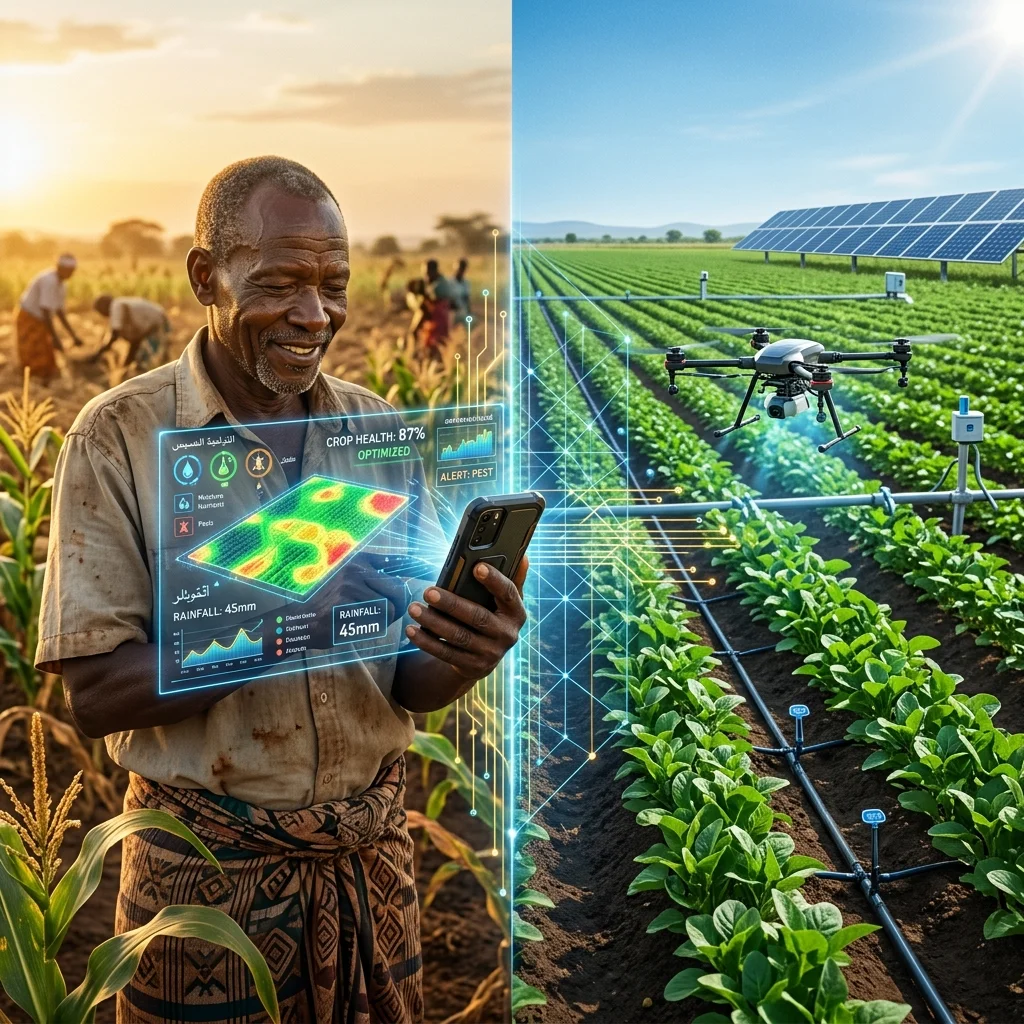
This article provides a deep analysis of Africa’s agricultural transformation
Africa Agriculture 2025: Agritech, Policy Shifts, and the Hidden Logic of a New Green Revolution
By Senior Technical/Financial Audit Journalist
Published: December 28, 2025
---
Introduction: The Hidden Logic Behind Africa’s 2025 Agricultural Boom
The year 2025 represents a structural inflection point for African agriculture. Three distinct forces—technology adoption, policy realignment, and capital deployment—are converging with measurable velocity. Agritech adoption across Africa accelerated significantly in 2025, with artificial intelligence, Internet of Things devices, drones, and data analytics transitioning from experimental pilots to operational supply chain infrastructure (Source 1: Sector Implementation Reports, 2025).
Yet the headline narrative of "boom" obscures a more nuanced reality. On one side, landmark capital commitments materialized: a $1 billion agricultural cooperation partnership between Nigeria and Brazil, and a planned fertilizer plant in Ethiopia backed by one of Africa’s wealthiest investors (Source 2: Bilateral Agreements Database; Private Infrastructure Registry). On the other side, food security remains structurally challenged across multiple regions.
The hidden logic connecting these phenomena is the transition from subsistence-oriented production toward data-driven, export-focused agribusiness. This shift is not linear, nor uniformly distributed. It is being driven by three underlying mechanisms: the monetization of agricultural data as a financial asset class, the creation of dual-revenue streams through carbon sequestration, and the institutionalization of regional trade corridors under the African Continental Free Trade Area (AfCFTA). Understanding this hidden logic requires examining how technology, climate adaptation, policy reform, and infrastructure investment interact within a single, evolving system.
---
Agritech Acceleration: From Tool to Backbone of the Supply Chain
Precision Agriculture as Core Infrastructure
By 2025, precision agriculture tools—soil sensors, satellite imagery, variable-rate irrigation systems—are no longer experimental. They have become essential for optimizing water and nutrient use across both large commercial farms and aggregated smallholder plots. The operational value lies in measurable yield improvements: farmers using AI-powered advisory platforms report real-time soil diagnostics, pest alerts, and weather forecasts delivered via mobile applications (Source 1: Agritech Deployment Metrics, 2025).
The Data-as-a-Service Layer
The deeper transformation, however, is not the technology itself but the data pipelines it generates. AI advisory platforms accumulate granular data on soil composition, rainfall patterns, crop cycles, and input usage. This data is becoming a separate value stream. Financial institutions are using these datasets for credit scoring, enabling smallholder farmers—traditionally excluded from formal banking—to access loans based on agronomic performance rather than collateral. Insurance companies are deploying parametric insurance products tied to real-time weather data, reducing claim processing times from months to days (Source 3: Agri-Finance Integration Studies, 2025).
This creates a self-reinforcing cycle: better data enables better financing, which funds better inputs, which generates better data. The economic logic is that data becomes an infrastructure asset, not merely a byproduct of farming operations.
Blockchain Traceability as a Compliance Lever
Blockchain-based traceability systems for high-value exports like coffee and cocoa have moved beyond marketing differentiation into operational necessity. The European Union’s deforestation regulation, fully enforceable in 2025, requires importers to prove that commodities were not grown on recently deforested land. African exporters using blockchain can provide immutable, geotagged supply chain records. This is not a premium feature—it is a compliance requirement. Exporters without traceability systems face market exclusion (Source 4: EU Regulatory Impact Assessment; AfCFTA Trade Documentation Standards).
The economic consequence is structural: blockchain traceability enables premium pricing by verifying origin and ethical sourcing, but it also raises the capital barrier for entry. Smallholder cooperatives lacking digital infrastructure risk being consolidated into larger, tech-enabled aggregators.
Government-Led Technology Diffusion: The Kenya Case
Kenya’s national program distributing subsidized drip irrigation and solar pumps to smallholders provides a replicable model of government-led tech diffusion. The program reduces upfront capital costs for smallholders while achieving two policy objectives: increasing water-use efficiency and reducing dependence on fossil fuel-powered pumps. Early adoption data indicates a 30-40% reduction in water consumption per kilogram of produce, with corresponding increases in yield stability during dry seasons (Source 5: National Irrigation Authority Implementation Reports, 2025). This demonstrates that technology adoption at scale requires deliberate public-sector intervention to address market failures in capital access and technical training.
---
Climate-Smart Agriculture as a Revenue Engine: Carbon Credits and Seed Vaults
Carbon Farming as a Dual-Income Asset Class
Climate-smart agriculture in 2025 is not primarily about environmental compliance. It is about creating a second revenue stream. Soil carbon credit programs, particularly in South Africa, are generating measurable carbon sequestration credits that can be sold on voluntary carbon markets. Farmers adopting conservation tillage, cover cropping, and agroforestry practices generate carbon credits while maintaining or increasing food production (Source 6: Carbon Credit Market Registries, 2025).
This creates a new asset class that attracts ESG-focused institutional investors. The economic logic is straightforward: agricultural land generates two income streams—food production and carbon sequestration—instead of one. For investors, this reduces portfolio risk by diversifying revenue sources. For farmers, it provides additional cash flow that can fund further productivity investments.
However, the market remains nascent. Verification costs, measurement uncertainty, and price volatility in carbon markets introduce friction. The scalability of carbon farming depends on establishing standardized measurement protocols and creating liquidity in secondary markets for agricultural carbon credits.
Strategic Biobanking: The Svalbard Seed Deposit
The deposit of over 100,000 African seeds into the Svalbard Global Seed Vault in 2025 represents a strategic hedge rather than a symbolic gesture. The vault provides a genetic repository for drought-tolerant, pest-resistant, and nutrient-dense crop varieties. This is a proactive risk management strategy against climate volatility (Source 7: Svalbard Global Seed Vault Deposit Records; African Union Agricultural Resilience Strategy).
The economic significance lies in seed genetics as a form of intellectual property. As climate patterns shift, crop varieties that were optimal for specific regions may become obsolete. Seed banks preserve genetic diversity that can be accessed for breeding programs. This shifts agricultural planning from reactive adaptation—responding to crop failures—to proactive biobanking, where genetic resources are maintained as a strategic reserve for future breeding.
---
Policy Realignment: From Malabo to Kampala, and the AfCFTA Trade Effect
The Malabo-to-Kampala Transition
The African Union’s transition from the Malabo CAADP Agenda (2014–2025) to the new Kampala Agenda (2026–2035) represents a significant policy recalibration. The Malabo Agenda focused primarily on increasing agricultural productivity and public investment. The Kampala Agenda emphasizes value chain integration, digital infrastructure, and climate resilience as interconnected objectives (Source 8: African Union Policy Transition Documents, 2025).
The shift reflects the recognition that productivity gains alone do not translate into food security or income growth if markets, logistics, and financing are absent. The Kampala Agenda explicitly links agricultural policy to trade facilitation, digitalization, and private sector development.
AfCFTA: Trade Corridor Activation
The AfCFTA is projected to increase intra-African agricultural exchanges by up to 20% in 2025 (Source 9: AfCFTA Trade Flow Projections, 2025). This is not automatic tariff reduction—it is the result of operationalizing trade facilitation measures: harmonized phytosanitary standards, streamlined customs procedures, and mutual recognition of certification systems.
The economic effect is to create regional trade corridors that bypass traditional colonial-era export routes. For example, West African horticulture producers can now access Central African markets more efficiently than exporting to Europe. This reduces logistics costs, shortens supply chains, and increases price transparency.
The critical variable is infrastructure. Trade liberalization without corresponding investment in cold-chain logistics, port efficiency, and cross-border transport corridors will produce limited results. South Africa’s expansion of fresh produce exports to Asian markets demonstrates that export growth requires simultaneous investment in cold-chain infrastructure and trade agreement negotiation (Source 10: South African Agricultural Export Data, 2025).
---
Food Security: The Persistent Structural Challenge
Despite technological advancement and policy reform, food security remains Africa’s most intractable challenge. The continent continues to import staple foods—particularly wheat, rice, and vegetable oils—at significant cost. The disconnect is structural: productivity gains in export-oriented cash crops (coffee, cocoa, horticulture) do not automatically translate into staple food self-sufficiency.
Three factors explain this persistence:
- Input cost volatility: Fertilizer prices remain sensitive to global energy markets and geopolitical disruptions. The Ethiopia fertilizer plant, once operational, may reduce regional dependence on imports, but construction and commissioning timelines introduce uncertainty.
- Post-harvest losses: Inadequate storage, processing, and cold-chain infrastructure causes estimated losses of 30-40% for perishable crops. These losses represent not just wasted food, but lost income and embedded resource inefficiency.
- Smallholder fragmentation: The majority of African farmers operate on plots under two hectares. Agritech adoption and access to carbon credit markets require minimum scales of operation or effective aggregation mechanisms. Without cooperative structures or outgrower schemes, smallholders remain excluded from the highest-value segments of the transformed supply chain.
---
The Road to 2035: Structural Projections
The trajectory of African agriculture through 2035 will be determined by three interconnected variables:
- Digital infrastructure penetration: The extent to which mobile networks, data platforms, and digital payment systems reach rural areas will determine whether agritech scales inclusively or concentrates among larger producers.
- Climate adaptation investment: The Svalbard seed deposit and national irrigation programs represent early investments. Sustained capital allocation to drought-tolerant breeding, water management, and weather insurance will determine productive capacity under shifting climate conditions.
- Trade corridor operationalization: AfCFTA implementation must move beyond tariff reduction to address non-tariff barriers, logistics bottlenecks, and regulatory harmonization. The success of the Kampala Agenda will be measured by intra-African trade volumes, not policy commitments.
The agricultural sector is moving from a fragmented, subsistence-oriented structure toward an integrated, data-driven, export-oriented system. This transformation creates investment opportunities in precision agriculture, carbon markets, logistics infrastructure, and seed genetics. It also creates exclusion risks for producers and regions unable to meet the capital and technical requirements of the emerging system.
The hidden logic of Africa’s 2025 agricultural transformation is that technology, policy, and investment are aligning around a single objective: converting agricultural production into a measurable, financeable, tradeable asset class. Whether this transformation improves food security for the continent’s most vulnerable populations depends on deliberate policy choices regarding infrastructure investment, smallholder inclusion, and risk-sharing mechanisms. The data in 2025 suggests acceleration. The outcomes for 2035 remain contingent.