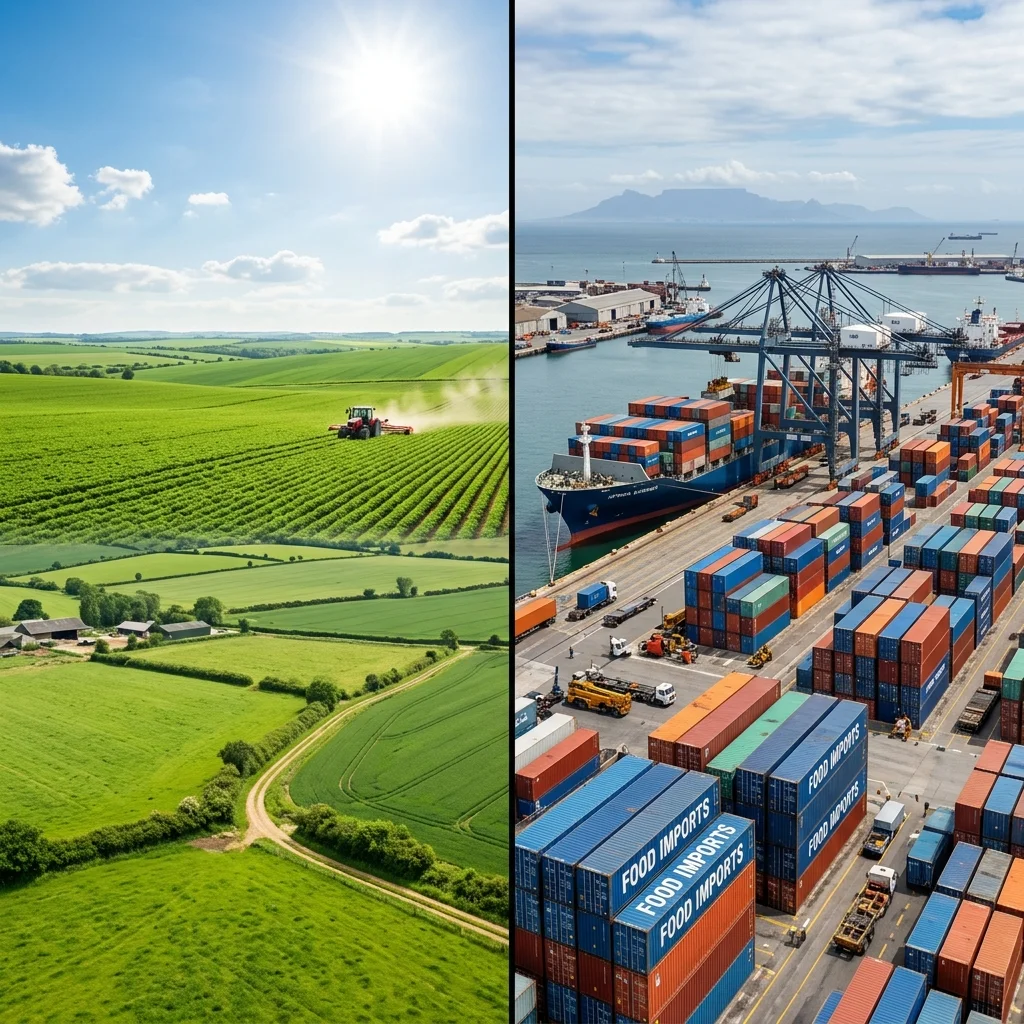
Despite holding 60% of the world's arable land, Africa attracts less than
Africa's Agricultural FDI Paradox: 60% of Arable Land, Yet $35 Billion in Food Imports
Africa holds more than 60 percent of the world’s uncultivated arable land. It has a young, growing population, abundant sunlight, and diverse agro-ecological zones that could support year-round production of staple grains, horticulture, livestock, and cash crops. Yet every year, the continent spends over $35 billion importing food that it could, in theory, grow itself.
This paradox sits at the heart of a deeper structural imbalance. In 2024, foreign direct investment into Africa reached an estimated $91 billion, according to UNCTAD data. But less than 5 percent of that total went into agriculture. The overwhelming share flowed to hydrocarbons, minerals, and metals — sectors with high returns and established off-take markets, but limited capacity to create broad-based employment or reduce food dependency. With the African Continental Free Trade Area (AfCFTA) now operational since 2021, a window exists to redirect capital toward agro-processing and regional value chains. Whether that window opens depends on how governments and investors address the hidden risks that have kept agriculture on the sidelines.
[IMAGE: A satellite image of cultivated fields next to a sprawling city market with imported food labels.]
The Numbers That Don't Add Up: Land Abundance vs. Food Dependence
The scale of the mismatch is striking. Africa’s 60 percent share of global uncultivated arable land is concentrated in countries such as the Democratic Republic of Congo, Tanzania, Zambia, Mozambique, and Sudan. The continent also possesses about 10 percent of the world’s renewable freshwater resources, much of it in the Congo Basin and the Great Lakes region. Yet agricultural productivity per hectare in sub-Saharan Africa is among the lowest in the world, averaging roughly one-third of levels in Southeast Asia.
The food import bill is not just large — it is growing. The $35 billion annual figure masks wide variation: North African countries, particularly Egypt and Algeria, are heavy wheat importers, while sub-Saharan nations import rice, vegetable oils, poultry, and sugar. Many of these imports are sourced from outside the continent, with intra-African agricultural trade accounting for only about 15 percent of total agricultural trade, far below levels in Europe or Asia.
Egypt alone accounted for approximately $35 billion of Africa's 2024 FDI inflows — roughly one-third of the continent's total. That investment, however, has been concentrated in energy, infrastructure, and the Suez Canal Zone, not in expanding farmland or processing capacity. Meanwhile, countries like Nigeria, Ethiopia, and Kenya import billions of dollars of food every year, straining foreign-exchange reserves and exposing consumers to global price volatility.
The numbers point to what economists call a "missing transformation": Africa has the natural resources to feed itself and export surplus, but lacks the capital, infrastructure, and policy frameworks to make that happen. FDI that does reach the continent generally bypasses agriculture and heads straight for extraction.
[IMAGE: Infographic showing FDI breakdown by sector in Africa (extractive vs. agriculture) with a small callout for the UAE's $110bn investment.]
Why FDI Skips Agriculture: The Extractives Bias and Missing Infrastructure
Understanding why agriculture attracts such a sliver of Africa's FDI requires examining the risk-reward calculus that foreign investors face. The extractive sectors — oil, gas, copper, cobalt, gold, and diamonds — offer a clear pathway: geological data exists, global commodity markets are liquid, and export infrastructure (pipelines, railways, ports) is often already in place or financed by offtake agreements. Investments in mining or oil can achieve payback periods of three to five years, with margins that dwarf those in farming.
Agriculture, by contrast, presents a bundle of risks that investors find hard to price. Land tenure is insecure in many countries: smallholders often lack formal titles, customary rights can be ambiguous, and large-scale land acquisitions have triggered political backlash in places like Ethiopia, Mozambique, and Tanzania. Logistics are weak: post-harvest losses for perishable crops can exceed 40 percent due to inadequate cold chains, poor roads, and unreliable electricity. Markets are fragmented: each country has its own regulatory environment, phytosanitary standards, and currency risks, making cross-border supply chains costly to establish.
The United Arab Emirates has emerged as one of the largest sources of FDI into Africa over the past decade, with cumulative investments around $110 billion. Yet the bulk of that capital has flowed into ports, airports, logistics hubs, and energy — not directly into farming. DP World, for example, operates terminals in Dakar, Berbera, and Durban; ADNOC has made large downstream investments; and Emirati sovereign wealth funds have backed mega-projects from Egypt's Red Sea coast to Zambia's solar plants. These investments support agricultural trade corridors indirectly — better ports reduce export costs for African farmers — but they do not address the fundamental production gap.
One notable exception is Harvest Group SA, an Africa-based agri-business that supplies grains and pulses to the United Nations World Food Programme. Harvest Group has demonstrated that structured off-take agreements can reduce investor risk: when buyers commit to purchase a defined volume at a pre-agreed price, lenders and equity investors gain the predictability they need to finance farming operations. The company's success has been limited to a few commodity chains (maize, sorghum, cowpeas) and a handful of countries, but it illustrates a model that could be scaled.
The lesson is clear: without institutional mechanisms that lower risk — such as land registries, crop insurance, warehouse receipt systems, and offtake contracts — agriculture will continue to lose out to extractives in the competition for FDI.
[IMAGE: Map of Africa highlighting AfCFTA trade corridors and key agricultural production zones.]
AfCFTA as a Game Changer: Can Trade Integration Redirect Investment?
The African Continental Free Trade Area, launched in 2021, represents the most ambitious attempt to reshape the continent's economic geography since independence. The agreement aims to eliminate tariffs on 90 percent of goods, reduce non-tariff barriers, and create a single market of 1.4 billion people — potentially the largest free-trade zone in the world by population. For agriculture, the implications are profound.
Currently, intra-African agricultural trade is low because tariffs and non-tariff barriers make cross-border commerce expensive. A cassava farmer in Ghana faces hurdles shipping to neighboring Côte d'Ivoire: multiple checkpoints, differing certification requirements, and currency conversion costs. Under AfCFTA, these barriers are supposed to come down, enabling regional specialization. West Africa, with its large cassava and yam production, could process these starches into flour and export them to urban markets across the continent; East Africa could focus on horticulture and coffee; Southern Africa on livestock and grains.
If AfCFTA functions as intended, it could attract FDI targeted at agro-processing and value chains rather than just raw commodity extraction. A foreign investor today might think: Why invest in a tomato-processing plant in Nigeria if the plant can only serve the Nigerian market, which is fragmented by poor logistics and regulatory unpredictability? Under AfCFTA, the same plant could serve markets from Accra to Nairobi, with harmonized standards and reduced trade costs. That changes the economic equation.
The payoff would be substantial. Reducing Africa's $35 billion food import bill by even 20 percent would free up $7 billion annually for domestic investment. More importantly, agro-processing is labor-intensive and can create millions of jobs — a critical need for a continent where 10 to 12 million young people enter the labor market each year. Studies by the African Development Bank suggest that agri-processing could absorb a significant share of these entrants, especially if linked to smallholder supply chains.
But AfCFTA is not a magic bullet. The agreement's success depends on implementation: many countries have been slow to lower tariffs, non-tariff barriers persist at borders, and rules of origin are still being negotiated. Without parallel investments in rural infrastructure — roads, electricity, irrigation — farmers will remain unable to produce the volumes needed to supply regional markets. Land governance reforms are equally essential: insecure tenure deters both foreign and domestic investment in long-term productivity improvements.
[IMAGE: Photo of port cranes and containers at an African port with a sign reading "DP World Africa" or similar logistics branding.]
Lessons from the UAE Model: Strategic Investment in Logistics and Value Chains
The UAE's approach to Africa offers a pragmatic blueprint, even if it has not yet addressed the core agricultural production gap. Rather than trying to own farms directly, Emirati investors have focused on the enabling infrastructure that makes agricultural trade possible. Ports, cold storage facilities, grain silos, and transport corridors form the backbone of a modern food system. When DP World upgrades the port of Berbera in Somaliland, it not only facilitates livestock exports from the Horn of Africa but also creates a potential gateway for agricultural imports and re-exports across the region.
One emblematic project is the $1.8 billion Grain and Oilseed Processing Complex in Senegal, backed by the UAE's International Resource Holding (IRH) in partnership with the Senegalese government. The complex is designed to process locally grown maize, soybeans, and groundnuts into animal feed and vegetable oil, targeting both domestic consumption and export markets under AfCFTA. It is a rare example of FDI that moves beyond extraction and into value-added processing.
Another model comes from the Ethiopian Industrial Parks Development Corporation, which has partnered with Emirati firms to develop agro-processing zones. These zones combine land leases, tax incentives, and common infrastructure (water, electricity, waste treatment) with the aim of attracting foreign processors who can source raw materials from surrounding smallholders. The parks have had mixed results — bureaucratic hurdles remain — but the concept aligns with the core insight that de-risking the environment for investors is the key to unlocking agriculture FDI.
Harvest Group's experience reinforces this point. The company's ability to supply the World Food Programme depends on its own network of warehouses, transport, and quality-control systems — infrastructure that most African farmers do not have. By investing in logistics and signing long-term purchase agreements, Harvest Group has created a self-contained value chain that can operate even in the absence of reliable public infrastructure. Scaling this model would require either government support (to build feeder roads and storage) or large-scale private investment in logistics corridors.
The ultimate lesson from the UAE model is that agriculture FDI does not have to mean foreign-owned fields. It can mean foreign-owned silos, ports, processing plants, and cold chains — assets that lower the cost of participation for local farmers and enable them to integrate into regional and global markets. This indirect approach may be more politically sustainable than large-scale land acquisitions, and it addresses the binding constraint: not land, but the infrastructure and market access needed to make land productive.
Supply-Chain Shifts and the Path Forward
The convergence of AfCFTA, growing urban demand, and rising global food prices creates a strategic moment for Africa to shift from a net food importer to a significant agricultural producer and processor. Achieving that shift requires a coordinated response across three dimensions.
First, governments must improve land governance. Insecure tenure is the single biggest deterrent to investment in long-term agricultural productivity. Countries such as Rwanda and Ghana have made progress with digital land registries and decentralized titling; others need to follow suit. Without clear rights, neither smallholders nor investors will plant trees, build irrigation systems, or invest in soil conservation.
Second, infrastructure investment must be prioritized for agricultural corridors. The African Development Bank's "Special Agro-Industrial Processing Zones" initiative is trying to do this by bundling infrastructure, preferential tariffs, and technical assistance. The UAE's DP World and other logistics companies are natural partners, but their involvement needs to be complemented by national investments in last-mile roads and rural electrification.
Third, financial instruments need to be adapted to agriculture. Blended finance — combining concessional capital from development institutions with commercial investment — can underwrite the risk of first-mover projects. Off-take agreements, such as those used by Harvest Group, can be replicated and scaled through partnerships with large buyers (supermarket chains, food processors, aid agencies). Warehouse receipt systems can give farmers access to credit against stored crops, smoothing income and reducing post-harvest losses.
The paradox of Africa's agricultural FDI is that the potential is enormous, but the mechanisms to unlock it are still nascent. For decades, the continent has been a supplier of raw materials and a net importer of food. With the right policy environment and targeted investment, that legacy can be rewritten. The $35 billion food import bill is not a permanent fate — it is a measure of the opportunity that remains unclaimed.
[IMAGE: A composite image showing on one side a green, irrigated field with smallholder farmers, and on the other side a modern agro-processing plant with packaging lines.]